
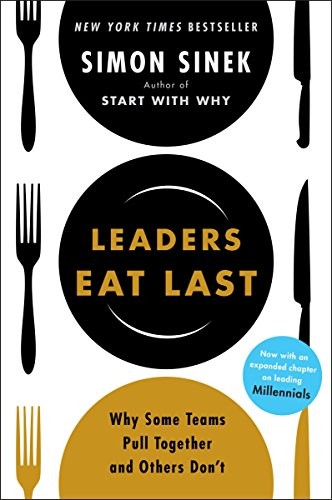
Leaders Eat Last
Portfolio/Penguin · 2014 · 368 pages
ISBN: 9781591845324
Review Editor
Daniel Okafor
Leaders Eat Last was published in January 2014 by Portfolio/Penguin. Simon Sinek, best known for his TED talk “How Great Leaders Inspire Action” and his earlier book Start with Why, follows up here with a deeper and more biologically grounded investigation into what makes teams work. The title comes from a practice Sinek observed in the Marine Corps: at mess halls, generals and senior officers eat after the enlisted. This is not a formal policy; it is culture. The most junior Marines eat first. Sinek treats this practice as a window into something larger: how the most effective organizations actually operate, and why employees at some companies will sacrifice for their colleagues and employer while employees at others simply won’t.
The book argues that four neurochemicals evolved in humans for specific survival purposes, and that modern organizations either work with or against these chemical drivers. Endorphins mask physical pain (the runner’s high). Dopamine rewards the completion of tasks and goals. Serotonin flows when we feel proud and respected, when our status within the group is recognized. Oxytocin, the one Sinek cares most about, generates trust, love, and lasting bonds between people. When leaders create what he calls a “Circle of Safety” around their people, shielding them from external threats and internal politics, teams stop competing with each other and start cooperating to face outside challenges together. The result is trust, loyalty, and performance that no bonus structure can manufacture.
Sinek draws case studies from the Marine Corps, Costco, Barry-Wehmiller, and others to make the argument concrete. He traces the decline of trust in American corporations to the rise of short-term shareholder primacy starting in the 1980s, and argues that the costs in employee disengagement, lost innovation, and public health have been enormous. This is a book about leadership, but it is also about community, biology, and what human beings actually need in order to do their best work together.
Character Arcs and Development
In a business book, the “characters” are the leaders and organizations the author profiles. Sinek does this well. Bob Chapman, CEO of the manufacturing conglomerate Barry-Wehmiller, emerges as the book’s moral center: a man who, when forced to address a recession-era budget shortfall, chose mandatory furloughs shared by everyone, including himself, rather than laying off a single worker. The insight he articulates, that it is better for many to suffer a little than for a few to suffer a lot, reads less like corporate wisdom and more like something a parent would say. Chapman becomes the embodiment of what Sinek argues leadership should look like: someone who absorbs cost rather than passing it down.
The contrast with Wall Street figures is instructive. Sinek does not name many villains directly, but he traces the rise of shareholder-value doctrine through specific historical moments, painting a picture of how a generation of executives was trained to optimize for the wrong metrics. When he quotes employees who say they would take a pay cut to stay at companies that treat them with genuine respect, you understand what is lost when leaders get this wrong. The personal toll on workers, and eventually on the leaders themselves, is not left abstract.
James Sinegal at Costco rounds out the portrait of what good leadership produces at scale. Sinegal kept his own salary modest for decades while building a company famous for paying employees well above retail averages and offering serious benefits. Costco has lower turnover, higher productivity, and stronger customer loyalty than most competitors. Sinek uses him not just as a good example but as a rebuttal: proof that you do not have to choose between genuinely caring for your people and running a profitable, growing business. These figures give the book its human weight.
Pacing
The book’s first half is energizing. The biology sections are clear, the case studies are well-chosen, and the argument builds real momentum. But around the midpoint, Sinek begins repeating himself. The core chemical framework is stated, then re-stated, then revisited with slightly different examples. The chapters on alcohol and social media addiction, while making a valid point (that dopamine hits from likes and notifications can substitute for genuine connection, with destructive results), occupy more pages than they need to. The book would be tighter at 280 pages instead of 368.
The final sections recover well, and the conclusion lands with genuine feeling. Sinek is better when he is telling stories than when he is restating his framework for the fourth time. Readers who pace themselves through the middle chapters, treating them as reinforcement rather than revelation, will reach the end in good shape. This is not a book that earns every one of its pages, but the pages it earns, it earns fully.
Deeper Thematic Exploration
The deepest claim in Leaders Eat Last is that the modern workplace has created a mental health crisis by violating the conditions humans evolved to require. Sinek is not making a soft argument about niceness. He is making a biological one: when we feel safe and trusted among our colleagues, oxytocin flows, cortisol drops, and we function better in every measurable way. The absence of psychological safety does not just make workplaces unpleasant; it makes people physically ill over time, elevating stress hormones that are meant for short-term emergencies into a permanent background condition.
This connects to a larger argument about what leadership is actually for. The title captures the essential distinction perfectly. In the Marine Corps, officers eat last because their function is to ensure their soldiers are fed, warm, and cared for before they attend to themselves. The food is symbolic. What it signals is: I am here to serve you, not the other way around. This inversion of the normal power dynamic is, Sinek argues, what generates the extraordinary trust that allows some teams to perform under impossible conditions while others fall apart under pressure.
The book is also quietly political. Sinek’s critique of shareholder-first ideology is pointed and sustained. He traces it to a specific moment: the embrace of Milton Friedman’s argument that a corporation’s only obligation is to its shareholders, which became orthodoxy at business schools through the 1970s and 1980s. He does not argue we can simply reverse this, but he insists the underlying values of the older model, genuine long-term commitment between employer and employee, are worth recovering. The costs of abandoning them show up not just in engagement surveys but in the hollowing out of communities and the erosion of civic trust over decades.
There is also a thread about generational change. Sinek is honest about the conditions that shaped younger workers entering the workforce: helicopter parenting, social media, and environments that optimized for self-esteem over resilience. He stops short of blaming them for the difficulties that result; the failure, he argues, belongs to the adults who built those systems. His prescription is demanding but not complicated: genuine mentorship, real presence over screen-mediated contact, and the slow, unglamorous work of building relationships that oxytocin can actually reinforce.
Style and Voice
Sinek writes accessibly and with conviction. He has the gift of the good analogy: the “Circle of Safety” works as a concept because it is instantly visual and spatial. You can picture being inside it or outside it. The prose is clean, the chapters are short, and the book never loses the feeling that someone who genuinely believes this subject matters is talking directly to you. He is not a stylist in any literary sense, and the writing is functional rather than beautiful, but it is honest and direct, which matters more in this genre. He is not selling you on his own cleverness; he is trying to change how you think about your obligations to the people you lead.
The book’s biggest stylistic risk is its use of neurochemistry. Business books that invoke science can easily veer into pseudoscience or resort to oversimplification that misleads more than it illuminates. Sinek walks this line carefully enough. He cites research without claiming more than it shows, acknowledges that the four-chemical framework is a simplification, and uses it as an organizing tool rather than a grand unified theory. The model is memorable precisely because it is simple, and Sinek knows when to use it and when to let a story carry the weight instead.
Verdict
Leaders Eat Last is a book for anyone who manages people, works within an organization, or has wondered why some workplaces feel like communities while others feel like tournaments where colleagues are rivals. Sinek asks a question most leadership books either assume away or answer badly: what are leaders actually for? His answer, that they exist to protect and serve the people around them, and that this is not sentimentalism but evolutionary biology, is simple, old, and regularly ignored. The book makes the case with enough scientific texture to take seriously and enough real-world grounding to feel achievable.
You will get the most from this book if you are early in your leadership journey, or if you are trying to articulate to yourself and others why a people-first culture is not just a nice idea but a strategic necessity. If you have already absorbed the core message and want detailed implementation tactics, you will find it repeats itself more than you would like. Sinek is a better moral philosopher of leadership than he is an operations manual. But the moral case he builds here has only grown more urgent as the conditions he describes have intensified, and that alone makes it worth your time.
Frequently Asked Questions about Leaders Eat Last
What is Leaders Eat Last by Simon Sinek about?
Leaders Eat Last argues that the most effective organizations are ones where leaders prioritize the safety and wellbeing of their people above their own. Sinek draws on military culture, neuroscience, and corporate case studies to explain why trust is the foundation of high-performing teams. The book examines why employees at some companies give everything they have, while workers at others do the minimum and leave as soon as something better appears.
Why is it called Leaders Eat Last?
The title comes from a practice Sinek observed in the United States Marine Corps, where officers eat at the mess hall only after all the enlisted Marines have been served. No one ordered them to do this; it emerged naturally from a culture that puts the welfare of those lower in rank above the comfort of those higher up. Sinek uses this as a metaphor for the kind of leadership that earns genuine loyalty and trust.
What are the main themes in Leaders Eat Last?
The four main themes are psychological safety (leaders create an environment where people can take risks without fear), biology and trust (the neurochemicals serotonin and oxytocin drive the bonds that make teams work), short-termism (how shareholder-first thinking erodes trust and harms both workers and organizations), and generational responsibility (how the environments adults build shape the capacity of younger workers to form real relationships and handle stress).
How long is Leaders Eat Last and is it a difficult read?
The book runs 368 pages in the hardcover edition. It is not a difficult read at all: the chapters are short, the language is clear, and Sinek avoids jargon throughout. Most readers with a general interest in business or leadership will move through it comfortably in five to seven hours. The biology sections are simplified enough to be accessible without any science background.
Is there a movie or TV adaptation of Leaders Eat Last?
There is no film or television adaptation of Leaders Eat Last. Sinek has given widely watched talks based on the book’s ideas, including appearances on YouTube and podcast interviews, but the book itself has not been adapted for screen. His earlier TED talk “How Great Leaders Inspire Action,” which covers related themes from Start with Why, remains one of the most-watched TED talks ever recorded.
How does Leaders Eat Last compare to Simon Sinek’s other books?
Start with Why (2009) asks why some leaders inspire while others merely manage; Leaders Eat Last goes deeper into the biological and organizational conditions that allow that inspiration to take hold. The Infinite Game (2019) extends the argument further into long-term strategy. Leaders Eat Last is the most data-rich and emotionally grounded of the three, with stronger case studies and more sustained argument, though it is also the longest and occasionally repetitive.
What is the Circle of Safety in Leaders Eat Last?
The Circle of Safety is Sinek’s term for the psychological boundary that effective leaders draw around their teams. Inside the circle, people feel safe: they can raise problems, take creative risks, and trust their colleagues without fear of being undermined or discarded. Outside the circle are real threats, competitors, market forces, and external pressures. When the circle is strong, people stop treating each other as threats and start working together against the actual challenges they face.
Should I read Leaders Eat Last and is it worth it?
Yes, particularly if you are in any kind of leadership role or if you work inside an organization that feels more like a competition than a team. The book offers a clear and persuasive case for why caring for your people is not separate from good leadership but is its entire foundation. It is most useful for people earlier in their leadership development; if you already think this way, you may find it confirming rather than revealing. Either way, the case studies alone are worth the read.
Book Details
- Title
- Leaders Eat Last
- Author
- Simon Sinek
- Genre
- Business
- Publisher
- Portfolio/Penguin
- Year Published
- 2014
- Pages
- 368
- ISBN
- 9781591845324
- WritersReview Rating
- 4.1 / 5