
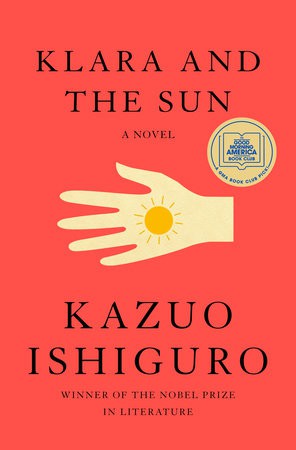
Klara and the Sun
Knopf · 2021 · 304 pages
ISBN: 9780593318171
🏆 Booker Prize longlist (2021)
Andrew Carnegie Medal for Excellence in Fiction longlist (2022)
Washington Post 10 Best Books of 2021
Barack Obama Summer 2021 Reading List
Review Editor
Marcus Webb
Kazuo Ishiguro published Klara and the Sun in March 2021, his first novel after winning the Nobel Prize in Literature in 2017. The book tells the story of Klara, a solar-powered Artificial Friend (AF) who sits in a shop window watching the world outside, hoping to be chosen by a child. When fourteen-year-old Josie, a girl whose health is failing, picks Klara to be her companion, the AF enters a household haunted by grief, secrecy, and the consequences of a society that has embraced genetic enhancement for its children. The novel is set in a near-future America where wealthy parents pay to have their kids “lifted,” a process that boosts intelligence but carries serious medical risks. Josie’s older sister Sal already died from the procedure, and Josie herself is growing weaker.
This is a quieter, more delicate book than its premise might suggest. Ishiguro is less interested in the mechanics of his speculative world than in the emotional landscape Klara navigates: what it means to love someone, what it costs to be devoted, and whether a machine that feels devotion is really so different from a person who does. If you come to it expecting hard science fiction, you will be disappointed. If you come to it willing to sit with ambiguity and let the novel’s questions settle slowly, you will find something that stays with you for a long time. The novel was longlisted for the 2021 Booker Prize and named one of the Washington Post’s ten best books of the year.
Character Arcs and Development
Klara is one of the most unusual narrators in recent fiction. She processes the world through careful observation, cataloging human behavior with the patience of a naturalist studying an unfamiliar species. Early in the novel, she watches passersby from the store window and draws conclusions about love, loneliness, and cruelty based on fragments of interaction she can barely understand. What makes her compelling is not her intelligence (she is, by her own kind’s standards, exceptionally perceptive) but her capacity for faith. Klara develops a deep, almost religious reverence for the Sun, whom she credits with the power to heal and nourish. When Josie’s health declines, Klara devises a plan to bargain with the Sun for Josie’s recovery, offering personal sacrifice in exchange for what she believes is divine intervention. This arc, from curious observer to selfless believer, is the emotional spine of the novel. Klara never becomes human, and Ishiguro never pretends she does. But her willingness to give everything for someone she loves raises the question of whether that distinction matters.
Josie, by contrast, is drawn with deliberate restraint. We see her mostly through Klara’s eyes, which means we get her kindness, her stubbornness, and her occasional cruelty toward Rick, the unlifted boy next door who has loved her since childhood. Josie is not the center of her own story here; she is the object of everyone else’s devotion, and that positioning is part of Ishiguro’s point. The Mother (we never learn her first name in Klara’s narration, though it is Chrissie) is the most complex human character: a woman who has already lost one daughter and is preparing, with terrifying practicality, for the possibility of losing another. Her plan for Klara, which becomes clear gradually, is one of the novel’s most unsettling revelations. Rick, the neighbor boy, functions as a kind of moral compass. Unlifted and therefore shut out of the elite educational track, he represents the human cost of a system that treats intelligence as a commodity. His loyalty to Josie, even as the world tells him he is not good enough for her, gives the novel some of its most affecting moments.
Pacing
The first third of Klara and the Sun moves at a gentle, absorbing pace. The store sequences, where Klara watches the street and learns about the world, have a childlike wonder that draws you in. Ishiguro takes his time establishing Klara’s way of seeing, and these early chapters reward patience. The middle section, after Klara moves into Josie’s home, slows further. Some readers will find this section meditative; others will find it draggy. The novel withholds information strategically, doling out revelations about the Mother’s plan, Josie’s condition, and the wider social order in careful increments. This works well for building unease but occasionally tips into vagueness, particularly around the mechanics of “lifting” and the political tensions simmering in the background. The final act accelerates noticeably. Events that feel like they should unfold over weeks compress into pages, and the emotional resolution, while powerful, arrives with a speed that can feel rushed after such a patient buildup. There is also an “interaction meeting” scene in the middle of the book, where lifted children gather socially under their parents’ watchful eyes, that stands out as one of the novel’s sharpest set pieces. The cruelty these kids display toward Klara, casual and reflexive, tells you more about this society than any exposition could.
Deeper Thematic Exploration
At its core, Klara and the Sun asks what makes a person irreplaceable. The Mother’s secret project (commissioning a portrait of Josie that is really a vessel for Klara to inhabit, so that if Josie dies, Klara could “become” her) forces every character, and the reader, to confront this question directly. Can you replace a child? If an AI can perfectly replicate someone’s mannerisms, speech patterns, and memories, is that person truly gone? Ishiguro does not answer these questions. He presents them through Klara’s limited perspective and lets the discomfort do the work.
The novel also wrestles with faith in a way that is surprisingly moving for a book about robots. Klara’s belief in the Sun’s healing power is never confirmed or denied by the narrative. You can read it as genuine miracle, coincidence, or the desperate projection of a machine whose programming compels her to find patterns and meaning. Ishiguro leaves all three readings available, and the novel is richer for it. There is something deeply human about Klara’s willingness to believe, to sacrifice, to bargain with forces she does not understand. That an artificial being arrives at faith through observation and love rather than programming is one of the book’s most quietly radical ideas.
The social stratification in the novel runs deeper than it first appears. The division between lifted and unlifted children is not just about intelligence; it is about who gets to participate in the future. Rick, for all his natural ability, faces a world that has no place for him because his mother refused to take the genetic gamble. The novel gestures toward broader unrest among the “post-employed” adults displaced by automation, but keeps this at the margins. This restraint is both a strength and a limitation. It preserves the intimacy of Klara’s perspective, but it also means the novel never fully reckons with the political implications of the world it has built.
Style and Voice
Ishiguro’s prose here is deceptively simple. Klara narrates in clean, slightly formal sentences that occasionally miss the mark of human idiom in ways that feel carefully calibrated. She refers to “the Mother” and “the Father” rather than using their names. She calls smartphones “oblongs.” She describes visual confusion as seeing the world break into “boxes,” a detail that evokes how machine learning systems actually process images. These small estrangements accumulate into something powerful: a voice that is warm and empathetic but fundamentally alien, always reaching toward understanding without quite grasping it.
The narrative point of view serves the story beautifully. Because Klara cannot fully understand what she observes, the reader must constantly fill in gaps, reading between her literal descriptions to grasp the emotional reality underneath. When Klara describes the Mother’s face as showing “a strange kind of happiness,” you understand, even if Klara does not, that this is the expression of a woman steeling herself for grief. This technique, which Ishiguro also used to devastating effect in The Remains of the Day with Stevens the butler, creates a particular kind of dramatic irony that rewards careful reading.
Verdict
Klara and the Sun is a gentle, melancholy novel that asks big questions in a quiet voice. It will not satisfy readers looking for rigorous world-building or the propulsive plotting of mainstream science fiction. The speculative elements are deliberately undercooked, serving as scaffolding for emotional and philosophical inquiry rather than as ends in themselves. Some of the secondary characters feel thin, and the novel’s refusal to engage more deeply with its own political backdrop can feel like a missed opportunity.
But if you are the kind of reader who values emotional precision over spectacle, who wants a book that trusts you to sit with ambiguity, this is essential reading. It belongs on the shelf next to Never Let Me Go and The Remains of the Day as another of Ishiguro’s investigations into what it means to serve, to love, and to be discarded. Read it slowly. Let Klara’s strange, earnest voice get under your skin. You will think about this book for months after you finish it, turning its questions over the way Klara turns over her memories of the Sun.
Frequently Asked Questions about Klara and the Sun
What is Klara and the Sun by Kazuo Ishiguro about?
Klara and the Sun follows an Artificial Friend (AF) named Klara, a solar-powered robot companion, who is purchased by a teenage girl named Josie in a near-future America. Josie has been genetically enhanced (“lifted”) to boost her intelligence, but the procedure has left her chronically ill. The novel, told entirely from Klara’s perspective, explores themes of love, sacrifice, faith, and what it means to be human through the eyes of a machine trying to understand the people she serves.
Is Klara and the Sun similar to Never Let Me Go?
Both novels share Ishiguro’s interest in characters who exist on the margins of humanity and who accept their roles with quiet dignity. Never Let Me Go focuses on human clones raised for organ donation, while Klara and the Sun centers on an artificial being devoted to a human child. Both books use speculative premises to explore questions about love, mortality, and what makes a life valuable. Klara and the Sun is warmer in tone and less devastating in its conclusion, but carries the same undercurrent of sadness.
What are the main themes in Klara and the Sun?
The novel explores four central themes: the nature of love and whether artificial beings can truly experience it, the ethics of genetic enhancement and social inequality, the role of faith and belief in giving life meaning, and the question of human uniqueness (specifically whether a person can be replicated or replaced). Ishiguro weaves these together through Klara’s limited but deeply empathetic perspective.
How long is Klara and the Sun and is it a difficult read?
The novel is 304 pages in the U.S. hardcover edition. It is written in clear, accessible prose and does not require any background in science fiction. The reading level is suitable for advanced high school students and up. The language is simple on the surface, but the novel rewards careful attention because much of its meaning lies in what Klara does not understand about the situations she describes.
Is there a movie adaptation of Klara and the Sun?
Yes. Sony’s 3000 Pictures acquired the film rights in 2020, and as of 2024, the adaptation is directed by Taika Waititi with Jenna Ortega cast as Klara and Amy Adams as Josie’s mother. Mia Tharia plays Josie and Aran Murphy plays Rick. Kazuo Ishiguro serves as an executive producer on the project.
What age group is Klara and the Sun appropriate for?
The novel is appropriate for readers aged 14 and up. There is no graphic violence, sexual content, or strong language. The themes of illness, death, and parental grief may be emotionally intense for younger readers, but the gentle narrative voice makes these subjects approachable. It works well for book clubs, high school AP Literature classes, and adult readers who enjoy literary fiction with speculative elements.
How does Klara and the Sun compare to Kazuo Ishiguro’s other novels?
Klara and the Sun sits comfortably alongside Ishiguro’s best work, though many critics consider it a step below The Remains of the Day and Never Let Me Go. It shares the restrained emotional power and unreliable first-person narration of those earlier novels. Compared to The Buried Giant, it is more focused and emotionally direct. It is Ishiguro’s most explicitly science-fictional novel, but readers who enjoyed the quiet devastation of his earlier work will find familiar territory here.
Should I read Klara and the Sun and is it worth it?
If you enjoy literary fiction that uses speculative settings to explore emotional and philosophical questions, absolutely yes. Readers who love character-driven novels with a slow, deliberate pace will find this deeply rewarding. If you prefer fast-paced science fiction with detailed world-building and action, this may not be for you. The novel’s strength lies in its voice and its willingness to leave big questions unanswered, trusting you to wrestle with them on your own.
Book Details
- Title
- Klara and the Sun
- Author
- Kazuo Ishiguro
- Genre
- Science Fiction
- Publisher
- Knopf
- Year Published
- 2021
- Pages
- 304
- ISBN
- 9780593318171
- Awards
- 🏆 Booker Prize longlist (2021) Andrew Carnegie Medal for Excellence in Fiction longlist (2022) Washington Post 10 Best Books of 2021 Barack Obama Summer 2021 Reading List
- WritersReview Rating
- 4.9 / 5