
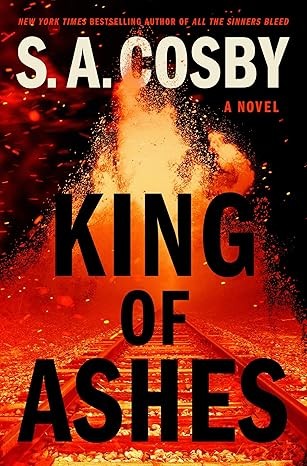
King of Ashes
Flatiron Books · 2025 · 352 pages
ISBN: 9781250832061
Review Editor
Mystery & Thriller Editor
S.A. Cosby has spent the last several years establishing himself as the most vital voice in Southern crime fiction, and King of Ashes is the book where he stops proving himself and starts building a legacy. Set in the fictional town of Jefferson Run, Virginia, this novel takes the family crime saga, a form most associated with Northern Italian-American stories, and transplants it to the Black South with a confidence and emotional depth that makes the material feel entirely new.
The setup is familiar enough to feel comfortable before Cosby starts pulling the rug. Roman Carruthers is a successful financial manager in Atlanta, far enough from his hometown to have built a respectable life and close enough to feel the pull of family obligation when crisis arrives. His father, the patriarch who runs the family crematorium, has been in a car accident and lies in a coma. Roman returns to Jefferson Run and finds exactly what he feared: his younger brother Dante is drowning in debt to the Gilchrist brothers, a pair of local criminals whose capacity for violence is both precise and expansive, and his sister Neveah is holding the family business and the family itself together through sheer force of will.
What elevates King of Ashes beyond its genre conventions is Cosby’s refusal to let any of his characters exist as types. Roman is not simply the prodigal son returning to clean up a mess. Dante is not simply the reckless sibling. Neveah is not simply the suffering woman who holds everything together. Each of them carries a specific history, specific wounds, and specific desires that complicate the roles the plot assigns them. By the time the violence escalates, and it does escalate considerably, you care about these people as individuals rather than as chess pieces in a crime narrative.
Character Arcs and Development
Roman Carruthers is one of the most nuanced protagonists in recent crime fiction. On the surface, he has everything figured out: a successful career managing wealth for high-profile clients, a polished exterior that suggests he has left Jefferson Run behind entirely. But Cosby reveals the cracks early and widens them steadily. Roman’s relationship with money, with the performance of respectability, with his own capacity for violence, these are not contradictions he has resolved but tensions he has managed, and his return home strips away every mechanism of management he has built.
Neveah is the novel’s emotional center, and Cosby gives her a narrative arc that runs parallel to Roman’s without ever becoming subordinate to it. She is conducting her own investigation into their mother’s decades-old disappearance, a thread that connects the family’s present crisis to a deeper history of loss and secrecy. Her romance with Detective Chauncey adds moral complexity without becoming a distraction, and her scenes provide necessary breathing room between the main plot’s increasingly violent set pieces.
The Gilchrist brothers deserve particular mention as antagonists. Cosby resists the temptation to make them cartoonish or entertainingly evil. Their cruelty is deliberate, rooted in their own experience of poverty and violence, and their threat feels genuine precisely because Cosby gives them enough interiority to make their actions comprehensible without making them sympathetic. They are terrifying because they feel real, not because they feel exaggerated.
Pacing
At 352 pages, King of Ashes moves with the controlled intensity of a fire working through a building. Cosby understands that effective thriller pacing is not about constant action but about the manipulation of tension and release. The early chapters take their time establishing the family dynamics, the town, and the specific textures of Jefferson Run’s economic and social landscape. When the violence arrives, it hits harder because you have spent time in the quiet spaces.
The novel’s dual structure, alternating between Roman’s confrontation with the Gilchrists and Neveah’s investigation into their mother’s disappearance, creates a rhythm that prevents the narrative from becoming monotonous. Each thread ratchets tension in a different register, and Cosby times the convergence of the two storylines with impressive precision. The final act is relentless, but it earns that relentlessness through the patience of what comes before.
Deeper Thematic Exploration
The crematorium at the center of the Carruthers family business is not just a setting; it is a metaphor that Cosby returns to throughout the novel. Fire transforms, destroys, purifies, and conceals. The family business is literally built on the reduction of bodies to ash, and the novel is deeply interested in what survives that process: what remains after violence, after grief, after the burning away of pretense and performance.
Cosby writes about race and class in the American South with a specificity that avoids both sentimentality and polemic. Jefferson Run is a town shaped by economic neglect, by the particular ways that poverty concentrates violence and limits options. The Carruthers family’s crematorium represents a form of Black entrepreneurship that exists within and against these constraints, and the threats they face come from both the criminal underworld and the systemic forces that created it. Cosby does not separate the personal from the political; he shows how they are the same thing, experienced at different scales.
The novel also explores the weight of family loyalty and the cost of generational trauma with considerable sophistication. Roman’s return home is not just a physical journey but a confrontation with everything he tried to leave behind: the violence he witnessed as a child, the father whose methods he rejected, the community he abandoned in pursuit of individual success. Cosby suggests that escape is never as clean as it seems, and that the debts we owe to family and place have a way of compounding in our absence.
Style and Voice
Cosby’s prose operates at a higher register than most crime fiction without ever becoming self-consciously literary. His sentences are muscular and precise, capable of delivering both visceral action sequences and moments of genuine tenderness. He has a particular gift for simile and metaphor drawn from the physical world of the rural South: machinery, weather, soil, fire. These images ground even the most extreme plot developments in a sensory reality that makes them feel immediate and consequential.
The dialogue is exceptional. Cosby writes speech that sounds authentically Southern without resorting to dialect transcription or folksy condescension. His characters speak in rhythms and idioms that reveal class, education, geography, and emotional state simultaneously, and the conversations between the Carruthers siblings have a lived-in quality that suggests decades of shared history in every exchange.
Verdict
King of Ashes confirms S.A. Cosby’s position as one of the most important crime novelists working today. It is a book that operates on multiple levels: as a propulsive family thriller, as a meditation on race and class in the American South, and as an emotionally rich portrait of siblings trying to save each other from the consequences of their father’s choices. Cosby has written a novel that respects its genre while expanding what that genre can contain, and the result is a book that will satisfy readers looking for narrative excitement and those looking for something that lingers in the mind long after the plot resolves.
Rating: 4.6/5
Frequently Asked Questions about King of Ashes
What is King of Ashes by S.A. Cosby about?
King of Ashes follows Roman Carruthers, a successful financial manager who returns to his hometown of Jefferson Run, Virginia, after his father’s car accident. He discovers his brother Dante is in debt to dangerous criminals called the Gilchrist brothers, and his sister Neveah is struggling to hold the family and their crematorium business together. The novel combines a crime thriller plot with a family drama about loyalty, trauma, and legacy.
Is King of Ashes similar to The Godfather?
King of Ashes has been compared to The Godfather for its family crime saga structure, and Cosby has acknowledged the influence. However, the novel transplants the form to the Black American South, centering a family that runs a crematorium rather than a criminal empire. The comparison is useful as a genre reference point, but Cosby’s themes of race, class, and Southern identity make the book distinctly its own.
What order should I read S.A. Cosby books?
S.A. Cosby’s novels are all standalone and can be read in any order. The publication order is Blacktop Wasteland (2020), Razorblade Tears (2021), All the Sinners Bleed (2023), and King of Ashes (2025). While each book stands alone, reading them in order lets you track Cosby’s evolution as a writer, with King of Ashes representing his most ambitious and structurally complex work to date.
Where is King of Ashes set?
King of Ashes is set primarily in Jefferson Run, a fictional town in Virginia. Like the settings of Cosby’s previous novels, Jefferson Run is a working-class Southern community shaped by economic neglect, racial history, and the particular dynamics of rural poverty. The town functions almost as a character in its own right, and Cosby’s depiction of its geography and social landscape is central to the novel’s themes.
How many pages is King of Ashes by S.A. Cosby?
The hardcover edition of King of Ashes published by Flatiron Books is 352 pages. The novel’s alternating storylines and propulsive pacing make it a fast read despite its substantial length, and the final hundred pages are particularly difficult to step away from.
Who are the Gilchrist brothers in King of Ashes?
The Gilchrist brothers are the novel’s primary antagonists, a pair of local criminals in Jefferson Run whose cruelty is deliberate and terrifying. They hold Dante Carruthers’ debt and use it as leverage against the entire family. Cosby draws them with enough depth to make their violence comprehensible without making them sympathetic, and their presence creates a pressure-cooker intensity throughout the novel.
Does King of Ashes have a sequel?
As of its publication in 2025, King of Ashes is a standalone novel with no announced sequel. S.A. Cosby has consistently written standalone crime novels rather than series, and King of Ashes tells a complete story with a definitive ending. However, Cosby continues to be one of the most prolific voices in crime fiction.
Is King of Ashes appropriate for sensitive readers?
King of Ashes contains graphic violence, including scenes of torture and murder, as well as strong language and some sexual content. The novel deals with themes of trauma, addiction, and family dysfunction. Readers who are sensitive to depictions of extreme violence should approach with caution, though Cosby never uses violence gratuitously; it always serves the story’s emotional and thematic purposes.
Book Details
- Title
- King of Ashes
- Author
- S.A. Cosby
- Genre
- Mystery & Thriller
- Publisher
- Flatiron Books
- Year Published
- 2025
- Pages
- 352
- ISBN
- 9781250832061
- WritersReview Rating
- 4.6 / 5