
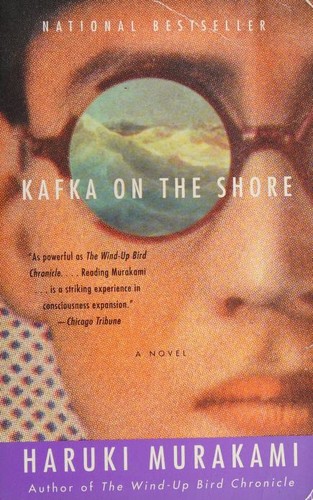
Kafka on the Shore is the novel in which Haruki Murakami most fully inhabits the territory he had been mapping since the beginning of his career. It runs two parallel stories that the novel spends 480 pages bringing toward each other without ever fully resolving what connects them, and this is not a failure of plotting but a deliberate and sustained argument about the nature of reality, fate, and consciousness.
What Happens in Kafka on the Shore
Kafka Tamura is fifteen, has run away from his absent father’s Tokyo home, and is traveling to Takamatsu on the island of Shikoku with a plan he cannot fully articulate. He arrives at a private library run by Oshima and Miss Saeki, a woman who may be a ghost, may be his mother, and is definitely someone who has stopped fully inhabiting her own life after the death of a young man she loved. Kafka reads, sleeps, runs, and waits for something he cannot name.
Satoru Nakata is an elderly man in Tokyo who lost most of his intelligence in a mysterious wartime incident. He can speak to cats, and this turns out to be relevant. After killing a man who may or may not be a supernatural entity, he begins walking west, compelled by a force he does not understand. He picks up a truck driver named Hoshino, who has nothing better to do than drive an old man wherever he needs to go.
The two stories develop independently, cross-reference obliquely, and converge in ways that remain partially mysterious even after the last page. This is either maddening or exactly right, depending on what you want from a novel.
Character and Development
Kafka is one of the more complex Murakami protagonists. He has structured himself around toughness as a defense, but the toughness is thin and cracks quickly when Miss Saeki appears. His development is toward a kind of acceptance of uncertainty that is harder to achieve than confidence.
Nakata is one of the most moving characters precisely because he is aware of his limitations without being diminished by them. He is simple in his speech and his desires, but the novel respects him completely. Hoshino, the truck driver who accompanies him, undergoes the most conventional character arc: he starts as someone without direction and ends as someone who has been changed by witnessing something he cannot explain.
Miss Saeki is the novel’s most enigmatic figure. She is writing something, she is disappearing from her own life, and her connection to the younger Kafka is one of the things the novel refuses to explain fully. Some losses are not resolved. They are carried.
Themes and Symbolism
The Oedipus myth is present throughout: Kafka is named for a prophecy involving his father and mother, and the novel engages with the question of whether fate can be escaped or only acknowledged. Murakami’s answer seems to be that fate is less a predetermined plot than a set of deep tendencies that will express themselves regardless of what you choose.
Cats are intermediaries throughout the novel, and Nakata’s ability to speak with them is presented matter-of-factly. In Murakami’s world, this is not a superpower but a kind of perceptual openness that other characters lack. The library is sanctuary and labyrinth both – a place where Kafka can read everything and be protected while also being unable to leave.
Writing Style
Murakami’s prose here is characteristically clean in individual sentences and accumulative in effect. He describes the surreal with the same matter-of-fact tone he uses for the ordinary, which is what makes the surreal feel real. Fish rain from the sky. People enter other people’s dreams. Nakata speaks to cats. All of this is reported with the same unexcited precision.
Who This Book Is For
Kafka on the Shore is not a novel that resolves. The mysteries stay mysterious. The connections between the two stories are felt rather than explained. This is the right choice. Murakami is interested in the experience of not-knowing. It is one of his best novels, and one of the best novels of its decade.
Frequently Asked Questions
- Do I need to read other Murakami books before Kafka on the Shore?
- No. It stands alone and works as an introduction to Murakami’s style. If you have already read Norwegian Wood and want to see his other mode, this is an excellent next step.
- What is the Oedipus connection in Kafka on the Shore?
- Kafka Tamura has been told a prophecy by his father: that he will kill his father and sleep with his mother and sister. The novel engages with how much of this prophecy he actually fulfills, partly literally and partly symbolically.
- What does the fish rain scene mean?
- The raining fish is one of several literally impossible events that Murakami presents without explanation. It happens in Nakata’s vicinity and seems connected to his proximity to supernatural forces, but the novel does not explain the mechanism.
- Are Kafka and Nakata the same person?
- No, they are different people at different points in their lives. The novel suggests connections between their experiences and fates, but they are not the same consciousness expressed in different ways.
- Is Kafka on the Shore suitable for teenagers?
- The protagonist is fifteen, and the novel is often assigned in high school. It contains sexual content and some violence, and its themes of fate, identity, and loss are appropriate for mature readers of any age.
- How does Kafka on the Shore end?
- Without complete resolution. Kafka returns to Tokyo, changed. Nakata’s mission is completed, though the full meaning is not spelled out. The two storylines do not fully merge; they simply end.
- What is the significance of the title?
- Kafka on the Shore refers to both the protagonist (who chose the name Kafka for himself) and a painting that hangs in the library. The title points toward the novel’s concern with solitude, longing, and the edge between two worlds.
- Is Kafka on the Shore magical realism?
- It is usually described as magical realism or surrealist fiction. The impossible events are integrated into the realistic setting without being treated as abnormal. This is characteristic of magical realism.
Book Details
- Title
- Kafka on the Shore
- Author
- Haruki Murakami
- Genre
- Literary Fiction
- Publisher
- Vintage
- ISBN
- 9781400079278
- WritersReview Rating
- 5.0 / 5