
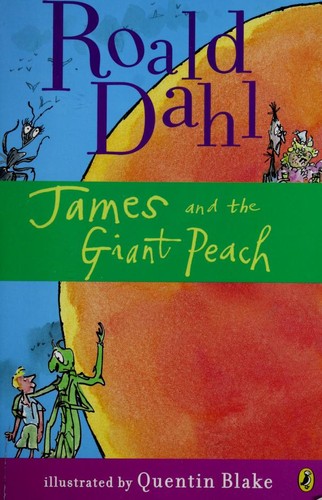
James and the Giant Peach
Alfred A. Knopf · 1961 · 146 pages
ISBN: 9780142410363
Review Editor
Hannah Bright
James and the Giant Peach arrived in 1961, a slim children’s novel by the British author Roald Dahl, and it has spent the decades since polarizing school librarians and delighting children in roughly equal measure. It is the story of James Henry Trotter, a boy of about seven who starts life happily near the sea, loses both his parents in an instant (a rhinoceros escapes from the London Zoo and eats them, an event Dahl reports with the same flat calm he might use for a traffic delay), and is sent to live on a hill in southeast England with his two aunts. Aunt Sponge is fat, damp, and forever eating. Aunt Spiker is tall, bony, and sharp in every sense. Between them, they have turned cruelty into an efficient household system. James does all the work, gets almost nothing to eat, is not allowed to play, and cannot walk down to the sea that glitters at him from a distance on clear days.
The book runs roughly 150 pages in most editions. Dahl uses those pages economically. He spends his early chapters building the case for James’s misery with enough specificity that the escape, when it comes, registers as genuine relief rather than mere plot device. A mysterious stranger with a bag of green, wriggling things sets things in motion. James drops the bag. The contents sink into the soil near an old peach tree. Hours later, the tree produces a peach the size of a house. Inside, James discovers seven insects who have grown to human scale: the Centipede (cheerful, argumentative), the Earthworm (glum, convinced disaster is always near), the Old Green Grasshopper (dignified and musical), the Ladybird (sensible and warm), Miss Spider (a skilled weaver who carries the weight of a difficult family history), the Glowworm (provides light without complaint), and the Silkworm (spins thread, also without complaint). When the aunts attempt to intervene and the peach rolls through them in a moment Dahl handles with what can only be called joyful economy, James and his companions begin their journey across the Atlantic Ocean toward New York City.
This is, in outline, a fantasy adventure. But James and the Giant Peach is also a book about what it costs to be a powerless child in the care of adults who have no interest in your wellbeing, and about what becomes possible when you find companions who actually see you. Dahl wrote it for children who already knew that the world was not always fair, and his refusal to pretend otherwise is a large part of why the book has lasted.
Character Arcs and Development
James is, at the opening, a study in what prolonged mistreatment does to a child. He is quiet, frightened, and inclined to become invisible. He is not, crucially, without intelligence or decency. Dahl plants both qualities early and clearly, which is why you want things to go right for James before you have much external reason to expect they will. What the story gives him is not a sudden transformation but a gradual recognition: he is useful, he is capable, and the people who told him otherwise were simply wrong. It is James who works out how to steer the peach using seagulls and silkworm thread. It is James who keeps the group oriented when things go badly. By the end of the journey, he has not become a different person. He has become a fuller version of the person he already was.
The insects carry more individuality than you might expect in a book this short. The Centipede generates most of the comedy. He boasts constantly, loses track of his own arguments mid-sentence, and has over a hundred boots to put on every morning, a process that takes considerable time and is a reliable source of delay and amusement in equal measure. His cheerful wrongness is an effective counterweight to the Earthworm, who is reliably convinced that everything is about to go catastrophically wrong and who is, often enough, not entirely incorrect. The Grasshopper is older and quieter, with the manners of someone who has seen a great deal and decided to remain civil about it. He plays music on long evenings using his own legs as an instrument, which is one of the novel’s more quietly beautiful images.
Miss Spider does the most moral work in the book. She arrives carrying a history of being feared and killed by humans, and she has every reason to extend James no warmth whatsoever. That she chooses to offer him friendship, and that he accepts it without hesitation, says something about both of them that Dahl never announces directly. The aunts, Sponge and Spiker, do not develop because they cannot. They are fixed monuments to a particular kind of adult selfishness, and their function is to be escaped. They sing a duet early in the book about their own beauty, each of them apparently sincere, and it is funny in the way that a closed system always is: completely self-referential, requiring nothing from outside itself, and therefore slightly terrifying.
Pacing
Dahl was constitutionally opposed to delay, and James and the Giant Peach reflects this. The setup takes roughly five chapters. Once James enters the peach, new complications arrive at a pace that does not allow you to settle too long into any single situation. There is a storm. There are sharks. There are Cloud-Men, built from something between weather and human shape, who are genuinely alarming. There is a mechanical city glimpsed from a distance and left as an image rather than a destination, which is exactly the right choice. Each episode has its own internal logic and its own register: some are frightening, some are funny, some manage to be both within a single paragraph.
The middle stretch of the Atlantic crossing does accumulate several set pieces without a fully clear narrative thread connecting them. In a longer book, this would be a structural problem. In a book this short, it is more of a texture, and younger readers tend to find the rapid succession of new wonders more exciting than disorienting. The ending arrives briskly, almost abruptly, but Dahl earns the pace by making the final destination feel like a genuine arrival rather than simply where the story happens to stop.
Deeper Thematic Exploration
At its center, James and the Giant Peach is a book about the necessity of escape. Not escape as comfortable fantasy or metaphor, but escape as practical, urgent fact: some situations cannot be improved from inside them, some adults with power over you cannot be reasoned with, and the right response to being trapped by people who wish you harm is to find a way out. Dahl was unusual among children’s authors of his era in his willingness to say this plainly. James does not learn to understand his aunts. He does not forgive them. They are simply gone, and the book does not ask him to regret this. That refusal to demand reconciliation from a child who was genuinely wronged is one of the reasons the book generates real loyalty from child readers who recognize something true in it.
The found-family structure is the other major emotional current. James arrives inside the peach with nothing and leaves having earned the loyalty and affection of seven strange, difficult, and entirely lovable companions. Dahl’s argument, embedded in the action rather than stated, is that family is not a biological assignment but something built through shared risk and mutual care. The Centipede, for all his boasting, puts himself in genuine danger repeatedly for the group. So does James. By the time they arrive in New York, they have accumulated enough shared history to constitute something real and lasting.
There is also something worth paying attention to in how the book handles fear. The Earthworm is afraid of almost everything throughout the journey, and the book does not mock him for it. The Cloud-Men are a genuine threat. The risks James faces are real. Dahl makes no promise that nothing bad will happen. What he shows instead is that you can be frightened and keep going anyway, that the people beside you can be frightened and still be worth having beside you. This is a more honest account of courage than most children’s literature provides, and it is part of why the book holds up on rereading.
Style and Voice
Dahl writes in James and the Giant Peach with the confidence of someone who has decided not to condescend. His prose is clear without being simple. He treats outrageous events with the same flat register he might use for unremarkable ones, and this is where most of his comedy originates. The rhinoceros in the first paragraph. The aunts flattened under the rolling peach. The Centipede falling into the ocean and needing to be rescued (twice). Each of these gets a sentence or two delivered as if the narrator is mildly interested rather than alarmed, and the contrast between the enormity of the event and the calm of the telling is reliably effective.
The Centipede’s songs are among the book’s real pleasures. They are cheerfully nonsensical in the tradition of Edward Lear, with internal rhythms and images that are funny because they have the form of meaning without its content. Dahl clearly enjoyed writing them, and the enjoyment transfers. In editions illustrated by Quentin Blake, the drawings amplify this quality: his lines are loose and quick, always slightly unsteady in a way that matches the world the book describes, where solid things tend not to stay that way.
Verdict
James and the Giant Peach belongs in the same conversation as the other great mid-century children’s novels, and not merely as a companion piece to Charlie and the Chocolate Factory. It is sharper in its anger, more emotionally precise in its portrait of a child who has been genuinely wronged, and more honest about what it actually takes to leave a bad situation behind. The book does not promise that things will be easy. It promises that they can change, and that the people you meet along the way might become the closest thing to family you have ever known.
It is best suited to readers aged seven and up, and particularly to children who have some experience of unfairness and who need to see that unfairness acknowledged plainly, without being told it does not matter. If you are reading it aloud to a child, you will find that the aunts generate real revulsion and the Centipede generates real laughter, often in the same chapter. If you are rereading it as an adult, you may find the book’s quiet intelligence more visible than it was the first time. Either way, the peach is worth boarding.
Frequently Asked Questions about James and the Giant Peach
What is James and the Giant Peach by Roald Dahl about?
James and the Giant Peach is a 1961 children’s novel about an orphaned boy named James Henry Trotter who escapes his cruel aunts by crawling inside a magical, house-sized peach that grows overnight in their garden. He befriends seven talking insects who have grown to human size, and together they travel across the Atlantic Ocean and eventually reach New York City. The book is both a fantasy adventure and a story about finding family outside the one you were given.
How long is James and the Giant Peach and is it a difficult read?
Most editions run between 140 and 180 pages, depending on illustrations and layout. Dahl wrote in clear, direct prose aimed at children roughly ages seven and up. The vocabulary is accessible, the chapters are short, and even readers still building stamina can finish one in a single sitting. It is generally easier than Charlotte’s Web or The Hobbit, though more demanding than most early chapter books. Children who have read other Roald Dahl novels will feel immediately at home.
What are the main themes in James and the Giant Peach?
The book explores the necessity of escape from genuine cruelty, the idea of family as something built through mutual care rather than biological assignment, and what it takes to be brave when you are actually afraid. A quieter theme runs through James’s relationship with Miss Spider: that prejudice against the unfamiliar is something you can choose to set aside. Dahl builds all of these through action and incident rather than through any character explaining them, which is one reason they land so cleanly.
Is James and the Giant Peach a banned book?
Yes, it has been regularly challenged and removed from school libraries since the 1980s. The most common objections are to the aunts’ fate (considered too violent by some adults), language that certain groups found inappropriate, and a reading of the plot’s magical elements as a positive depiction of drug use. Dahl’s children’s books as a group have been among the most challenged in American schools, and James and the Giant Peach appears consistently on those lists.
Is there a movie adaptation of James and the Giant Peach?
Yes. The 1996 film directed by Henry Selick (who also directed The Nightmare Before Christmas) combines live action and stop-motion animation. It starred Paul Terry as James and featured voices from Simon Callow, Richard Dreyfuss, Susan Sarandon, and Jane Leeves, among others. The film is generally well-regarded as a faithful and visually inventive adaptation, though it adjusts certain plot elements. A stage musical adaptation opened in 2010 and has had numerous productions worldwide since.
What age group is James and the Giant Peach for?
The book is typically recommended for ages seven through twelve, and it works well read aloud to children as young as five or six with an attentive adult present. The novel is honest about cruelty and danger in a way that some younger children may find unsettling, so fit depends as much on the individual child as on age. Children who have any experience of unfairness or difficult home situations often connect with it most strongly. Adults who encountered it as children tend to find it worth revisiting.
How does James and the Giant Peach compare to Roald Dahl’s other books?
It shares Dahl’s characteristic qualities: dark humor, memorable villains, a child protagonist underestimated by every adult around him, and a refusal to offer false comfort. It is more emotionally direct than Charlie and the Chocolate Factory, which holds more satirical distance between reader and story. It is more surreal and fantastical than Danny the Champion of the World, which is warmer and more grounded in the everyday. Matilda, published in 1988, covers similar territory around mistreated children but equips its protagonist with supernatural abilities rather than friendship and circumstance.
Should I read James and the Giant Peach, and is it worth it?
Yes, particularly if you care about children’s literature that takes children seriously rather than reassuring them. It is a short book and reads in a couple of hours. The characters stay with you: the Centipede’s brand of confident wrongness, the Earthworm’s faithful gloom, James’s quiet determination to do what needs doing even when he is frightened. If you are handing it to a child you care about, you are handing them something that may stay with them for a long time.
Book Details
- Title
- James and the Giant Peach
- Author
- Roald Dahl
- Genre
- Children's
- Publisher
- Alfred A. Knopf
- Year Published
- 1961
- Pages
- 146
- ISBN
- 9780142410363
- WritersReview Rating
- 4.6 / 5