
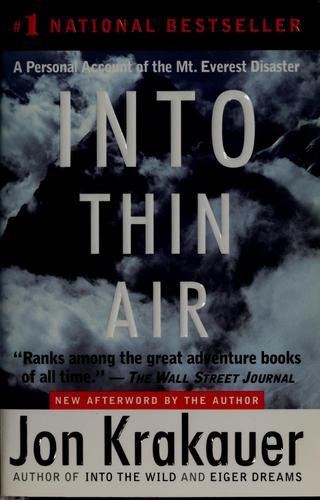
Into Thin Air
Villard Books · 1997 · 332 pages
ISBN: 9780385494786
Review Editor
Thomas Calloway
Into Thin Air is Jon Krakauer’s firsthand account of the May 10, 1996 disaster on Mount Everest, in which eight climbers died in a single afternoon and evening. Krakauer had gone to the mountain as a journalist for Outside magazine, assigned originally to cover the rapid commercialization of Everest: a peak once reserved for the world’s most elite climbers, now open to anyone who could afford a guided expedition. By the time his editor gave him the go-ahead to attempt the summit himself, the original reporting assignment had folded into something far more personal. Krakauer trained hard, joined Adventure Consultants (a guided expedition company run by New Zealand mountaineer Rob Hall), and climbed with a group of clients ranging from a Texas pathologist to a postal worker from suburban Seattle.
The book opens almost at the moment of disaster, then doubles back to explain how Krakauer came to be on the mountain in the first place: weeks of acclimatization on Everest’s lower flanks, the glaciers, the tea houses, the base camp routines that build a false sense of familiarity with an environment that tolerates human beings only barely. The summit attempt begins in high spirits on a cold, clear night. By early afternoon of May 10, a storm has settled over the upper mountain. By nightfall, two expedition leaders are dead or dying, several clients are stranded without oxygen, and Krakauer is inside a tent trying to make sense of what has happened.
The backdrop to all of this matters. By 1996, Adventure Consultants and Scott Fischer’s Mountain Madness were competing for wealthy clients willing to pay $65,000 apiece for the chance to stand on top of the world. The mountain had changed. What once required years of elite alpine experience now mainly required endurance, money, and willingness to follow a guide’s instructions. Krakauer documents that transformation without moralizing, letting the facts accumulate their own weight. Published in 1997, just months after the events it describes, the book became one of the bestselling works of narrative nonfiction of the decade. It still holds that ground.
Character Arcs and Development
The most compelling figure in Into Thin Air is not Krakauer, who narrates with deliberate restraint, but Rob Hall, the expedition leader who dies on the mountain. Hall runs his expedition with precision and genuine care for his clients. He sets turnaround times. He monitors oxygen supplies. He knows the mountain in a way that a paying client, however fit, never will. When he stays with a struggling client, Doug Hansen, past the agreed turnaround time and then becomes stranded helping Hansen descend, his decisions acquire the weight of tragedy. Before he dies, Hall manages to reach his pregnant wife in New Zealand by satellite phone. He tells her he loves her. He names their unborn daughter. The scene is one of the most quietly devastating in modern nonfiction, and Krakauer renders it without ornamentation.
Doug Hansen, a postal worker who had attempted Everest the previous year and turned back 300 feet from the top, returned in 1996 partly because Hall believed in him and offered him a discounted rate. That near-miss colors everything: Hansen’s determination to get to the top this time, and the decision Hall makes not to turn him around when the clock runs out, becomes one of the disaster’s central threads. Scott Fischer, Hall’s commercial rival, is drawn with genuine warmth. Fischer is charismatic where Hall is methodical, a showman who projects confidence even when exhausted. His death on the descent, alone and without oxygen, arrives with a particular sadness because Krakauer has shown us a man who believed his own strength could carry him past any obstacle.
Beck Weathers is the book’s closest thing to a miraculous presence. A Dallas pathologist who loses both hands and his nose to frostbite, Weathers is left for dead twice on the mountain and still walks off under his own power, stumbling into camp in a state that leaves other climbers in disbelief. His survival stands as a reminder of how arbitrary outcomes can be at altitude. Why Weathers lives when others, seemingly stronger, do not is a question the book poses honestly without pretending to answer. Andy Harris, a young guide whose fate remains uncertain in the account, haunts the book’s margins in a way that says something true about what it is to die in places where the witnesses themselves can barely function.
Pacing
Krakauer’s structure is intelligent. The book begins near the moment of crisis before pulling back to weeks of preparation, which means you read the early chapters already knowing something terrible is coming. A description of a crevasse crossing, a team dinner at base camp, a rest day at Camp Two: all of these carry the quiet weight of foreshadowing. The summit push occupies roughly the middle third of the book, and this section moves fast. Prose that was measured and observational becomes tight and compressed as oxygen drops and decisions accelerate. Events that took hours feel immediate. Then retrospective confusion sets in on the page in a way that mirrors what Krakauer says he experienced on the mountain: certainty dissolves, timelines blur, and the account becomes conditional.
Some readers find the book’s final third, which covers the aftermath, the public controversy, and Krakauer’s own reckoning with his role, to move more slowly than the summit chapters. The shift from survival to reconstruction is necessarily different in texture. But it earns its place. Krakauer’s confrontation with what he missed and what he got wrong is honest in a way that makes the whole account more credible. He does not tidy the ending.
Deeper Thematic Exploration
The book’s deepest concern is responsibility in conditions where the normal rules of human solidarity break down. At extreme altitude, exhausted and hypoxic, a climber can pass someone sitting motionless in the snow without the cognitive resources to process what they are seeing. Krakauer describes seeing Andy Harris near the oxygen cache and assuming, incorrectly, that Harris was fine. Whether anything could have been done differently is genuinely unclear. But the moment haunts the book’s final chapters, and Krakauer refuses to let himself off the hook simply because the impairment was real. The guilt sits on the page because he puts it there.
This question of individual responsibility connects to the book’s larger argument about what commercial guiding on Everest actually means. Hall was, by the standards of his profession, a careful and responsible guide: he had taken thirty-nine clients to the summit without a fatality before 1996. But two guided expeditions on the same route on the same day, each with commercial pressure to deliver summits, created conditions where small failures could cascade. When both expedition leaders bent their own turnaround rules, the margin for error disappeared. Krakauer examines this without offering a verdict that is neater than the facts allow.
The clients themselves resist easy characterization. Several had significant physical accomplishments to their names. None were naive about the risks. But Everest’s death zone, above 8,000 meters, is genuinely inhospitable to human cognition. Decisions that would be obvious at sea level become elusive in the thin air above Camp Four. The book suggests, carefully, that paying clients and competitive guides can together build a system where the decision to turn back becomes nearly impossible to make, even for people who know better. It is an argument about systems as much as individuals, and it landed with considerable force in 1997 and has not lost it since.
Style and Voice
Krakauer’s prose is direct and spare, without the florid romanticism that adventure writing often slides into. He describes cold as cold, fear as fear, altitude as altitude, reaching for metaphor only when a precise physical description falls short. The book began as a long article in Outside magazine, and that origin shows in its efficiency. Nothing lingers that does not need to. The sentences are mostly short to medium length, with occasional longer constructions that gather momentum the way the climbs themselves do.
The first-person voice is unusually honest about its own limitations. Krakauer acknowledges repeatedly that he was hypoxic and disoriented during key events, and that his reconstruction depends partly on accounts from other participants. This is not a tidy narrative where the witness sees everything. It is a conditional account, hedged where honesty requires hedging, and the hedging makes it more trustworthy rather than less. His willingness to include and engage with criticism of his own account (especially the controversy surrounding his portrayal of Anatoli Boukreev, the Kazakh guide on Fischer’s team) gives the book a quality of intellectual integrity that pure narrative momentum might have sacrificed.
Verdict
If you want a book that takes adventure seriously as a moral and human proposition, Into Thin Air is worth your time. Krakauer does not make Everest look heroic, and he does not make it look simply foolish either. He makes it look like what it is: an extreme environment where ordinary human failures, commercial pressures, and genuine bad luck can converge with fatal results. The reader who finishes this book understands why people climb Everest, and also why they probably should not, and the tension between those two reactions is precisely the point.
It is worth knowing that Krakauer’s account has been disputed by some of the participants. Anatoli Boukreev, whose actions Krakauer questions in the book, wrote a rebuttal in The Climb (1997). Some climbers present on the mountain have offered details that differ from Krakauer’s reconstruction. Read it as one account among several, not as the final word on what happened. That caveat does not diminish the book. It is one person’s honest attempt to understand a catastrophe he witnessed, participated in, and survived. As an example of narrative nonfiction, it is very hard to match.
Frequently Asked Questions about Into Thin Air
What is Into Thin Air by Jon Krakauer about?
Into Thin Air is a firsthand account of the May 10, 1996 disaster on Mount Everest, in which eight climbers died in a single storm. Jon Krakauer was on the mountain as a journalist for Outside magazine, assigned to cover the commercialization of Everest guiding, and he ended up witnessing and surviving the worst single-day death toll in Everest history at that point. The book covers the weeks of preparation, the summit attempt, and the chaotic aftermath, along with Krakauer’s attempt to understand what went wrong.
Is Into Thin Air based on a true story?
Yes, completely. Krakauer was present on the mountain during the May 1996 disaster and wrote the book from his own experience, supplemented by interviews with other survivors and witnesses. Some participants have disputed details of his account, particularly his portrayal of guide Anatoli Boukreev, and Boukreev wrote his own book, The Climb, in response. The core events are real and documented by multiple sources.
What are the main themes in Into Thin Air?
The book works through several interlocking themes: the commercialization of extreme adventure and what it does to safety culture; personal responsibility when individual judgment is compromised by altitude and exhaustion; survivor’s guilt and the ethics of bearing witness; and the limits of human cognition in extreme environments. Krakauer also explores what ambition costs when it outpaces sound judgment, at both the individual and organizational level.
How long is Into Thin Air and is it a difficult read?
The paperback Anchor Books edition runs 332 pages. It is not a difficult read in the sense of demanding prose or complex structure: Krakauer writes clearly and accessibly, and the narrative momentum of the summit chapters carries you through quickly. Some readers find the book emotionally demanding given the deaths it describes, and the sections on altitude physiology require some attention, but no specialist knowledge is needed.
Was Into Thin Air adapted into a film or TV show?
The book was adapted into a made-for-television movie, Into Thin Air: Death on Everest, in 1997, starring Christopher McDonald as Krakauer and Peter Horton as Scott Fischer. The 2015 theatrical film Everest, directed by Baltasar Kormákur, covers the same events but is not officially based on Krakauer’s book; director Kormákur has said it draws on multiple accounts. Krakauer himself has been publicly critical of the 2015 film’s accuracy.
What age group or reading level is Into Thin Air for?
Into Thin Air is written for adult readers, though motivated high school readers (around age 15 and up) will handle it without difficulty. The prose is clear and the storytelling is direct. Parents should be aware that the book contains detailed descriptions of death, physical suffering, and moral ambiguity, which make it inappropriate for younger children but very suitable for mature teenage and adult readers interested in true adventure narratives.
How does Into Thin Air compare to Jon Krakauer’s other books?
Krakauer’s other major works include Into the Wild (1996), about Christopher McCandless’s fatal journey into the Alaskan wilderness, and Under the Banner of Heaven (2003), an investigation into fundamentalist Mormon violence. Into Thin Air shares with Into the Wild a focus on what draws people to extreme risk, but it is more immediate in its narrative since Krakauer was a direct participant rather than a journalist reconstructing events after the fact. Readers who respond to the moral weight of Into Thin Air typically find Into the Wild similarly compelling.
Should I read Into Thin Air and is it worth it?
If you have any interest in true survival narratives, the psychology of risk, or the ethics of commercial adventure, yes. The book holds up nearly thirty years after publication because it asks questions about ambition, judgment, and responsibility that do not age. If you prefer adventure stories with clean outcomes and uncomplicated heroes, this is not the book: Krakauer makes no one look heroic by conventional standards, including himself. But if you want a book that stays with you, this one earns that reputation honestly.
Book Details
- Title
- Into Thin Air
- Author
- Jon Krakauer
- Genre
- History
- Publisher
- Villard Books
- Year Published
- 1997
- Pages
- 332
- ISBN
- 9780385494786
- WritersReview Rating
- 4.3 / 5