
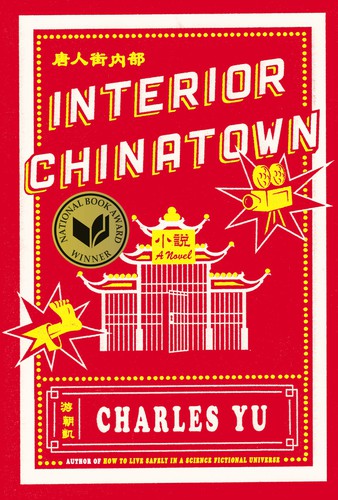
Interior Chinatown
🏆 National Book Award for Fiction (2020)
Longlisted for Andrew Carnegie Medal for Excellence in Fiction (2021)
Review Editor
Eleanor Marsh
Charles Yu’s Interior Chinatown, published in January 2020 by Pantheon Books, is a novel written entirely in screenplay format. It follows Willis Wu, a bit-part actor stuck playing “Generic Asian Man” on a perpetually filming cop show called Black and White. Willis lives in a Chinatown SRO above the Golden Palace restaurant, shuffling between roles like “Background Oriental Making a Weird Face” and “Disgraced Son,” dreaming of the day he might be promoted to “Kung Fu Guy,” the ceiling of what Hollywood will offer someone who looks like him.
The book unfolds across seven acts, each one escalating Willis’s involvement in a real crime that starts bleeding into the scripted world of the show. When a young woman goes missing and Willis recognizes connections to his own family’s story, he begins pushing against the boundaries of his assigned role. Along the way, Yu maps out the history of Willis’s parents, Ming-Chen and Karen, Taiwanese immigrants who arrived in America with ambitions that were slowly whittled down by the limited parts available to them.
At 288 pages and formatted like a script, it reads fast. But its brevity is deceptive. Beneath the wit and the formal cleverness, Interior Chinatown is doing something deeply felt about what it means to exist inside a system that has already decided who you are before you open your mouth.
Character Arcs and Development
Willis Wu begins the novel as someone who has accepted his invisibility. He’s not angry about it; he barely registers it. He knows the rules of the world he inhabits: Asian men are background, Asian women are love interests or victims, and the leads are always the white detectives. His aspiration to become Kung Fu Guy is itself a commentary on how constrained his imagination has become. He can’t even dream beyond the best stereotype available.
The shift comes when Willis starts investigating the disappearance connected to his brother, Older Brother, who vanished years earlier after briefly achieving Kung Fu Guy status himself. Willis begins breaking the fourth wall, stepping out of the script, and Yu frames this as both literal and metaphorical rebellion. Willis doesn’t suddenly become a hero in the traditional sense; instead, he starts asking why the story is structured the way it is and who benefits from keeping him in the background.
Willis’s parents are the emotional spine of the novel. Ming-Chen once played “Kung Fu Dad,” a role with real physicality and presence, but age and the industry’s indifference reduced him to silence. Karen, once “Pretty Oriental Woman,” retreated into herself as her children grew up inside a system she couldn’t protect them from. Their arcs are told in compressed, devastating flashbacks that carry more weight than many full-length family sagas. The secondary characters, including Willis’s love interest Turner (a white detective on the show) and the various Chinatown residents, function more as types than fully drawn individuals, but that’s the point. Yu is showing how the system flattens everyone.
Pacing
The screenplay format keeps things moving at a clip. There’s no room for filler when every line reads like a stage direction or dialogue cue. The first half builds momentum as Willis starts to notice the machinery around him, and the middle sections, where Yu dives into the family history, slow down deliberately to give the emotional material room to breathe.
If there’s a section that tests patience, it’s in the third and fourth acts, where the metafictional layers stack up and the line between the cop show plot and Willis’s real life blurs almost too aggressively. Some readers will find this thrilling; others may feel like they’ve lost their footing. But the final act pulls everything together with a courtroom scene that drops the screenplay format entirely and shifts into direct, first-person prose. That transition hits hard precisely because of the formal constraint that came before it.
Deeper Thematic Exploration
Interior Chinatown is, at its core, about the violence of being reduced to a type. Willis doesn’t just play a background character on a TV show; he lives inside a culture that has already cast him. The screenplay format makes this literal: his life has stage directions, he has lines written for him, and deviating from the script is treated as a disruption. Yu is asking what happens when you internalize the role that society assigns you so completely that you forget you ever had a self underneath it.
The novel also wrestles with the model minority myth and the particular trap it sets for Asian Americans. Willis’s parents sacrificed everything so their children could have better roles, but “better” still means playing within the same narrow range. Ming-Chen traded his body and his pride for a foothold in a country that rewarded his effort with invisibility. Karen smiled through decades of being ornamental. The generational bargain, work hard, don’t complain, and your children will have it better, is revealed as a bargain with a system that never intended to hold up its end.
There’s also a sharp critique of how American popular culture constructs race through storytelling. The fictional show Black and White is a police procedural where the white detectives are complex, flawed protagonists and the Asian characters are furniture. Yu doesn’t just point this out; he builds the entire novel’s architecture around it. When Willis finally breaks free of the format, it feels like an act of survival, not just a narrative trick. The book suggests that the stories we tell about each other aren’t harmless entertainment: they shape who gets to be fully human and who remains a prop.
Style and Voice
The screenplay format is the most immediately striking thing about Interior Chinatown, and it could easily have been a gimmick. In Yu’s hands, it becomes something more: a structural argument. The clipped stage directions (“WILLIS WU stands in the background. He is not important.”) do the work of exposition and characterization simultaneously. When Yu describes a scene in a few terse lines, the white space on the page becomes its own statement about what’s missing, about the interiority that the format refuses to grant its characters.
Yu’s voice is warm and funny even when the material cuts deep. He has a gift for lines that land as jokes on first read and as something sadder on the second pass. The prose is spare by necessity, but it never feels thin. And when the format breaks in the final act, when Willis speaks directly in full paragraphs for the first time, the shift in texture is startling. You realize how much the screenplay format had been holding back, and that withholding was the point all along.
Verdict
Interior Chinatown is a novel that does something genuinely new with form and uses that novelty to say something true about race, family, and the stories America tells about itself. It won the National Book Award in 2020, and the recognition feels earned: this is a book that expands what a novel can look like while remaining emotionally grounded and readable.
If you’re a reader who wants your fiction to take formal risks, this is essential. If you care about how representation works in popular culture, not just who appears on screen but what roles they’re allowed to inhabit, this book will stay with you. It’s also short enough to read in an afternoon, which makes it an easy recommendation for anyone curious about contemporary literary fiction but wary of 500-page commitments. The one caveat: readers who prefer conventional narrative structure may find the screenplay format more disorienting than liberating, and the metafictional layers in the middle section ask for patience. But the payoff, when Willis finally speaks in his own voice, is worth every page of stage directions that came before.
Frequently Asked Questions about Interior Chinatown
What is Interior Chinatown by Charles Yu about?
Interior Chinatown follows Willis Wu, an Asian American actor stuck playing bit parts like “Generic Asian Man” on a fictional cop show called Black and White. Written entirely in screenplay format, the novel traces Willis’s journey as he begins investigating a real crime connected to his family while trying to break free of the limited roles assigned to him by Hollywood and by American culture more broadly. It’s a satire about racial typecasting that doubles as a moving story about immigrant families and generational sacrifice.
Is Interior Chinatown based on a true story?
Interior Chinatown is a work of fiction, not based on a specific true story. However, Charles Yu has spoken in interviews about drawing on his own experiences as a Taiwanese American and on the broader history of Asian representation in American media. The novel’s depictions of Chinatown, the model minority myth, and the limited roles available to Asian actors reflect real cultural patterns that many Asian Americans recognize from their own lives.
What are the main themes in Interior Chinatown?
The novel explores four major themes. First, racial typecasting and the way American media reduces Asian people to stereotypes. Second, the immigrant experience and the sacrifices parents make for their children’s futures. Third, the model minority myth and how it traps Asian Americans in a narrow range of acceptable behavior. Fourth, identity and selfhood, specifically what happens when you internalize the limited role that society assigns you and forget that you could be something more.
How long is Interior Chinatown and is it a difficult read?
Interior Chinatown is 288 pages, and because it’s written in screenplay format with short lines and plenty of white space, most readers finish it in three to five hours. The format makes it a quick read, though the metafictional elements (where the line between the fictional TV show and Willis’s real life blurs) can be disorienting in the middle sections. It’s accessible to any adult reader comfortable with literary fiction, and the humor keeps it from feeling heavy despite its serious subject matter.
Is there a TV adaptation of Interior Chinatown?
Yes. Hulu released a 10-episode limited series adaptation of Interior Chinatown in November 2024. The show stars Jimmy O. Yang as Willis Wu, with Ronny Chieng and Chloe Bennet in supporting roles. Charles Yu served as showrunner and adapted his own novel for the screen. The series received generally positive reviews, earning an 87% score on Rotten Tomatoes.
What age group or reading level is Interior Chinatown for?
Interior Chinatown is written for adult readers, though mature high school students (ages 16 and up) would also find it accessible and rewarding. The language is straightforward and the book contains no graphic violence or explicit sexual content. It’s frequently assigned in college courses on Asian American literature, contemporary fiction, and media studies. The screenplay format makes it particularly approachable for readers who are new to literary fiction.
How does Interior Chinatown compare to Charles Yu’s other books?
Charles Yu’s earlier novel, How to Live Safely in a Science Fictional Universe (2010), shares Interior Chinatown’s interest in metafiction and identity but uses science fiction tropes rather than Hollywood conventions. His short story collections, Third Class Superhero and Sorry Please Thank You, explore similar themes of alienation and cultural displacement through speculative scenarios. Interior Chinatown is widely considered his most accomplished and emotionally resonant work, and it’s the book that brought him mainstream recognition with the National Book Award.
Should I read Interior Chinatown and is it worth it?
If you’re interested in how race and identity operate in American culture, or if you enjoy fiction that experiments with form, Interior Chinatown is well worth your time. It’s funny, it’s smart, and its final section delivers a genuine emotional punch. Readers who love conventional plotting may find the screenplay format frustrating at first, but the book rewards patience. At under 300 pages, the investment is small and the payoff is substantial. It earned the National Book Award for good reason.
Book Details
- Title
- Interior Chinatown
- Awards
- 🏆 National Book Award for Fiction (2020) Longlisted for Andrew Carnegie Medal for Excellence in Fiction (2021)
- WritersReview Rating
- 4.9 / 5