
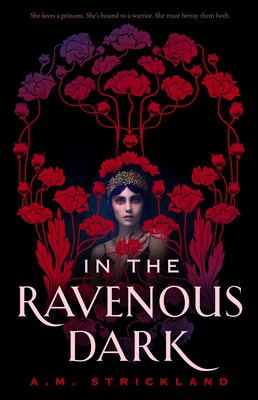
In the Ravenous Dark
Imprint · 2021 · 400 pages
ISBN: 9781250764799
Review Editor
Marcus Webb
A.M. Strickland’s In the Ravenous Dark, published in 2021 by Imprint, drops you into Thanopolis, a city steeped in ancient Greek-inspired culture where bloodmages are bound to undead shades who serve as both guardian and jailer. The premise is deceptively simple: a young woman named Rovan has spent twelve years hiding her blood magic after watching her father die at the hands of the king’s enforcers. When she accidentally reveals her power in a public square, she’s hauled into custody, forcibly bound to a shade, and thrown into the deep end of royal politics.
What follows is a story about power, control, and who gets to decide how magic is used. Rovan doesn’t go quietly. She’s sarcastic, impulsive, and furious, and Strickland makes no apologies for any of it. Bound to a shade named Ivrilos who can literally control her body against her will, Rovan also finds herself drawn to Lydea, a princess with her own reasons for rebellion. The three of them, along with Rovan’s best friend Japha, form an uneasy alliance to uncover what the king is really doing with his bloodmages.
The book wears its influences openly. Greek mythology, necromancy, and palace intrigue blend into a setting that feels both familiar and strange. Strickland builds a world where death magic and blood magic exist in opposition, where the line between the living and the dead is a political boundary as much as a spiritual one. It’s a lot of world to absorb in 400 pages, but Strickland trusts you to keep up.
Character Arcs and Development
Rovan is the engine of this book, and she runs hot. She’s 19, angry about the system that killed her father, and absolutely unwilling to play along with the power structure that now claims ownership of her body. What saves her from being merely reactive is that Strickland gives her a genuine internal conflict: Rovan wants vengeance, but she also wants connection. She wants to burn the palace down, but she keeps finding people inside it worth saving. That tension between destruction and attachment drives nearly every decision she makes, and it gives the story real stakes beyond the political machinations.
Ivrilos, the shade bound to Rovan, could easily have been a flat supernatural love interest. Instead, Strickland makes him complicit in a system he’s grown to question. He has the power to override Rovan’s autonomy completely, and the fact that he increasingly chooses not to becomes its own kind of character development. His arc is quieter than Rovan’s, but it mirrors hers: both of them are learning what it means to have power over another person and deciding, deliberately, not to use it.
Lydea is sharp and politically savvy, a princess navigating her own family’s corruption. Her relationship with Rovan develops through shared risk rather than grand romantic gestures, which makes it feel earned. Japha, Rovan’s nonbinary best friend, provides grounding and warmth. They don’t get as much page time as they deserve, but the scenes they do get reveal a loyalty that predates and outlasts the political crisis at the book’s center. The secondary cast is thinner; some of the royal court characters blur together, functioning more as obstacles than as people.
Pacing
Strickland keeps the story moving at a clip that borders on breathless. There’s very little downtime here. Rovan lurches from one crisis to the next, from forced magical ceremonies to palace confrontations to underground conspiracies, and the book rarely pauses long enough for you to catch your breath. For readers who want propulsive fantasy, this works. You’ll turn pages fast.
The trade-off is that some emotional beats don’t land as hard as they should. When Rovan suffers a betrayal or discovers a new piece of the conspiracy, the narrative rushes past it to the next plot point. A few more quiet scenes, a few more moments where characters sit with what just happened, would have given the story more emotional weight. The middle third, in particular, packs in so many revelations that individual ones lose their punch.
Deeper Thematic Exploration
At its core, In the Ravenous Dark is a book about bodily autonomy. The shade-binding system strips bloodmages of control over their own bodies, and Strickland is unsubtle about the horror of this. Ivrilos can move Rovan’s limbs, silence her voice, override her decisions. The parallels to real-world systems of control over marginalized bodies are clear without being heavy-handed. Strickland doesn’t lecture; she shows you what it feels like to have someone else’s will imposed on yours, and she lets the discomfort speak for itself.
The book also digs into the ways power structures use fear to maintain themselves. Thanopolis treats bloodmages as dangerous, assigns them shades to “protect” the public, and uses that arrangement to extract magical labor. It’s colonialism dressed up as public safety. Strickland draws on Greek, Roman, and Taino cultural elements to build this world, and the fusion is deliberate: Thanopolis is a place where cultural assimilation has already happened, where the machinery of empire runs on the bodies of the people it claims to be protecting.
The polyamorous relationship between Rovan, Ivrilos, and Lydea carries its own thematic weight. In a world that tries to dictate who controls whom, choosing to share love and trust freely becomes an act of resistance. Strickland handles this without making it a curiosity or a controversy; it’s simply how these characters relate to each other, and the normalcy of it within the story’s framework is itself a statement. The book’s queerness is not a subplot or a twist. It’s the texture of the world.
Style and Voice
Strickland writes in first person through Rovan, and the voice is consistent: sharp, observant, occasionally self-deprecating, always a little angry. The prose is clean and direct, favoring action and dialogue over extended description. When Strickland does slow down for a descriptive passage, the imagery tends toward the visceral. Blood magic reads as physically demanding, and the writing conveys that through concrete sensory detail rather than abstract mystical language.
The narrative perspective serves the story well, though it does limit your understanding of other characters to what Rovan notices and interprets. There are moments where you want access to Ivrilos’s internal experience or Lydea’s political calculations, and the tight first-person POV keeps those at arm’s length. Strickland compensates by making Rovan a perceptive narrator, someone who reads people closely even when she’d rather not.
Verdict
If you’re looking for a fantasy that takes bodily autonomy seriously, builds a world where queerness is baked into the foundation rather than bolted on as an afterthought, and moves at a pace that keeps you reading past your bedtime, In the Ravenous Dark delivers. It’s a book with genuine convictions about power and freedom, carried by a protagonist whose anger feels justified and whose growth feels real.
It’s not flawless. The pacing sacrifices emotional depth for momentum, some secondary characters remain sketches, and the sheer density of worldbuilding in the first hundred pages asks a lot of you. But Rovan’s voice holds the center, and the themes resonate well beyond the final page. Readers who love Leigh Bardugo’s moral complexity or Samantha Shannon’s political fantasy will find plenty to chew on here. If you need your fantasy to slow down and breathe, this one may leave you a little winded.
Frequently Asked Questions about In the Ravenous Dark
What is In the Ravenous Dark by A.M. Strickland about?
In the Ravenous Dark follows Rovan, a young bloodmage in the city of Thanopolis who has hidden her powers for twelve years. When she’s discovered and forcibly bound to an undead shade named Ivrilos, she’s thrust into palace politics and a conspiracy surrounding the king’s use of bloodmages. The story weaves together rebellion, romance, and questions about who controls your body and your magic.
Is In the Ravenous Dark based on a true story?
No, it’s a fantasy novel, though Strickland draws on elements of Greek and Roman mythology and Taino cultural traditions to build the world of Thanopolis. The themes of bodily autonomy and systemic oppression resonate with real historical patterns of colonialism and marginalization, but the story and characters are entirely fictional.
What are the main themes in In the Ravenous Dark?
The book centers on bodily autonomy, exploring what it means to have someone else control your physical self. It also examines systemic oppression and how power structures use fear to justify control. Identity, found family, and the politics of resistance run through the narrative. The polyamorous relationship at the heart of the book raises questions about trust, consent, and what it means to choose love freely in a world designed to restrict choice.
How long is In the Ravenous Dark and is it a difficult read?
The book runs 400 pages and reads quickly thanks to its fast pace and accessible prose. It’s not a difficult read in terms of language, though the worldbuilding is dense in the opening chapters. Once you settle into Thanopolis and its magic system, the story moves at a clip. Most readers finish it in a few sittings.
Is there a movie or TV adaptation of In the Ravenous Dark?
As of 2026, there is no movie or TV adaptation of In the Ravenous Dark. The book’s vivid action sequences and politically charged setting would translate well to screen, but no adaptation has been announced. Strickland has published other standalone fantasies, including Court of the Undying Seasons, but none have been adapted either.
What age group or reading level is In the Ravenous Dark for?
The book is categorized as young adult fantasy and is suitable for readers ages 15 and up. It contains violence, including graphic depictions of blood magic, as well as romantic content including a polyamorous relationship. The themes of autonomy and political oppression give it crossover appeal for adult readers who enjoy YA fantasy.
How does In the Ravenous Dark compare to A.M. Strickland’s other books?
Strickland’s other works include Beyond the Black Door and Court of the Undying Seasons. All three are standalone dark fantasies featuring queer protagonists and explorations of power and consent. In the Ravenous Dark is the most politically charged of the three, with a broader scope and more complex worldbuilding. Court of the Undying Seasons leans more into gothic romance, while Beyond the Black Door focuses on asexual identity. If you enjoy one, the others are worth exploring.
Should I read In the Ravenous Dark and is it worth it?
If you enjoy fast-paced fantasy with diverse queer representation and themes that go deeper than surface-level adventure, yes. The worldbuilding is inventive, Rovan is a compelling protagonist, and the exploration of bodily autonomy gives the story substance beyond its plot. Readers who prefer slower, more introspective fantasy or who want deeply developed secondary characters may find it less satisfying. But for what it sets out to do, it does it with conviction and energy.
Book Details
- Title
- In the Ravenous Dark
- Author
- A.M. Strickland
- Genre
- Science Fiction
- Publisher
- Imprint
- Year Published
- 2021
- Pages
- 400
- ISBN
- 9781250764799
- WritersReview Rating
- 3.8 / 5