
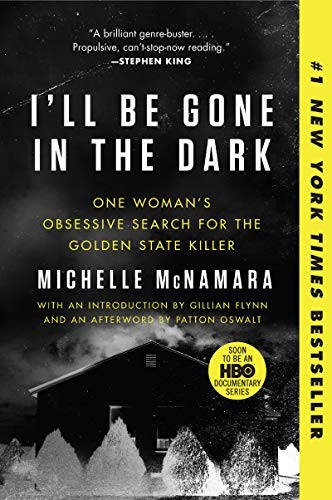
I’ll Be Gone in the Dark
HarperCollins · 2018 · 344 pages
ISBN: 9780062319791
Review Editor
Priya Nair
Summary
Michelle McNamara spent the last years of her life pursuing a serial killer she named the Golden State Killer: a man who committed at least fifty rapes and thirteen murders across California in the 1970s and 1980s and was never identified. She was not a detective. She was a true crime writer, the founder of a website called True Crime Diary, and, by her own account, obsessed. She died in 2016 before she could finish the book she was writing about the case. Her husband, the comedian Patton Oswalt, and two researchers finished it from her notes and drafts.
I’ll Be Gone in the Dark was published in 2018 and became an immediate bestseller. A few months after its publication, a retired police officer named Joseph James DeAngelo was arrested and later pleaded guilty to being the Golden State Killer. McNamara did not solve the case herself, but her book was part of the cultural pressure that kept it alive, and her obsessive documentation of the evidence contributed to the investigators’ work. The title comes from a taunt the killer sent to a newspaper: “Excitement’s in the needle. I’ll be gone in the dark.”
The book is not primarily a who-done-it. It is a portrait of an obsession, an investigation into what draws people to true crime, and a work of literary journalism that refuses to treat its subject’s victims as mere pieces of a puzzle. McNamara writes about the Golden State Killer’s victims with the specificity and care she reserves for every aspect of the case, and the book is as much about them as it is about the perpetrator or the investigation.
Character Arcs and Development
McNamara is the book’s protagonist as much as the killer she pursues, and she is the most interesting figure in it. She writes about her own obsession with intelligence and without excusing its costs: the hours it took from her family, the darkness it pulled her into, the way it became entangled with her own anxieties about safety and danger. She is funny and self-aware and deeply serious, and the portrait of her that emerges from the book is of someone whose gifts were enormous and whose obsessions were genuinely dangerous to her own wellbeing.
The victims are rendered as individuals rather than statistics, which is the most important formal decision in the book. Each survivor or victim’s family member who appears in these pages is given enough space to exist as a person, and the effect is a corrective to the genre’s frequent tendency to treat victims as props for the killer’s story.
Pacing
The book’s pacing is uneven in a way that is probably unavoidable: it was written by a person who died before she finished it and completed by others working from her notes. The seams are sometimes visible. But even the uneven sections have McNamara’s voice running through them, and that voice is so distinctive and so compelling that the structural irregularities matter less than they might in another book.
The passages of pure investigative journalism are the most rigorously structured, the chapters in which McNamara tracks the killer’s movements across California and pieces together what the evidence tells her. The autobiographical sections are more impressionistic, and they give the book its heart, its awareness that the person writing it is not a neutral observer but someone who has been changed by what she is examining.
Deeper Thematic Exploration
The book’s central question is: what do we owe to the dead? McNamara pursues the Golden State Killer not because she expects to solve the case singlehandedly, but because she believes his victims deserve the sustained attention of someone who will not stop looking. This is an ethics of true crime that the genre often lacks: the understanding that the investigation is in some sense a service to those who were harmed, not merely entertainment for those who read about it.
There is also a less explicit investigation of the psychology of obsession and what draws particular people to particular obsessions. McNamara does not fully explain why the Golden State Killer’s case absorbed her so completely, but the reader begins to see the shape of an answer: it involves her own history of anxiety, her fear of home invasion, her need to understand a kind of randomness and violence that the world offers with no explanation.
Style and Voice
McNamara writes true crime prose with a literary sensibility that makes the category feel inadequate. Her sentences are alive in a way that journalism rarely manages, her images precise and unexpected, her humor genuine even in proximity to the darkest material. The book reads as if someone finally taught the genre to write, which is both what makes it so good and why it is so mourned as an uncompleted project.
The passages written by her collaborators to complete the book are honorably done but clearly different in register, which is both inevitable and not their fault. They preserved what was essential: McNamara’s voice in the sections she wrote, and the factual material necessary to complete the investigation.
Verdict
I’ll Be Gone in the Dark is the best work of true crime literature published in recent decades, a book that simultaneously honors the genre and transcends it. It is haunting not primarily because of the killer it pursues, though the case is genuinely terrifying, but because of the writer it reveals: someone whose obsession was also her greatest gift, and whose gift was cut short before it could reach its full expression.
The fact that the Golden State Killer was identified after the book’s publication feels, retrospectively, like the conclusion that McNamara deserved and was denied. The book stands as it is: extraordinary, incomplete, and irreplaceable.
Five stars: essential reading for anyone interested in true crime, literary nonfiction, or the relationship between obsession and art.
Did Michelle McNamara identify the Golden State Killer?
No, McNamara died in 2016 before the killer was identified. Joseph James DeAngelo was arrested in April 2018, two months after the book’s publication, following DNA analysis through a genealogy database. McNamara’s book helped keep public interest in the cold case alive, and investigators have credited the cultural attention surrounding the case as a factor, but the identification came from forensic genealogy work that she did not directly participate in.
Who finished the book after McNamara died?
McNamara’s husband, comedian and actor Patton Oswalt, worked with researchers Billy Jensen and Paul Haynes to complete the book from her notes, drafts, and research files. Oswalt has written and spoken publicly about the process, and the book includes an afterword explaining how it was completed. The sections written to fill the gaps are clearly marked in the published text.
Is I’ll Be Gone in the Dark suitable for readers who don’t normally read true crime?
It is perhaps the best possible introduction to literary true crime precisely because McNamara is so self-aware about the genre’s ethics and so careful about how she writes about victims. Readers who find conventional true crime exploitative or sensationalistic will find here a writer who shares those concerns and writes accordingly. The literary quality also makes it accessible to readers whose primary interest is in good prose rather than crime investigation.
What is True Crime Diary?
True Crime Diary was a website McNamara founded to write about cold cases. It developed a significant readership and community, and her work there was how she came to the Golden State Killer case. The online community of amateur investigators that gathered around her work was part of the larger ecosystem of attention that she believed was necessary to keep cold cases from being forgotten.
Is there a TV adaptation?
Yes, HBO produced a documentary series also called I’ll Be Gone in the Dark, released in 2020. It covers McNamara’s investigation and her life, as well as the aftermath of DeAngelo’s arrest. Both the book and the documentary series are highly regarded, and together they provide a comprehensive account of the case and the investigation.
How does the book handle the killer’s victims?
With unusual care for the genre. McNamara insisted on treating victims as individuals with full lives rather than as props for the killer’s story, and the book consistently returns to the survivors and the families of those killed with specificity and respect. This is one of the things that distinguishes it from conventional true crime, where victims often disappear into the background of their own story.
What was the Golden State Killer’s actual identity?
Joseph James DeAngelo, born in 1945, was a former police officer who pleaded guilty in 2020 to thirteen murders and fifty or more rapes committed in California between 1973 and 1986. He received eleven consecutive life sentences without the possibility of parole. The crimes were committed under several names before the FBI unified them under the “Golden State Killer” designation that McNamara coined.
Is the book finished or does the incompleteness affect the reading?
The incompleteness is noticeable in places, particularly in the transitions between sections and in some structural choices that feel provisional. But McNamara’s voice is present throughout in the sections she wrote, which constitute the majority of the book, and the collaborators who completed it were careful to signal where they were filling gaps. Most readers find the book compelling despite its incompleteness, and some find that the incompleteness is itself meaningful: the book ends where McNamara was cut off, which is its own kind of conclusion.
Book Details
- Title
- I’ll Be Gone in the Dark
- Author
- Michelle McNamara
- Genre
- Biography
- Publisher
- HarperCollins
- Year Published
- 2018
- Pages
- 344
- ISBN
- 9780062319791
- WritersReview Rating
- 5.0 / 5