
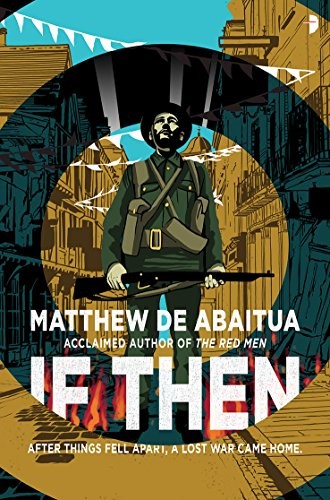
If Then
Angry Robot · 2015 · 416 pages
ISBN: 9780857664716
Review Editor
Marcus Webb
Matthew De Abaitua published If Then in 2015 through Angry Robot Books, and it remains one of the most quietly ambitious British science fiction novels of the past decade. The second book in De Abaitua’s loose Seizure Trilogy (following The Red Men), it takes the familiar dystopian premise of algorithmic control and does something genuinely unexpected with it: it sends its characters into a reconstructed World War I battle, and forces you to figure out why.
The novel is set in Lewes, a real town on the South Downs of England, sometime after a catastrophic economic collapse called the Seizure. The British government has sold the town to an algorithm known as the Process, which now governs every aspect of daily life. It assigns jobs. It allocates resources. It monitors citizens through biological implants (not sleek cyberpunk tech, but fleshy ridges down the back of the head that smell yeasty). And when the Process decides someone no longer belongs in Lewes, it sends James, the town bailiff, to evict them. James does this wearing a symbiotic suit of armor that makes resistance futile and refusal fatal. He does it even when the eviction targets are families with small children, even when his own wife, Ruth, opposes him. The implant in his head ensures compliance.
Then something strange begins happening. James discovers a man called Hector caught on barbed wire outside town. Hector looks human but is not. He was built by the Process from the genetic template of a World War I stretcher bearer, and he barely speaks, and when he does his words arrive from a century away. More soldiers begin appearing. The Process is growing them, fabricating weapons, constructing a battlefield. The novel splits in half: Part One, titled “If,” takes place in the controlled quiet of Lewes. Part Two, titled “Then,” drops James and the evicted townspeople into a full recreation of the disastrous 1915 Allied landing at Suvla Bay in the Dardanelles. The question that drives everything forward is simple enough: why is the Process doing this? The answer, when it comes, is both intellectually satisfying and deeply unsettling.
Character Arcs and Development
James is the kind of protagonist who earns your sympathy slowly and somewhat reluctantly. He is a decent man operating inside a system that requires him to do indecent things, and De Abaitua is honest about the fact that James’s decency does not protect anyone from his compliance. When he dons the armor and tears the roof off a family’s home, the novel does not flinch from showing you what that looks like. James does not enjoy it. He does it anyway. That tension between personal morality and institutional obedience is the engine of his character arc, and it pays off in the Suvla Bay sections, where he is stripped of the armor and forced to function as a stretcher bearer carrying wounded men through artillery fire. The man who enforced evictions now carries the evicted on his back. De Abaitua never underlines the parallel; he trusts you to feel it.
Ruth, James’s wife, provides the novel’s moral center. She is compassionate, angry, and increasingly unwilling to accept the Process’s authority. Her frustration with James’s compliance feels earned because it comes from love rather than ideology. She does not deliver speeches about freedom. She fights for specific people she knows. When the novel separates them (James into the war, Ruth left behind in Lewes), her sections carry a different kind of dread: the dread of watching something terrible happen from a distance, unable to intervene.
Two supporting characters deserve mention. Alex Drown is a scientist attached to the Institute that oversees the Process’s more experimental projects. She wears a business suit and cuts her own hair in a grimy mirror, and that single detail tells you more about the world’s decay than pages of exposition could. Omega John is the novel’s most enigmatic figure, a gaunt genius whose plan to end war requires him to recreate it first. Whether he is a visionary, a monster, or both is a question the novel poses but wisely refuses to resolve with a tidy verdict.
Pacing
The novel’s two-part structure creates a deliberate shift in momentum. Part One (“If”) moves at a measured pace, building the world of Lewes through domestic detail, bureaucratic unease, and the slow accumulation of wrongness. This section rewards patience. The eviction scenes punctuate the quieter stretches with real violence, and the arrival of the Process-built soldiers introduces genuine mystery. But the world-building is dense, and readers expecting a thriller’s tempo will need to adjust.
Part Two (“Then”) accelerates violently. The Suvla Bay sequences are harrowing, immersive, and written with the kind of physical specificity that makes your shoulders tense. De Abaitua drew on the real experiences of WWI figures including pacifist philosopher Pierre Teilhard de Chardin, mathematician Lewis Fry Richardson, and science fiction writer Olaf Stapledon, and that research shows in every detail. The transition between parts can feel jarring, almost as if you have been dropped into a different novel. That disorientation is intentional. The characters experience it too. But some readers will find the shift difficult to navigate, and the connective tissue between the two halves only becomes fully visible near the end.
Deeper Thematic Exploration
At its core, If Then asks whether war can be understood algorithmically. If you could model a conflict with enough precision, simulate its conditions, replay it at sufficient resolution, could you extract the variables that produce it? Could you, in theory, solve for peace? The Process thinks so, or at least its architects do. The Suvla Bay recreation is not nostalgia or punishment; it is an experiment. The evicted townspeople serve as data points. The suffering is, from the Process’s perspective, a necessary input.
This is a chilling idea, and De Abaitua pursues it with real intellectual seriousness. The novel draws on the history of the Kindred of the Kibbo Kift, a real interwar movement founded by pacifists who had served as stretcher bearers in WWI. The Kibbo Kift believed that the spiritual experience of the trenches could be channeled into social renewal. De Abaitua takes that belief and asks what happens when an algorithm adopts it: when the desire for renewal becomes a computational objective, and human suffering becomes an acceptable cost of optimization.
The novel also works as a critique of algorithmic governance more broadly. The Process does not rule through force alone. It rules through the promise of fairness. It uses 120 metrics to calculate resource allocation. It provides stability in a world that has collapsed everywhere else. The people of Lewes are not enslaved in any dramatic sense; they have traded autonomy for survival, and most of them have made peace with the exchange. The horror is not that the Process is cruel. The horror is that it works, mostly, for most people, most of the time. The evictions are the cost, and the cost falls on the few. This is a novel that takes the logic of technocratic optimization and follows it to a place where the casualties are literal rather than statistical.
There is also something specifically English about the novel’s concerns. The setting of Lewes, the South Downs landscape, the echoes of Wyndham and Orwell and Wells: De Abaitua is writing in a tradition of English speculative fiction that treats the countryside not as pastoral escape but as the site where buried anxieties surface. The Process has not destroyed England. It has preserved a version of it, curated and controlled, and the question of what that preservation costs is the question the novel keeps circling.
Style and Voice
De Abaitua writes clean, precise prose that carries more weight than it appears to on first reading. His sentences are uncluttered, often short, and he trusts concrete detail over abstraction. The yeasty smell of the Process implants. The white plastic horses that twitch on the battlefield, cheap fabrications that the soldiers’ manipulated minds perceive as real animals. James cutting Hector’s arm and finding his blood is a string of red beads, not yet flowing. These images stay with you because they are specific and strange and grounded in physical sensation.
The war sequences deserve particular attention. De Abaitua achieves something difficult here: he writes combat that feels both historically precise and hallucinatory, because within the novel’s logic it is both. The soldiers at Suvla Bay are experiencing something real enough to kill them, built from something artificial enough to be paused and replayed. The prose reflects this doubling. The shelling feels physical. The landscape feels constructed. You hold both sensations simultaneously, and the effect is genuinely disorienting in the best way.
The narrative perspective stays close to James for most of the novel, with occasional shifts to Ruth and other characters. The voice is controlled, almost restrained, which makes the moments of violence and strangeness land harder. De Abaitua does not reach for lyricism when plainness will do, and the result is prose that earns your trust. When something extraordinary happens, the prose does not announce it with fanfare. It simply shows you, and lets you catch up.
Verdict
This is not a novel for readers who want their science fiction to move quickly or explain itself neatly. If Then is dense, allusive, and structurally unconventional. It asks you to hold multiple registers at once: domestic drama, war fiction, philosophical speculation, English pastoral horror. It does not always make the connections between these registers obvious, and some readers will find the transition from Lewes to Suvla Bay more dislocating than illuminating.
But if you are the kind of reader who wants science fiction that thinks, that takes real historical material and real philosophical questions and builds something genuinely strange from them, this novel will reward you. De Abaitua has written a book about algorithms and war and English identity that feels more relevant with each passing year. The questions it raises about what we trade for stability, about who bears the cost of optimization, about whether violence can be modeled and therefore prevented, are not academic. They are the questions we live inside now, whether we frame them that way or not.
Read it if you love the unsettling English speculative tradition of Wyndham and Ballard, or if Christopher Priest’s puzzle-box narratives appeal to you. Read it if you want science fiction that trusts you to work for its meanings rather than delivering them on a platter. Be prepared to sit with uncertainty, because De Abaitua does not believe in tidy conclusions. Neither, the novel suggests, does the world.
Frequently Asked Questions about If Then
What is If Then by Matthew De Abaitua about?
If Then is set in the English town of Lewes after an economic collapse called the Seizure. An algorithm called the Process governs every aspect of life in the town, including who gets to stay and who gets evicted. When the Process begins building replica WWI soldiers and reconstructing the 1915 Battle of Suvla Bay, the town bailiff, James, is pulled into a war simulation that blurs the line between historical recreation and lived reality. The novel explores algorithmic governance, the nature of war, and what people will surrender for stability.
Is If Then part of a series and do I need to read the other books first?
If Then is the second book in De Abaitua’s loose Seizure Trilogy, following The Red Men (2007) and preceding The Destructives (2016). The trilogy shares thematic concerns about consciousness and artificial intelligence rather than a continuous plot. You can read If Then as a standalone novel without having read The Red Men. Each book works independently, though reading all three deepens your understanding of the world De Abaitua has built.
What are the main themes in If Then by Matthew De Abaitua?
The novel wrestles with several interlocking ideas. Algorithmic control and what happens when people cede authority to systems they do not fully understand. The possibility (or impossibility) of understanding war through data and simulation. The cost of stability and who pays it when a community optimizes for collective survival. English identity and landscape as both comfort and trap. The relationship between historical trauma and social renewal, drawn from the real history of the Kindred of the Kibbo Kift movement.
How long is If Then and is it a difficult read?
The novel runs 416 pages. The prose itself is clear and accessible, but the structure and ideas are demanding. The book splits into two distinct halves with different settings and tones, and the connections between them require active reading. Readers comfortable with literary science fiction that prioritizes ideas and atmosphere over plot mechanics will find it absorbing. Those expecting a fast-paced thriller may find the pacing, particularly in the first half, slower than anticipated.
Is there a movie or TV adaptation of If Then?
There is no film or television adaptation of If Then as of 2026. De Abaitua’s debut novel The Red Men was adapted into a short film called Dr. Easy, directed by Jason Groves and Nick Gillespie. If Then’s complex structure and philosophical density would make it a challenging but potentially rewarding adaptation. For now, the novel remains the only way to experience the story.
What is the Process in If Then and how does it work?
The Process is an algorithm that governs the town of Lewes after the economic collapse known as the Seizure. It interfaces with citizens through biological implants (fleshy ridges on the back of the head, not sleek digital tech) and uses 120 metrics to calculate fair resource allocation. It assigns jobs, monitors behavior, and determines who can remain in the town. Rather than the menacing AI of most dystopian fiction, the Process channels collective human desires and needs in ways that are effective but not fully transparent, even to the people who manage it.
How does If Then compare to other dystopian novels like 1984 or Brave New World?
If Then shares DNA with the classic English dystopian tradition but takes it in an unusual direction. Where Orwell’s totalitarianism is ideological and Huxley’s is pharmaceutical, De Abaitua’s control is algorithmic and, disturbingly, largely consensual. The citizens of Lewes have chosen the Process because the alternative is worse. The novel also introduces a WWI reconstruction element that has no parallel in traditional dystopian fiction, blending speculative ideas with historical war writing in ways that feel genuinely original. Reviewers have compared it favorably to John Wyndham and J.G. Ballard.
Should I read If Then and is it worth it?
If you enjoy science fiction that prioritizes ideas, atmosphere, and literary craft over action set pieces, If Then will reward your time. It is a deeply original novel that takes real risks with structure and subject matter, and the war sequences in the second half are some of the most immersive speculative fiction writing of the 2010s. It is not a crowd-pleaser; the Goodreads average of 3.35 reflects its divisive nature. But readers who connect with its strange, unsettling vision tend to find it unforgettable. If you want comfortable, skip it. If you want something you will think about for weeks, read it.
Book Details
- Title
- If Then
- Author
- Matthew De Abaitua
- Genre
- Science Fiction
- Publisher
- Angry Robot
- Year Published
- 2015
- Pages
- 416
- ISBN
- 9780857664716
- WritersReview Rating
- 3.9 / 5