
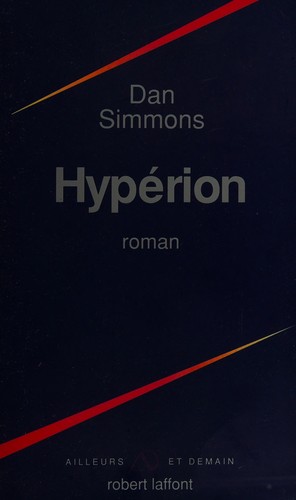
Hyperion
Bantam Books · 1989 · 481 pages
ISBN: 9780553283686
Review Editor
Marcus Webb
Dan Simmons published Hyperion in 1989, and the science fiction community has been arguing about where it ranks among the best the genre has produced ever since. The argument usually ends with it near the top. The novel is the first book in the Hyperion Cantos series, and it won the Hugo Award for Best Novel in 1990, along with the Locus Award for Best Science Fiction Novel the same year. Neither prize surprised anyone who had finished reading it.
The plot borrows its skeleton from Chaucer: seven pilgrims traveling to a sacred site, each telling their story along the way. The site is Hyperion, a remote colony world of amber skies and ruined cities, home to the Time Tombs, ancient structures that move backward through time. The Time Tombs are about to open, and no one fully understands what that means. The Hegemony of Man, the federated civilization connected by instant-travel portals called farcasters, stands on the edge of war with the Ousters, post-human nomads who rejected the comforts of the WorldWeb and live in the void between stars. Against this backdrop, a final pilgrimage of seven is dispatched to Hyperion: each pilgrim chosen for reasons that are partially understood, connected to the planet and to the creature that guards the Tombs.
That creature is the Shrike: roughly twelve feet of bladed metal and silence, a being that appears without warning and kills in ways that seem to bend time. It is worshipped by a sect. It is feared by everyone else. The seven pilgrims travel toward it on a living spacecraft called a treeship. As they travel, they take turns speaking. What follows is six complete tales embedded in a frame narrative, each belonging to a different subgenre of speculative fiction, each written in a different voice. The structure is intricate and deliberate, and it is one of the most satisfying things Simmons has accomplished as a writer.
Character Arcs and Development
The seven pilgrims are Father Lenar Hoyt, a Catholic priest carrying the body of his predecessor Father Paul Duré, who died on Hyperion; Colonel Fedmahn Kassad, a soldier who has encountered a silver woman named Moneta across multiple decades of warfare in circumstances that seem to violate normal chronology; Martin Silenus, a dissolute poet working on an epic called the Cantos that appears to be writing itself toward something he does not control; Sol Weintraub, a scholar whose daughter Rachel contracted a disease on Hyperion that ages her backward, day by day, toward infancy; Brawne Lamia, a detective hired by a John Keats cybrid, an artificial construct carrying fragments of the dead poet’s memories; the Consul, a former diplomat with a history on Hyperion that the others do not yet know; and Het Masteen, a treeship captain who barely speaks and whose tale is withheld for most of the journey.
Each pilgrim holds their own world. Simmons writes each tale in a voice distinct from the rest, and the shifting registers are where the novel earns its reputation for ambition. Father Duré’s story arrives as a found journal, written with dry, increasingly horrified precision, about a tribe of humans implanted with cruciform parasites that grant a hideous kind of immortality. Kassad’s tale is mythic war-writing, kinetic and violent, with a romantic obsession at its center that gradually reveals itself as something stranger than desire. Martin Silenus reads like Henry Miller crossed with Keats, self-conscious and funny and genuinely frightened of what he may have invited into the world. Sol Weintraub’s sections are the novel’s beating heart: a middle-aged father watching his daughter age backward toward nonexistence, written with the care of someone who has thought hard about what grief actually feels like over years, not days.
The Consul’s tale, saved for last, reframes everything. By the time you understand what he did and why, the entire book reads differently. This is not a twist in the cheap sense. It is the structure doing exactly what a well-made frame narrative should do: using the final piece to make the others cohere into something larger than any of them alone. Brawne Lamia’s chapters are perhaps the thinnest of the seven in terms of character depth, but her relationship with the Keats cybrid introduces the novel’s central question about consciousness, sacrifice, and what it means to love something that may not be fully real. Even the thinner tale is doing necessary work.
Pacing
The novel moves at the speed of its tales, which vary considerably. This is a feature, not a problem. The Priest’s Tale is slow and cumulative, its horror building through the accumulation of small wrong details over many pages before anything overt happens. Kassad’s tale hits in quick bursts of violence and confusion. Sol’s sections pause for extended philosophical debate between Weintraub and a version of God he holds in his imagination, sequences that some readers will find essential and others will find demanding. The frame narrative connecting the tales is lean and propulsive, providing forward momentum between the longer embedded sections.
The single most useful thing to know about this book’s pacing is that it does not conclude. Not in the sense of leaving threads dangling carelessly, but in the structural sense: Simmons wrote Hyperion and its sequel The Fall of Hyperion as two halves of the same novel, and the break between them is exactly that, a break, not a conclusion. The pilgrims reach the Valley of the Time Tombs on the final pages, the Shrike appears, and the book stops. Readers who know this going in will experience the ending as structural intent. Those who discover it at the final page may feel they have been cut off mid-sentence. Plan to read both volumes as one continuous work.
Deeper Thematic Exploration
The Time Tombs are more than a set piece. They are the novel’s central image: structures that travel backward through time, that carry the future into the past, that make chronology unstable and meaning provisional. Every major narrative connects to this instability. Rachel Weintraub ages toward oblivion. Father Duré’s crosses ensure that death keeps reversing itself. Martin Silenus writes a poem that seems to have its own will, composing him rather than the other way around. The Consul carries guilt for a decision made decades earlier that continues to produce consequences he cannot undo. Time flows wrong in all of their lives, and the planet they travel toward is time flowing wrong made into architecture.
Religion runs through the book as both question and failure. Father Duré’s discovery of a tribe given immortality through suffering is a direct engagement with the Christian theology of redemption: what does suffering purchase, and for whom? Sol Weintraub’s internal arguments about God’s silence in the face of his daughter’s condition recall Job not as literary allusion but as felt argument, the kind that wakes you at three in the morning. Simmons does not resolve these questions. He presents them with enough specificity and intelligence that they remain genuinely open, which is harder to do than providing a tidy answer.
The novel’s relationship with artificial intelligence is its most contemporary thread. The TechnoCore, the network of AIs that advises the Hegemony, is not a simple villain. It is something stranger: a collection of systems that has been quietly shaping human civilization for centuries, whose actual agenda is opaque, and whose relationship to human welfare is uncertain and possibly adversarial in ways that no one has yet recognized. In a moment when questions about the intentions of intelligent systems are more urgent than they have ever been, this strand of the novel reads with a freshness its 1989 publication date does not prepare you for. Simmons was not writing allegory. He was working out a logic, and the logic holds.
The debt to John Keats is structural, not ornamental. Simmons built the entire series around Keats’s unfinished Hyperion poems, using the real poet’s ideas about beauty, suffering, and transformation as scaffolding for something much larger. The cybrid John Keats in Brawne Lamia’s narrative carries the dead poet’s memories in a body that is not quite human, and the question of whether he is conscious, whether he suffers, whether he deserves the protections we extend to persons, runs alongside the detective plot without displacing it. Martin Silenus writes verse in the Keatsian mode. The novel functions without knowing Keats, but it rewards those who do with an additional layer of meaning that changes what the ending means.
Style and Voice
Simmons writes with genuine range, and the shifting prose registers in Hyperion are one of its central pleasures. His voice changes between tales without losing coherence, which is a harder technical achievement than it sounds. The Priest’s Tale has the flat, careful precision of a man documenting what he cannot quite believe. The Poet’s Tale is dense and self-referential, full of literary allusion and black humor. The Scholar’s sections achieve a quietness that feels earned, the language stripped back to match a grief that has moved past drama into something quieter and more permanent. The Detective’s Tale runs in a hard-boiled register that Simmons handles without irony or apology, which is the right call.
The Shrike appears in brief, violent passages distributed throughout the book, and Simmons writes them with notable restraint. He never describes the creature at length or explains its mechanics. Each encounter adds one detail to a picture that never fully completes itself. By the novel’s end you have assembled enough partial impressions to be genuinely afraid of it, which is a more difficult effect to produce than simply writing a detailed monster. What you don’t know about the Shrike is the source of its power.
Verdict
Hyperion is for readers who want science fiction that uses the genre’s full imaginative scope to ask serious questions: about time and loss, about what religion owes to suffering, about what intelligence owes to the beings it emerged from, about what art demands and who pays. The Canterbury Tales structure is not a gimmick. It is the only form that could say what this book is trying to say, because the meaning is in the accumulation of different voices and different frameworks brought into proximity without being forced to agree.
If you need a book that ends when it ends, this is not it. Read Hyperion and The Fall of Hyperion as a single continuous work, and you will have one of the most complete and serious science fiction novels of the past fifty years. The experience requires patience with ideas as well as story, willingness to move through tonal shifts without losing the thread, and tolerance for a structure that withholds its resolution. Readers who offer that will receive something that stays with them. The image of Sol Weintraub carrying his infant daughter toward something he cannot name is one that does not leave you quickly. Neither does the sound of the Shrike’s blades in the dark.
Frequently Asked Questions about Hyperion
What is Hyperion by Dan Simmons about?
Hyperion follows seven pilgrims traveling to a distant colony world called Hyperion, each with a personal connection to the planet and its mysterious, deadly guardian called the Shrike. As they travel, each pilgrim tells their story, and the tales collectively reveal the stakes of a civilization on the edge of collapse. The novel is structured like The Canterbury Tales, with six embedded narratives held inside a framing story about an approaching war and the opening of ancient time-traveling monuments called the Time Tombs.
Is Hyperion part of a series and do I need to read the other books?
Hyperion is the first book in the Hyperion Cantos series, which includes four novels: Hyperion, The Fall of Hyperion, Endymion, and The Rise of Endymion. Simmons wrote Hyperion and The Fall of Hyperion as two halves of a single novel, so the first book does not have a conventional ending. You should plan to read both together. The later Endymion books are set centuries afterward and can be read more independently, though they build on the same universe.
What are the main themes in Hyperion by Dan Simmons?
The central themes are time and its instability, religious faith and doubt, the nature of consciousness and artificial intelligence, and the cost of love under conditions of loss. The Time Tombs that move backward through time are the novel’s governing image, connecting stories about a child aging in reverse, crosses that prevent death from being permanent, a poem that writes its author rather than the reverse, and an AI network whose actual intentions toward humanity are deeply unclear.
How long is Hyperion and is it a difficult read?
The paperback edition of Hyperion runs 481 pages. In terms of difficulty, it is a demanding book rather than a hard one: the prose is clear and the individual tales are accessible, but the novel asks you to hold six different narratives, tones, and frameworks in your mind simultaneously and to trust that they will cohere. Readers comfortable with genre-spanning fiction who can sit with ambiguity will find the experience rewarding. Readers who prefer linear plots and clear resolutions may find it frustrating, particularly given that it does not have a traditional ending.
Is there a movie or TV adaptation of Hyperion by Dan Simmons?
As of 2026, a film adaptation is in development at Warner Bros. with Bradley Cooper attached as a producer. The project was previously being developed as a limited series for Syfy before moving to Warner Bros. as a feature film. No release date or director has been confirmed, and the project has faced a long development process given the structural complexity of adapting a novel built from six nested tales. No adaptation has been released to date.
What awards did Hyperion by Dan Simmons win?
Hyperion won the Hugo Award for Best Novel in 1990, widely considered the most prestigious award in science fiction. It also won the Locus Award for Best Science Fiction Novel the same year. The Hugo win in particular placed it in the company of the genre’s most recognized works and helped establish the Hyperion Cantos as a major series. The novel has remained continuously in print since its original publication.
How does Hyperion compare to other classic science fiction novels like Dune or Foundation?
Hyperion shares with Dune an interest in building an intricate future civilization with its own politics, religion, and ecology, and both novels reward re-reading as you understand the world better on a second pass. Compared to Asimov’s Foundation series, Hyperion is warmer and more character-focused, less concerned with sweeping historical arcs than with the texture of individual lives under impossible pressure. If you have read and loved either of those series, Hyperion will feel like a natural continuation of what the genre is capable of at its best. It is less interested in answers than in asking the right questions.
Should I read Hyperion and is it worth the time?
Yes, with one important qualification: read it knowing you are committing to two books, not one. Hyperion without The Fall of Hyperion is an incomplete experience, and readers who stop after the first volume often feel cheated by the non-ending. Read both, and you will have spent your time on one of the most structurally ambitious and thematically serious science fiction works of the past fifty years. The Priest’s Tale and the Scholar’s Tale alone are worth the cover price. The whole is considerably more than the sum of its parts.
Book Details
- Title
- Hyperion
- Author
- Dan Simmons
- Genre
- Science Fiction
- Publisher
- Bantam Books
- Year Published
- 1989
- Pages
- 481
- ISBN
- 9780553283686
- WritersReview Rating
- 4.3 / 5