
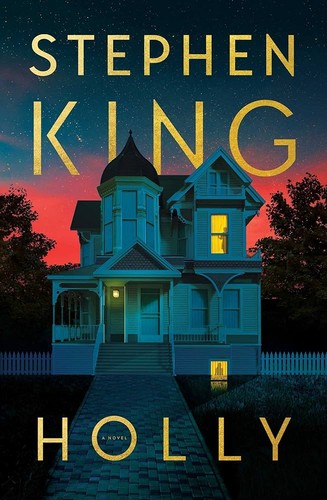
Holly
🏆 Goodreads Choice Award for Horror (2023)
New York Times Notable Book of 2023
Review Editor
Eleanor Marsh
Stephen King published Holly on September 5, 2023, through Scribner, and it marks the first full-length novel devoted entirely to Holly Gibney, one of King’s most enduring characters. Holly first appeared as a supporting player in Mr. Mercedes back in 2014, then returned in Finders Keepers, End of Watch, The Outsider, and the novella If It Bleeds. Over those appearances, she grew from a painfully shy woman crippled by anxiety into someone capable of facing down genuine evil. This novel picks up her story in July 2021, during the thick of the COVID-19 pandemic, just after Holly’s controlling mother has died from the virus.
The case at the center of the story begins simply enough. Penelope Dahl contacts Holly because her daughter Bonnie has vanished. Bonnie’s abandoned bicycle turned up near Deerfield Park with a note reading “I’ve had enough,” and the police have written her off as a voluntary missing person. Holly takes the case, and as she digs deeper, she discovers that Bonnie’s disappearance connects to at least two others: a college student named Peter Steinman and a janitor named Ellen Craslow. The trail leads Holly toward a pair of retired professors, Emily and Rodney Harris, who live in a quiet house on a pleasant street and who harbor a secret so grotesque it belongs in a fairy tale by the Brothers Grimm.
King sets this investigation against a backdrop of masking debates, vaccine hesitancy, and political friction that defined 2021 in America. Whether that grounding works for you may depend on how much distance you’ve put between yourself and those months, but it does give the novel a specificity that many crime thrillers lack.
Character Arcs and Development
Holly Gibney has always been King’s most psychologically nuanced recurring character, and she carries this novel with a quiet authority that would have been unthinkable in her early appearances. The Holly of Mr. Mercedes could barely make eye contact; the Holly here runs her own detective agency, manages her grief, and pushes through her obsessive-compulsive tendencies with a discipline that feels hard-won rather than convenient. King respects the architecture of her anxiety. She still counts things, still flinches at confrontation, still talks herself through difficult moments. But she acts anyway. That gap between fear and action is where her character lives, and King writes it with precision.
The villains, Emily and Rodney Harris, are among King’s most unsettling creations because they look so ordinary. Emily is sharp, socially graceful, and entirely convinced that what she does is justified. Rodney is losing his faculties to early-stage dementia, which makes him both pitiable and more dangerous. King builds them through a series of flashbacks that reveal how two educated, cultured people rationalized something monstrous. The Harrises believe that consuming human flesh staves off aging and disease. It is a delusion rooted in desperation, not malice, and that makes it worse. King draws a deliberate parallel between the Harrises’ refusal to accept their own mortality and the pandemic-era denial playing out around them.
The supporting cast is thinner. Penelope Dahl exists mostly to launch the plot, and Holly’s colleagues at Finders Keepers (the detective agency she inherited from Bill Hodges) appear only briefly. Jerome and Barbara Robinson, fan favorites from the Bill Hodges trilogy, get cameos rather than arcs. This is Holly’s show, and King keeps the spotlight focused tightly on her.
Pacing
King structures the novel as a slow convergence. Holly works her case from one end; the Harrises go about their terrible routines from the other; and the reader watches the distance between them shrink. The first half moves deliberately, layering in Holly’s grief over her mother, her pandemic anxieties, and the procedural details of her investigation. If you come to this book expecting the relentless momentum of Misery or Gerald’s Game, the opening hundred pages may test your patience. King is taking his time because he wants you to feel how Holly’s mind works, how she circles a problem before committing to a direction.
The payoff comes in the final third, when Holly enters the Harris house and everything accelerates. The basement sequences are claustrophobic and genuinely frightening, and King earns that tension precisely because he spent so long building Holly’s competence and vulnerability in equal measure. You know what she can do, you know what scares her, and you watch both collide.
Deeper Thematic Exploration
At its core, Holly is a novel about consumption. The Harrises consume people, literally, to preserve themselves. The pandemic consumes public trust and civil discourse. Holly’s late mother consumed Holly’s autonomy for decades through guilt and manipulation. King braids these threads together with more care than he sometimes receives credit for. The Harrises are not random monsters; they are a logical extension of the book’s interest in what happens when self-preservation overrides every other moral consideration.
There is also a sustained meditation on aging and the refusal to accept decline. Emily Harris is in her seventies and suffering from sciatica. Rodney’s mind is fraying. Their cannibalism began as a kind of folk remedy and hardened into ritual. King has always been fascinated by the stories people tell themselves to justify terrible acts, and the Harrises’ self-mythology is one of his sharpest explorations of that theme. They do not see themselves as villains. They see themselves as survivors, doing what the body demands.
The pandemic setting also allows King to explore how isolation breeds both paranoia and predation. The Harrises benefit from a world where people stay home, where neighborhoods grow quiet, where someone disappearing does not raise the alarm it might have two years earlier. King is not subtle about this, but he does not need to be. The COVID-era backdrop is not decoration; it is infrastructure.
Style and Voice
King writes Holly in close third person, and the prose hews to Holly’s sensibility: observant, slightly anxious, grounded in sensory detail. There is less of the expansive, riffing King voice you find in novels like It or The Stand. The sentences are shorter, more controlled, which suits both the character and the crime-fiction framework. When King shifts to the Harrises’ perspective, the prose takes on a chilling politeness, mirroring Emily’s composure.
The dialogue is strong throughout. King has always had an ear for how people actually talk, and Holly’s conversations with witnesses and suspects feel natural and unforced. Her internal monologue carries the book, and King resists the temptation to over-explain her psychology. You learn who Holly is through what she notices, what she avoids, and what she forces herself to confront.
Verdict
Holly is not King’s most ambitious novel, and it is not trying to be. It is a focused, character-driven crime story built around a protagonist who has earned her place in his pantheon through five previous appearances. Readers who love Holly Gibney will find her in peak form here: brave without being fearless, capable without being invincible, and funny in ways that sneak up on you. The pandemic setting will feel dated to some readers and uncomfortably recent to others, and the political commentary occasionally lands with more force than finesse. The villains, though, are first-rate, and the final act delivers genuine suspense.
If you have never read the Bill Hodges trilogy or The Outsider, you can still follow this novel, but you will miss the emotional weight of Holly’s journey. Start with Mr. Mercedes if you want the full experience. For readers already invested in this character, Holly is a satisfying, occasionally harrowing chapter in her story, and one that proves King can write a tight investigative thriller when he wants to.
Frequently Asked Questions about Holly by Stephen King
What is Holly by Stephen King about?
Holly follows private investigator Holly Gibney as she investigates the disappearance of a young woman named Bonnie Dahl in the summer of 2021. Her investigation uncovers a connection to other missing persons and leads her to a retired couple with a horrifying secret. The novel is set against the backdrop of the COVID-19 pandemic and explores themes of consumption, mortality, and self-preservation.
Do I need to read other Stephen King books before Holly?
You can read Holly as a standalone novel and follow the plot without difficulty. However, Holly Gibney first appeared in Mr. Mercedes (2014) and has since appeared in Finders Keepers, End of Watch, The Outsider, and the novella If It Bleeds. Reading at least Mr. Mercedes first will give you a much richer understanding of Holly’s character and how far she has come.
What are the main themes in Holly by Stephen King?
The novel explores several interconnected themes: consumption (both literal and metaphorical), the fear of aging and mortality, the way isolation enables predatory behavior, and the tension between self-preservation and moral responsibility. King also examines grief and the complicated process of separating from a controlling parent, as Holly processes her mother’s recent death throughout the story.
How long is Holly by Stephen King and is it a difficult read?
Holly runs 449 pages in hardcover. It is a straightforward read by King’s standards, with clear prose and a linear investigation structure. The pacing is deliberate in the first half and accelerates sharply in the final third. Readers comfortable with crime fiction and moderate horror elements will find it accessible, though some scenes involving the villains are genuinely disturbing.
Is there a movie or TV adaptation of Holly by Stephen King?
As of 2026, a television series adaptation of Holly is in development. Producer Jack Bender, who previously worked on King adaptations Under the Dome and Mr. Mercedes, is attached to the project. Holly Gibney has previously been portrayed on screen by Justine Lupe in the Mr. Mercedes series and by Cynthia Erivo in HBO’s The Outsider.
What age group or reading level is Holly by Stephen King appropriate for?
Holly is written for adult readers. The novel contains graphic descriptions of violence, cannibalism, and captivity that make it unsuitable for younger readers. Mature teens (16+) who are experienced with horror fiction could handle it, but parents should be aware of the disturbing content involving the villains’ activities. The pandemic-era setting also includes political themes that younger readers may find less engaging.
How does Holly compare to Stephen King’s other books?
Holly sits comfortably in King’s crime fiction lane alongside the Bill Hodges trilogy rather than his supernatural horror. It is tighter and more focused than sprawling works like The Stand or It, running closer in structure to Misery or Gerald’s Game. Fans of King’s character-driven work will appreciate how well he knows Holly Gibney after a decade of writing her. Those who prefer his more expansive, supernatural storytelling may find the scope modest by comparison.
Is Holly by Stephen King worth reading?
Holly is a rewarding read for anyone who enjoys character-driven crime fiction with horror elements. Its greatest strength is its protagonist, who is one of King’s most fully realized characters. The villains are memorably creepy, and the final act is genuinely tense. If pandemic-era settings bother you, be aware that COVID-19 is woven throughout the story. For readers who appreciate King’s ability to ground the monstrous in the mundane, Holly delivers exactly that.
Book Details
- Title
- Holly
- Genre
- Literary Fiction
- Awards
- 🏆 Goodreads Choice Award for Horror (2023) New York Times Notable Book of 2023
- WritersReview Rating
- 4.9 / 5