
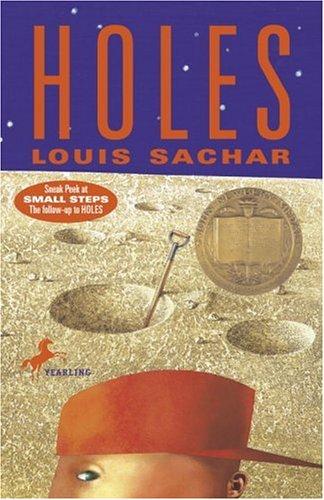
Holes
Farrar, Straus and Giroux · 1998 · 233 pages
ISBN: 9780440414803
Review Editor
Hannah Bright
Louis Sachar published Holes in August 1998, and within months it had swept up both the National Book Award for Young People’s Literature and, the following year, the Newbery Medal. For a middle-grade novel about boys digging holes in a Texas desert, those prizes might sound unlikely. They are not. Holes is one of those rare books that works on every level at once: as a mystery, as a comedy, as a folk tale, and as a quietly devastating critique of what adults do to children in the name of discipline.
The setup is deceptively simple. Stanley Yelnats IV (note the palindrome) is a chubby, friendless fourteen-year-old whose family blames all its misfortune on a “no-good-dirty-rotten-pig-stealing great-great-grandfather” who broke a promise to a fortune teller in Latvia. This curse has dogged the Yelnats men for generations, and now it drops Stanley into Camp Green Lake, a juvenile corrections facility in a barren Texas desert where there is, conspicuously, no lake. The boys at camp are told that digging one cylindrical hole five feet wide and five feet deep every day will build their character. Stanley suspects otherwise. So does the reader.
Sachar weaves three storylines through the novel: Stanley’s present-day ordeal at the camp; the story of his great-great-grandfather Elya in Latvia roughly a century and a half earlier; and the tragedy of Katherine “Kissing Kate” Barlow, a Green Lake schoolteacher who transforms into a notorious outlaw after the townsfolk murder the man she loves. These narratives spiral in on each other, and the way Sachar braids them together is the real engine of the book. Every detail placed early pays off. Every strange name carries weight. By the final chapters, the precision of the construction becomes genuinely thrilling.
Character Arcs and Development
Stanley begins the novel resigned to his own misfortune. He does not even protest his conviction for a crime he did not commit, because his family has always been unlucky, and being unlucky is what they do. What changes over the course of the book is not Stanley’s circumstances but Stanley himself. He grows physically, his body hardening from the daily digging. He grows in confidence. And, crucially, he grows in loyalty. The clearest sign of his transformation comes when he steals the camp warden’s truck to go looking for Zero, who has fled into the desert. That is not the act of a boy who sees himself as a victim of fate. It is the act of someone who has decided to matter.
Zero is the book’s great secret. Hector Zeroni is the smallest camper, assumed by everyone, including the counselors, to be unintelligent because he cannot read. He communicates mostly in silence and keeps his guard up. But Sachar gives Zero the keenest mind in the novel. He figures things out before Stanley does. He makes choices, some of them violent and calculated, that surprise everyone. His backstory, revealed gradually, reframes everything that came before it. The novel never lets you forget that the cruelest thing about Camp Green Lake is that the adults in charge have already decided these boys’ lives are written.
Katherine Barlow deserves a novel of her own. Her story, which occupies several chapters set in 1880s Green Lake, moves from sweetness (spiced peaches, adult literacy classes by lantern light) to devastation with a speed that makes it genuinely sorrowful. She and Sam the onion man are drawn with care and specificity, and the racism that destroys them does not feel like a lesson. It feels like a wound. The shift in Kate from teacher to outlaw is not a corruption of character. It is a logical response to an unjust world, and Sachar handles it without a drop of sentimentality.
Pacing
The book moves. The chapters are short, often just two or three pages, and Sachar cuts between timelines at exactly the right moments. The desert chapters operate under steady pressure: the heat, the aching arms, the Warden’s presence overhead like a weather system. The Latvia and 1880s Green Lake flashbacks arrive as relief and also as complication, each one dropping another piece into a puzzle whose shape the reader cannot yet make out.
The middle section, after Zero runs away and before Stanley follows him into the desert, is the stretch where the book comes closest to feeling slow. The daily routine at camp becomes numbing by design, which is thematically right but tests patience. Sachar wants you to feel that monotony, the same hole every day, the same sun, the same meager canteen of water. When Stanley finally breaks from that routine, the momentum surges and does not let go until the last page. The final chapters are as tightly assembled as anything in middle-grade fiction. Everything clicks into place, and the pleasure of it is almost architectural: you see at last how every load-bearing piece was placed exactly where it needed to be.
Deeper Thematic Exploration
The deepest thing Holes is about is the relationship between history and the present, specifically the way injustice compounds across generations. Sam is killed in 1888 because he loved the wrong woman and had the wrong skin color. That murder causes Kate to become an outlaw, which causes the Yelnats family to lose its fortune, which eventually leads to Stanley sitting in a courtroom after being wrongly convicted of stealing shoes. The chain of causation is long, absurd, and structurally real. Sachar presents it all with a light enough touch that younger readers can enjoy the plot machinery while the book’s argument about inherited consequence quietly does its work.
The novel also takes labor seriously in a way that children’s fiction rarely does. The boys at Camp Green Lake perform backbreaking physical work, in scorching heat, with inadequate water. This is presented simultaneously as punishment, as character-building, and as exploitation, depending on who is speaking. The Warden believes in the work’s purpose because she needs the holes dug. The boys understand it as punishment. And the reader understands it as labor extracted under coercion from people who cannot refuse. The fact that all three readings are available at the same time is what makes the camp feel like a real place and not a metaphor.
The novel’s treatment of friendship is unusual too. Stanley and Zero’s alliance grows out of mutual need: Stanley needs someone to help dig his hole; Zero needs to learn to read. The arrangement is transactional, and both boys know it. What becomes clear slowly is that the transaction has become something else: the first real friendship either boy has had, built on honesty that only comes from shared hardship. When Stanley carries Zero up the mountain, it is not presented as heroic. It is presented as necessary. That unsentimental quality is what makes the friendship convincing, and what makes the ending feel earned rather than arranged.
Style and Voice
Sachar writes in clean, declarative sentences. “There is no lake at Camp Green Lake” is his register exactly: flat, ironic, information-bearing. He never explains his jokes and never over-explains his sadness. The narrator’s voice is omniscient but restrained, dropping into characters’ heads without commentary, trusting readers to feel what is not spelled out for them.
The novel reads faster than its page count suggests. Short chapters, varied timeline, and the near-total absence of elaborate description create something that moves more like a thriller than like most middle-grade fiction. But Sachar earns real moments of stillness too: Stanley watching Zero shrink into the desert heat, Kate laughing as the lizard bites her. These scenes work because they are surrounded by so much motion. The recurring motifs, the lullaby Elya learns from Madame Zeroni, Sam’s onions, the palindromic names, feel organic rather than labored because they always operate first as plot. The song is a lullaby before it is a curse-breaker. The onions feed people before they repel lizards. Sachar builds meaning from the bottom up, not the top down.
Verdict
Holes is the right book to give a middle schooler who has decided they do not like reading. It is also the right book to give an adult who wants to be reminded that children’s fiction can be formally inventive and morally serious at the same time. The novel’s greatest achievement is structural: three stories spanning more than a hundred and fifty years, all converging in a single night in a dried-up lakebed in Texas, with not a single thread that does not need to be there.
Its one genuine weakness is that several of the camp boys, Magnet, Zigzag, Squid, remain sketched rather than fully drawn. They serve their function in the story, but Zero’s richly developed interior life makes their thinness visible by comparison. This is a small complaint about a book that accomplishes nearly everything it attempts. If you read it as a child and remember it fondly, rereading it as an adult will probably surprise you: the jokes are darker, the justice more complicated, the racism in the Kate Barlow chapters more unsettling. And if you have never read it, start on a Thursday afternoon. You will probably finish by Sunday.
Frequently Asked Questions about Holes
What is Holes by Louis Sachar about?
Holes follows Stanley Yelnats IV, a fourteen-year-old wrongly convicted of stealing a pair of shoes, who is sentenced to a juvenile corrections facility called Camp Green Lake in the Texas desert. There is no lake. Every day the boys dig a five-foot hole, supposedly to build character, though Stanley slowly realizes the warden is looking for something buried underground. The novel weaves Stanley’s story together with two others: his great-great-grandfather’s broken promise in nineteenth-century Latvia and the tale of a schoolteacher who became an outlaw after the town murdered the man she loved.
Did Holes by Louis Sachar win any awards?
Yes, several major ones. Holes won the Newbery Medal in 1999 for “the most distinguished contribution to American literature for children” and the National Book Award for Young People’s Literature in 1998. It also won the Boston Globe-Horn Book Award for Fiction and the American Library Association’s Best Books for Young Adults designation. In 2012, School Library Journal ranked it the sixth-best children’s novel of all time.
What are the main themes in Holes by Louis Sachar?
The book explores how injustice compounds across generations: a racist murder in 1888 eventually lands an innocent boy in a desert prison a century later. Sachar also examines the exploitation of youth labor, the way names and identity shape how people see themselves, and the nature of real friendship versus transactional alliances. Underneath all of it is a folk tale logic: curses, promises, and the idea that breaking a cycle requires someone to finally do the thing that was left undone.
How long is Holes and is it a difficult read?
Holes is 233 pages in the standard Dell Yearling paperback edition and reads quickly because Sachar keeps his chapters short and his sentences plain. Most adult readers finish it in two or three sittings. The reading level targets grades 4 through 7, and the vocabulary is accessible, but the multiple interweaving timelines require a reader who can hold several threads at once. Younger children who are strong readers can handle it comfortably; it rewards attention without punishing any lack of it.
Is there a movie or TV adaptation of Holes?
Walt Disney Pictures released a film version of Holes in 2003, directed by Andrew Davis and written by Sachar himself, who also has a brief cameo. The film received generally positive reviews and was commercially successful, with Shia LaBeouf, Sigourney Weaver, and Jon Voight in key roles. A Disney+ television series pilot was ordered in January 2025 with a female-led reimagining, but Disney announced in December 2025 that it would not move forward with the project.
What age is Holes appropriate for?
The book is generally recommended for readers aged 9 to 14, which maps roughly to grades 4 through 8. It has no explicit content, but it does contain racism depicted directly (the murder of Sam in the 1880s storyline), physical abuse at a juvenile detention facility, and the death of several characters. Parents of sensitive younger readers may want to read alongside them. Most teachers and librarians recommend it as a classroom novel for grades 5 and 6, and many adults who encounter it for the first time find it completely absorbing.
How does Holes compare to Louis Sachar’s other books?
Most of Sachar’s other work is lighter in tone: the Wayside School series, which made his reputation before Holes, is surrealist comic fiction aimed at younger readers. Holes is widely considered his most ambitious and formally complex novel, and Sachar himself has acknowledged it as an outlier in his catalog. The 2006 follow-up Small Steps returns to one of the secondary characters from Holes, Armpit, and is a solid companion piece, but it does not have the same structural ambition. Holes remains the book that people mean when they talk about Sachar.
Should I read Holes and is it worth it?
Yes, and it works at nearly any age. For younger readers, it delivers a fast-moving mystery with memorable characters and satisfying payoffs. For adult readers, the same story reveals itself as a carefully constructed argument about generational injustice, racial violence, and what it costs a child to be failed by every adult in the room. The book manages to be genuinely funny and quietly heartbreaking at the same time, and the architecture of its three interlocking plots is something you can only fully appreciate once you have read to the end and looked back at the beginning. It earns every prize it won.
Book Details
- Title
- Holes
- Author
- Louis Sachar
- Genre
- Children's
- Publisher
- Farrar, Straus and Giroux
- Year Published
- 1998
- Pages
- 233
- ISBN
- 9780440414803
- WritersReview Rating
- 4.5 / 5