
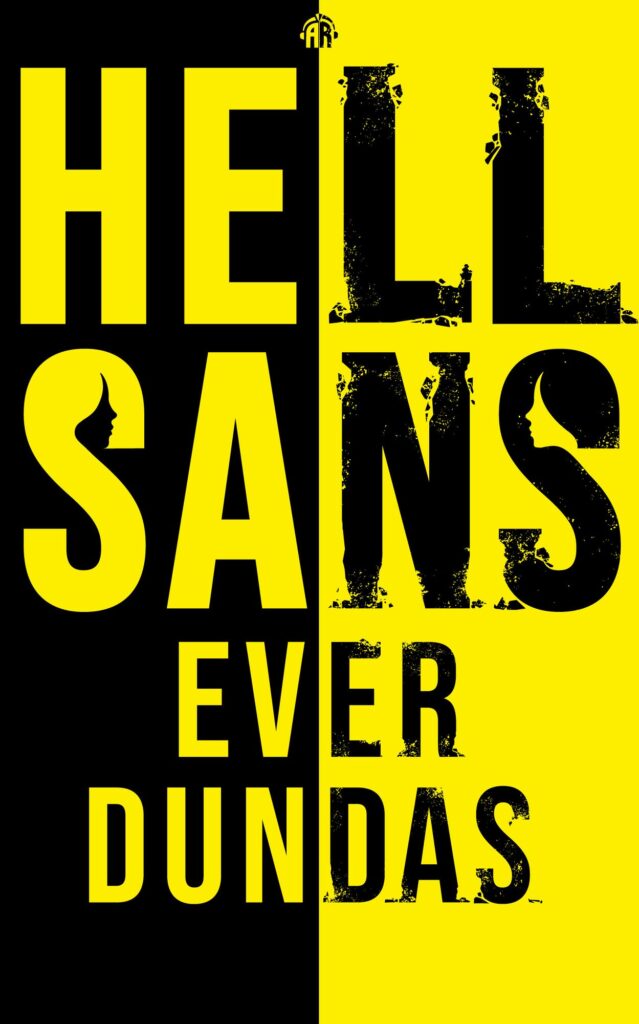
The Font of All Authority
Ever Dundas’s debut novel HellSans is a work of sustained invention. Published in 2022 by Solaris, it imagines a near-future United Kingdom in which a single typeface, HellSans, has been enshrined as the national standard, enforced by law in all public communications and spaces, and capable of inducing a state of euphoric compliance in the majority of those who see it. The minority who are physiologically allergic to the font, known as the HellSans Allergic or HSAs, are persecuted, stripped of their social standing, and confined to a ghetto at the edges of the capital. Against this premise, Dundas builds a story of surveillance capitalism, bodily autonomy, and radical solidarity, delivered through two protagonists whose trajectories form a collision course. The result is one of the most formally adventurous and politically urgent debut novels in recent British science fiction.
To call HellSans a satire is accurate but incomplete. The book operates with the visceral force of body horror as much as it does with the distancing wit of satire. When Jane Ward, the CEO of the company that manufactures the Inex, a cyborg doll-like creature that has supplanted the smartphone as the essential personal accessory, falls ill with the allergy, her transformation from a woman who has benefited from the system to one being crushed by it is rendered in physical and psychological detail that never allows the reader to treat the persecution as merely metaphorical. These are bodies in distress, and Dundas does not let you forget it.
Plot and Structure
HellSans is told in three parts, with a notable formal innovation: the first two parts follow Jane Ward and Icho Smith respectively, and they are designed to be read in either order. Jane is the Inex executive who becomes an HSA; Icho is a scientist who has developed a cure for the allergy and is now a fugitive, hunted by both the government and a ghetto resistance group called the Seraphs. The third part brings their stories together in the revolutionary conclusion Dundas has been building toward.
This reading order choice is not a mere gimmick. It is structural argument: the experience of the novel shifts depending on which protagonist you encounter first, and the worldbuilding lands differently depending on whether you approach it from the perspective of privilege or of the persecuted. Readers who begin with Jane gain one understanding of the Inex, of HellSans compliance, of the HSA ghetto; readers who begin with Icho gain another. Both are partial, and both are true. By the time the third part fuses these perspectives, the novel has demonstrated in practice the impossibility of any single authoritative account of a divided society.
Character and Voice
Jane Ward is not, at the start of the novel, a sympathetic figure in any conventional sense. She is successful, complacent, and entirely embedded in the systems of control that are oppressing others. Her fall into HSA status could be written as a simple moral tale about privilege and consequence, but Dundas is a more exacting writer than that. Jane’s radicalisation is uneven, interrupted by self-interest, and complicated by her past, and the novel is honest about the ways in which someone can understand injustice intellectually while still resisting it emotionally when that injustice reaches them personally.
Icho Smith provides a counterpoint. She has been outside the system of HellSans privilege for longer, and her scientific project, a cure for the allergy, has made her a target for multiple factions who each want to control what that cure means. Icho is formidable and morally clear in ways that Jane is not, but Dundas gives her vulnerabilities too, and the scenes in which these two very different women finally share space crackle with tension and mutual incomprehension that slowly, painfully, becomes something else. The supporting cast, including Seraphs, government agents, and Inex units, fills out a world that feels uncomfortably plausible.
Themes and Ideas
Typography as a mechanism of social control is an idea so specific and strange that it requires a novelist of genuine confidence to execute, and Dundas earns every page of the premise. HellSans functions in the novel as all dominant technologies function in the real world: it is so thoroughly normalised that questioning it reads as pathology. The fact that some bodies cannot tolerate it without pain is not treated as evidence that the technology should be reconsidered; instead, those bodies are treated as defective. The parallel with disability, with queerness, with any form of embodied difference that makes a person incompatible with a normative system, is clear without being laboured.
The Inex is a companion technology that adds another layer: a cyborg doll that people carry everywhere, that knows them better than they know themselves, and that reinforces the HellSans world by providing constant, intimate reinforcement of its values. Dundas writes this technology with the sharp eye of someone who has thought hard about what smartphones are doing to human selfhood, and the Inex sections carry a particular kind of dread. The novel is also a story about resistance movements and their fractures: the Seraphs are not uncomplicated heroes, and HellSans is interested in what movements lose when they become too focused on the strategic value of the cure rather than the welfare of the people who need it.
Narrative Craft
Dundas writes with pace and physicality. The prose does not linger in abstraction; even when the novel is making its most political arguments, it does so through the texture of lived experience: what it feels like to have your skin react to a font on a billboard, what it costs to move through a city that has been designed to hurt you. The structure is bold but never showy. The reading order choice earns its place because Dundas has written two first parts that are genuinely different in register and perspective, not just in plot, and the third part synthesises them without merely resolving the tension they generate.
For a debut, HellSans shows remarkable control. There are moments when the allegory sits slightly close to the surface, but they are rare, and they are quickly overtaken by the specificity of what Dundas is imagining. The novel’s violence, when it comes, lands with weight because the book has done the work of making its characters real before it puts them in danger. This is science fiction that treats its genre’s toolkit with genuine seriousness, a novel that uses the speculative to illuminate things about the present that realist fiction would struggle to hold.
Final Verdict
HellSans is an accomplished, politically charged debut that uses an audacious premise to serious purpose. Ever Dundas brings a sharp intelligence to questions of bodily difference, institutional power, and the mechanics of compliance, and wraps them in a narrative with genuine momentum. The formal innovation of its reading structure is matched by the quality of the writing and the depth of its characterisation. For readers who want science fiction that makes them uncomfortable in productive ways, that takes the speculative seriously as a mode of social criticism, HellSans is essential reading. One of the most impressive British science fiction debuts of recent years.
What is HellSans?
HellSans is a typeface that has been made the legally enforced standard in all public communications in the novel’s fictional United Kingdom. The majority of people experience a state of blissful compliance when exposed to it; a minority, the HellSans Allergic (HSAs), have a painful physical reaction. The font operates as the novel’s central metaphor for normative systems that sort populations into compliant and deviant.
Who are the two main protagonists?
The novel follows Jane Ward, the CEO of the company that manufactures the Inex, and Dr Icho Smith, a scientist who has developed a cure for the HellSans allergy. Jane becomes an HSA and loses her wealth and status; Icho is on the run from multiple factions who want to control her cure. Their stories converge in the novel’s third part.
What is the Inex?
The Inex is a cyborg doll-like creature that functions as the primary personal technology in the novel’s world, having replaced the smartphone as the essential personal accessory. It is manufactured by Jane Ward’s company and is deeply integrated into how people relate to the HellSans world. Dundas uses the Inex to explore ideas about technological intimacy and social conformity.
Can you really read the first two parts in either order?
Yes. The novel is explicitly designed so that parts one and two, which follow Jane and Icho respectively, can be read in either order. This is a deliberate structural choice: the experience of the book changes depending on which perspective you encounter first, and Dundas uses this to make an argument about how position shapes understanding of the same social reality.
What are the Seraphs?
The Seraphs are a resistance group operating in the HSA ghetto. They are one of several factions interested in Icho’s cure, but not for purely altruistic reasons. Dundas treats them as a complex organisation with internal divisions, and the novel is critical of how resistance movements can replicate the dehumanising logics of the systems they oppose.
Is HellSans a difficult read?
HellSans deals with persecution, violence, and body horror, and readers who are sensitive to these themes should be aware of them. However, the novel is also propulsively plotted and not gratuitously dark. Its difficulty is moral and political rather than purely visceral. It is challenging in the ways that good speculative fiction should be challenging.
What was the critical reception to HellSans?
HellSans received strong critical attention on publication. It was praised as “speculative fiction at its best: political, fearless, smart, badass,” described as “a dark and clever sci-fi social satire,” and noted as “the best debut fiction by a Scottish author since 2012” by multiple reviewers. Its distinctive premise and formal innovation attracted significant attention in science fiction circles.
Who should read HellSans?
HellSans is ideal for readers who enjoy dystopian fiction with serious social and political ambitions, body horror, and formally innovative structures. Fans of authors like Naomi Alderman, Nnedi Okofor, and Kameron Hurley will find much to admire. It is particularly well suited to readers interested in how science fiction can use the speculative to make visible the mechanisms of real-world oppression.
Book Details
- Title
- HellSans
- Author
- Ever Dundas
- Genre
- Science Fiction
- Publisher
- Solaris
- Year Published
- 2022
- Pages
- 456
- ISBN
- 9781915202215
- WritersReview Rating
- 5.0 / 5