
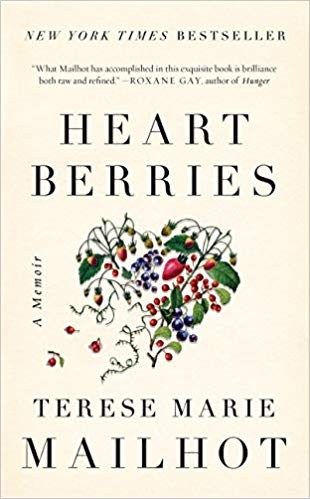
Heart Berries: A Memoir, published by Counterpoint Press in 2018, is the kind of book that arrives without much warning and changes what you thought a memoir could do. Terese Marie Mailhot wrote it while receiving treatment for PTSD and bipolar disorder at a psychiatric facility, drafting it first as letters to her therapist, then as something that grew beyond that origin into a formally unprecedented piece of literary witness. The subject is her life: growing up on the Seabird Island Band Reserve in British Columbia, the poverty and violence of her childhood, her relationship with her father who died when she was eleven, her mother’s own struggles and disappearances, her years of addiction and precarious living, and the love affair with a writer named Casey that both sustains her and nearly breaks her. What makes Heart Berries remarkable is not its subject matter, which is harrowing, but its form: Mailhot writes in a style that is compressed, elliptical, and internally associative in ways that bear no resemblance to the chronological narrative arc that most memoirs deploy.
The book runs just over 100 pages, and those pages carry more weight per sentence than most 400-page memoirs. Mailhot does not explain herself to readers who lack the context to understand her experience; she writes for an imagined reader who will meet her where she is or not at all. This is not a book that makes Indigenous experience legible for a settler audience in the ways that settler publishing often implicitly demands. It is a book that insists on its own terms, written in a voice that is formally innovative in ways that grow directly from the specific experience of a woman who learned early that conventional narrative – the kind that moves from wound to understanding to resolution – was not made for her.
Heart Berries won the American Book Award and was a finalist for the Governor General’s Literary Award for English-language non-fiction. It was named a New York Times Notable Book and appeared widely on Best Books of 2018 lists. The 2018 Meridian Award for Biography and Memoir recognizes a work that transformed its genre: one of the most formally innovative Indigenous memoirs of the contemporary period and one of the most honest accounts of mental illness, love, and survival in recent literary nonfiction.
Subject and Voice
The subject of Heart Berries is Mailhot’s life, but the organizing principle is not chronology. The book moves by association, by the logic of trauma memory – which does not store experience in neat sequence but in clusters of sensation and feeling that surface according to their own laws. Mailhot’s childhood on Seabird Island comes to the reader in fragments: the fact of her father’s death, the shape of her mother’s absence, the particular texture of poverty on a reserve in British Columbia, the violence that moved through her early life as a constant background condition. These are not rendered as scenes in the standard memoir sense – set up, described, reflected upon. They are stated, felt, and released, the way memory actually works.
Her relationship with Casey runs through the book as its animating tension. Casey is a white writer who loves Mailhot but cannot always hold the weight of what she carries; the relationship is described with a precision that is neither romantic nor bitter but honest about the specific difficulties of loving someone whose pain history you can acknowledge but not fully inhabit. Mailhot writes about this with no self-pity and no blame. She is interested in what is true, not in casting either herself or Casey as hero or villain.
The voice is the most extraordinary thing about the book. Mailhot writes in a style that is elliptical and aphoristic, full of sentences that have the quality of stones: dense, specific, hard-edged. She does not use transitional language to guide the reader between thoughts. She does not smooth the rough edges of her experience into something more comfortable. The result is a prose style unlike anything else in contemporary memoir, and it is not a stylistic choice imposed on the material from outside; it grows from the experience itself, from the specific way this particular mind processes what happened to it.
Narrative Drive
For a book with no conventional plot in the thriller sense, Heart Berries is extraordinarily hard to put down. This is partly because Mailhot’s sentences are so compelling that you read forward to find the next one. But it is also because the book has a structure beneath its apparent fragmentation: each section accumulates weight that the next section detonates. You are always reading toward something, even when you cannot quite name what. The formal unpredictability – you never know if the next section will be addressed to Casey, to Mailhot’s dead father, to a therapist, to the reader, or to no one identifiable – creates a sustained alertness in the reader that a more conventional memoir structure would not.
The book’s brevity is also a form of narrative drive. At just over 100 pages, it does not give you time to relax your attention. Every sentence is doing work. Mailhot does not pad or repeat. The effect is of sustained intensity at a pitch that a longer book could not maintain, and which the subject matter – PTSD, grief, poverty, love, the particular conditions of life on a reserve – demands. A 300-page version of this book would be a lesser book. The form is the argument.
Thematic Depth
The book’s deepest subject is what Mailhot calls “Indian condition” – a phrase she uses to describe the particular quality of dispossession, grief, and resilience that marks life in Indigenous communities that have been systematically devastated by colonial policy. She does not deploy this phrase as a sociological explanation. She deploys it as a lived reality that she is trying to articulate from the inside, without the distance that sociological language would impose. This is a memoir that refuses to make Indigenous experience available for outside consumption by softening it, contextualizing it, or making it legible through the frameworks that dominant culture provides.
Mental illness runs through the book as one of its central preoccupations, but Mailhot does not treat her PTSD and bipolar disorder as simply clinical conditions. They are also the legible symptoms of specific historical violences: the violence done to her family, to her community, to the land and culture that shaped her. She does not separate the personal from the political in the way that Western therapeutic culture often demands. The body that carries the trauma is also the body that carries history, and the two cannot be disentangled without doing violence to both.
Love, and its specific difficulties across lines of race and trauma history, is the third major preoccupation. The relationship with Casey is rendered with extraordinary honesty: the ways it sustains her, the ways it fails her, the ways her own history makes her both more demanding and more guarded than the relationship can easily hold. Mailhot is interested in love not as salvation but as territory – something to be navigated with whatever tools you have, knowing that your tools are incomplete and your maps are wrong.
Style and Voice
Mailhot’s prose style is the book’s most distinctive and most discussed feature, and it deserves to be. Her sentences are short, declarative, and percussive. They do not build toward conclusions; they deliver them whole. Her paragraphs do not develop arguments; they accumulate evidence for emotional truths that she states directly when she states them at all. The writing bears some resemblance to the lyric essay tradition – it has the associative logic and the tolerance for fragment that characterize that form – but it is not quite that either. It is something Mailhot made out of her own necessity, shaped by the fact that she was writing in a psychiatric facility, in sessions limited by circumstance, with no time for the kind of deliberate construction that traditional memoir requires.
The effect is of writing that is both raw and controlled, which sounds like a paradox but is not. Mailhot is in full control of what she reveals and how; the rawness is not the rawness of unprocessed experience but the rawness of experience processed through an intelligence that refuses protective distance. Some of the book’s most powerful sentences are also its most understated, and the understatement is where the power lives. She earned every word through the specific difficulty of the life she is describing, and the prose carries that weight without calling attention to it.
Verdict
Heart Berries is one of those rare books that changes the reader rather than simply informing them. It does not offer the comfort of narrative resolution or the reassurance of hard-won wisdom packaged in accessible form. What it offers is something rarer: a voice that has worked out, through great effort and suffering, how to tell the truth about its own experience without flinching and without performing the flinching for an audience. Readers looking for the conventional memoir arc – wound, struggle, healing, growth – will not find it here, and that is not a limitation but an achievement. This is a book for readers willing to be uncomfortable, to be uncertain, to hold the complexity of a life that does not resolve. Those readers will find it indispensable.
Frequently Asked Questions about Heart Berries
What is Heart Berries: A Memoir about?
Heart Berries is Terese Marie Mailhot’s memoir about growing up on the Seabird Island Band Reserve in British Columbia, the violence and poverty of her childhood, the loss of her father at age eleven, her years of addiction and difficult living, and the love affair that both sustains her and strains her while she is receiving treatment for PTSD and bipolar disorder. The book is not structured chronologically. It moves by association and by the logic of trauma memory, written in a formally innovative style that sets it apart from conventional memoir.
Who is Terese Marie Mailhot?
Terese Marie Mailhot is a writer and professor from the Seabird Island Band in British Columbia. She wrote Heart Berries while receiving inpatient psychiatric treatment, originally drafting sections as letters to her therapist. Before the memoir’s publication she had published essays and fiction in various literary journals. Heart Berries became her breakthrough work, winning the American Book Award, receiving widespread critical acclaim, and establishing her as one of the most important voices in contemporary Indigenous literature and literary nonfiction. She has since taught creative writing at several universities.
What makes Heart Berries formally innovative?
The book abandons the chronological narrative arc that most memoirs use, instead organizing itself by emotional association and the specific logic of traumatic memory. Sections shift without transition from past to present, from direct address to Casey to address to the reader, from personal history to cultural history to psychiatric observation. The prose style itself – compressed, aphoristic, refusing explanation and contextual framing – is unlike most memoir prose. Mailhot does not guide the reader through the experience; she drops the reader into it and trusts them to orient. This formal choice is not arbitrary; it grows directly from the specific experience of writing while in psychiatric treatment, under conditions that precluded leisurely construction.
How does Heart Berries handle Indigenous identity and experience?
The book handles Indigenous identity and experience from the inside, without the contextualizing or translating frame that much writing about Indigenous communities directed at mainstream audiences employs. Mailhot does not explain her community’s history for readers unfamiliar with it; she describes her experience of living within and shaped by that history. The concept she calls “Indian condition” – the specific texture of dispossession, grief, and resilience that marks life in communities devastated by colonial policy – is stated as a lived reality rather than as a sociological category. This approach may require some readers to do additional research on their own; the book does not apologize for that requirement.
What awards did Heart Berries win?
Heart Berries won the American Book Award and was a finalist for the Governor General’s Literary Award for English-language non-fiction, Canada’s most prestigious literary prize. It was named a New York Times Notable Book and received the 2018 WritersReview Meridian Award for Biography and Memoir, recognizing it as one of the most formally innovative and emotionally significant Indigenous memoirs of the decade. It appeared on numerous Best Books of 2018 lists in both the United States and Canada and has been widely taught in university courses in creative nonfiction, Indigenous literature, and memoir.
Is Heart Berries difficult to read?
The book is demanding in two distinct ways. Its form – the associative structure, the lack of transitional explanation, the compressed prose style – requires sustained active reading. You cannot skim or half-read; the density of the writing means that missed sentences are missed meanings. Its subject matter is also difficult: PTSD, childhood violence and poverty, addiction, and the specific grief of growing up in a community that has been systematically harmed. Neither difficulty is gratuitous. Both are integral to what the book is and what it achieves. Readers who accept both demands will find the book one of the most powerful reading experiences in recent literary nonfiction.
How long is Heart Berries?
The Counterpoint Press edition runs just over 100 pages, making it one of the shorter memoirs in recent literary publication. That brevity is itself a formal choice: Mailhot wrote under conditions that made compression necessary, and the result is a book whose density per page far exceeds what most memoirs achieve. Most readers will finish it in a single sitting of two to three hours, but the reading experience is intense enough that many will want to pause and return to sections. It is not a book that benefits from being rushed.
Who should read Heart Berries?
Anyone seriously interested in contemporary literary memoir should read Heart Berries. Anyone interested in Indigenous literature, in the formal possibilities of creative nonfiction, or in writing about mental illness and trauma that refuses the therapeutic arc should read it. It is required reading for writers working in the lyric essay or experimental memoir tradition, and it should be on any syllabus that takes seriously the literature of marginalized communities in North America. It is not a comfortable book, and it is not intended to be. It is intended to be true, and on that measure it succeeds completely.
Book Details
- Title
- Heart Berries
- Genre
- Biography
- WritersReview Rating
- 5.0 / 5