
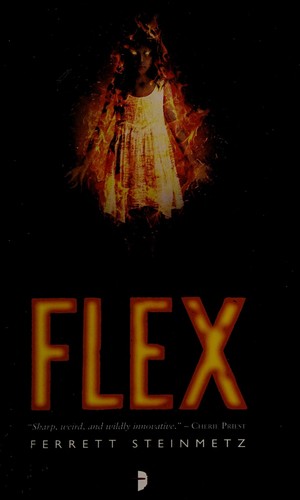
Paul Tsabo is not the kind of person you would expect to save the world. He is an insurance adjuster in an alternate New York where people whose obsessions burn hot enough can reshape reality. These people are called ‘mancers, and their magic is illegal. Paul has a daughter with severe burns, a prosthetic foot, and a deep, romantic love of paperwork. He has spent years tracking ‘mancers for the government, trying to understand what drove them to power and what destroyed them. When his daughter Aliyah is caught in the crossfire of a ‘mancer battle and nearly killed, Paul discovers that he too has the gift: he is a Bureaucromancer, and he can work miracles through forms in triplicate.
Flex is the debut novel of Ferrett Steinmetz, published by Angry Robot in March 2015, and it is the first volume in the ‘Mancer trilogy. It is one of those books that sounds ridiculous in a pitch and then turns out to be something genuinely moving. The magic system is built on obsession: whatever you love most becomes the lens through which you channel power. A gamer can reshape probability. A chef can weaponize food. A bureaucrat can make the impossible happen if he fills out the right form. The conceit is comic, but Steinmetz plays it straight, and the result is a novel with real emotional stakes buried under a very entertaining premise.
The title refers to a crystallized form of ‘mancer magic that can be consumed like a drug, giving ordinary people a temporary hit of reality-bending power. It is addictive, destructive, and the source of most of the plot’s forward motion.
Character Arcs and Development
Paul is an excellent protagonist precisely because he is not built for heroism. His power is paperwork. His instinct is to de-escalate. His primary motivation throughout the novel is not to defeat evil or become powerful but to keep his daughter safe and, where possible, to repair the damage ‘mancers cause to ordinary people. This makes him unusually sympathetic for an urban fantasy lead. He is not cool. He is not magnetic. He is a worried father who happens to be able to bend bureaucratic reality, and watching him figure out how to use that in a fight is consistently satisfying.
Aliyah, his daughter, is written with unusual care. Child characters in adult fiction often exist purely to motivate the adult protagonist, but Aliyah has her own personality: stubborn, video-game-obsessed, already showing the seeds of her own obsessive tendencies. The scenes between father and daughter carry genuine warmth without becoming sentimental. Their relationship is the emotional core of the book, and it holds.
The antagonist, a ‘mancer who has gone fully off the rails, is less developed, functioning more as a force of nature than a character. This is a recurring limitation in the novel: the world is rich, Paul and Aliyah are vivid, but the supporting cast tends to fade into function. Valentine, a Videogamemancer who becomes Paul’s reluctant ally, is a partial exception. She is loud, impulsive, and genuinely funny, and her dynamic with the careful, cautious Paul generates most of the book’s best comic moments.
Pacing
Flex moves quickly. Steinmetz is not a writer who lingers. The novel establishes its world and magic system efficiently in the opening chapters, and once the plot kicks in, it rarely slows down. The action sequences are imaginatively staged: battles between ‘mancers are essentially contests between competing obsessions, which means a fight can involve anything from paperwork avalanches to video game logic being imposed on physical reality. These scenes are inventive and fun, if occasionally hard to visualize precisely.
The pacing does create some problems. Secondary characters are introduced and then not developed enough for their later story beats to land with full force. The romance subplot feels slightly rushed. And the final act, while exciting, resolves certain threads a little too cleanly. Steinmetz is clearly building toward the rest of the trilogy, and there are moments where the setup for future books comes at the expense of full closure in this one. For a debut novel, though, the pacing is confident and the story never drags.
Deeper Thematic Exploration
The novel’s central metaphor is both playful and pointed. Magic in this world is not a gift: it is the product of obsession so consuming that it crowds out ordinary human connection. Every ‘mancer is at risk of what the book calls “flux,” a catastrophic reality-backlash that punishes magical excess, and the only way to avoid it is to channel your obsession responsibly. Paul’s bureaucratic magic is interesting precisely because it forces him to work within systems rather than around them: his power is about process, documentation, and accountability, which makes him a fundamentally different kind of ‘mancer than the chaos-embracing outlaws he usually hunts.
There is a thread running through the book about what it costs to be exceptional. Every ‘mancer has sacrificed normal social functioning for their power. They love their obsession more than they love most people. Paul is unusual because he found his obsession through love for his daughter rather than despite it, and the novel uses this to ask whether power can be wielded responsibly when it grows from care rather than compulsion. The answer is not simple, and Steinmetz deserves credit for not pretending it is.
The “Flex” drug subplot also functions as a pointed commentary on how power and addiction intersect, and how systems designed to exploit human desire create wider damage. It is not subtle, but it does not need to be.
Style and Voice
Steinmetz writes with energy and humor. The prose is punchy, the dialogue is sharp, and he has a gift for comic timing that keeps even the darkest scenes from becoming oppressive. The first-person narration puts you firmly inside Paul’s anxious, over-analytical head, which works well for a character whose magic is literally powered by analytical thinking.
The worldbuilding is delivered efficiently. Steinmetz does not dump exposition: he lets the magic system reveal itself through action, and the reader picks up the rules as Paul does, through trial and consequence. This approach trusts the reader and keeps the opening chapters from becoming a lecture. A few concepts require multiple encounters to fully grasp, but that is a minor complaint about a debut novel with a genuinely unusual magic system.
Verdict
Flex is one of the more original urban fantasy debuts of the last decade. The magic system is inventive, the father-daughter relationship is genuinely touching, and Steinmetz has a voice that is hard to confuse with anyone else in the genre. If you read fantasy for the joy of a writer fully committed to a strange premise, this book delivers.
Its weaknesses are mostly those of a first novel: supporting characters who need more page time, a romance that could use more development, and an ending that gestures at future volumes a little too openly. But these are the kinds of flaws you forgive in a book this much fun. If you enjoy urban fantasy that takes its magic systems seriously while keeping its sense of humor intact, Flex belongs on your list. The sequels, The Flex and Fix, are both worth continuing with.
Frequently Asked Questions about Flex
What is Flex by Ferrett Steinmetz about?
Flex follows Paul Tsabo, an insurance adjuster in an alternate New York where people whose obsessions burn hot enough can reshape reality. When his daughter is caught in magical crossfire and nearly killed, Paul discovers he is a Bureaucromancer, capable of working miracles through paperwork. He must navigate the underground world of illegal magic users to protect his daughter and deal with a crystallized magic drug called Flex that is spreading through the city.
Is Flex by Ferrett Steinmetz part of a series?
Yes. Flex is the first book in the ‘Mancer trilogy. It is followed by The Flux (2015) and Fix (2016), both published by Angry Robot. The trilogy follows Paul and Aliyah across three novels as the consequences of their magical lives escalate. You should read them in order, as each book builds directly on the events of the previous one.
What are the main themes in Flex?
The novel explores obsession as both a creative force and a destructive one, the tension between working within systems and burning them down, and the lengths a parent will go to protect a child. It also examines how power and addiction are intertwined, and what it costs socially and personally to be exceptional in a way the world does not understand or approve of.
How long is Flex and is it a difficult read?
Flex is 429 pages and reads quickly. The prose is punchy and the pacing is fast, with action scenes arriving regularly. The magic system requires some attention to follow, but Steinmetz explains it through action rather than exposition, so it does not feel like homework. Most readers comfortable with urban fantasy will find it accessible and entertaining.
What makes the magic system in Flex unique?
Magic in Flex is powered by obsession. Whatever a person loves most intensely becomes the source of their power. A gamer can manipulate probability like a video game. A chef can weaponize food. Paul, who is obsessed with paperwork and process, can reshape reality through bureaucratic documentation. The catch is that using magic creates “flux,” a reality-backlash that must be managed carefully or it causes catastrophic damage to the world around you.
Is Flex appropriate for younger readers?
Flex is written for adult readers. It contains violence, some adult themes, and a subplot involving a magic drug trade. The tone is often comic, but the content and emotional complexity are aimed at adults. Older teenagers who regularly read adult fantasy would likely handle it without difficulty, but it is not a young adult novel.
How does Flex compare to other urban fantasy novels?
Flex occupies an unusual niche. It has the alternate-New York setting and magic-in-the-real-world premise common to urban fantasy, but the magic system is more systematically developed than most genre entries, and the emotional center, a father’s love for his damaged daughter, is more grounded and less romantic than the typical urban fantasy protagonist dynamic. Readers who enjoyed Jim Butcher’s Dresden Files or Ben Aaronovitch’s Rivers of London will find familiar pleasures here alongside genuinely original ideas.
Should I read Flex?
If you enjoy urban fantasy with a genuinely original magic system, a protagonist who is more worried dad than action hero, and a writer who commits fully to a comic premise while taking the emotional stakes seriously, Flex is worth your time. It is not a perfect debut, but it is a memorable one, and the father-daughter relationship at its core gives the book real weight beneath the fun.
Book Details
- Title
- Flex
- Author
- Ferrett Steinmetz
- Genre
- Science Fiction
- Publisher
- Angry Robot
- Year Published
- 2015
- Pages
- 429
- ISBN
- 9780857664594
- WritersReview Rating
- 3.9 / 5