
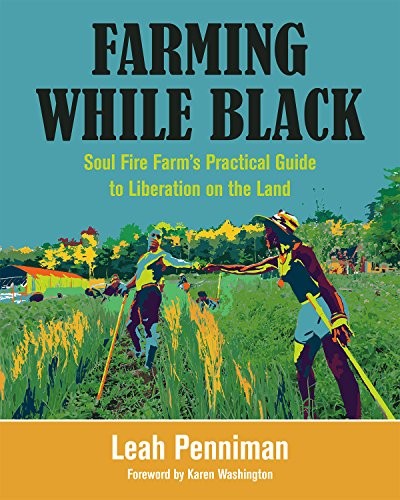
Farming While Black: Soul Fire Farm’s Practical Guide to Liberation on the Land arrived in 2018 from Chelsea Green Publishing and immediately occupied a category of its own. Leah Penniman, co-founder and co-director of Soul Fire Farm in Grafton, New York, wrote a book that is simultaneously a technical farming manual and an act of cultural recovery. The premise is both practical and political: Black Americans have been systematically severed from agricultural land and knowledge for generations, and that severance has consequences for food security, health, community resilience, and identity. Reconnecting to the land is not nostalgia. It is liberation.
The book is organized into growing seasons, moving from soil preparation through planting, cultivation, and harvest, with sections addressing everything from composting and cover cropping to seed saving and livestock care. Woven through every chapter are historical context, African and African diasporic farming traditions, and explicit instruction for Black and other people of color who want to farm but encounter structural barriers. Soul Fire Farm itself, a community farm committed to ending racism and injustice in the food system, provides the living laboratory from which Penniman draws her instruction. The book is not theoretical. Every technique it describes has been tested in actual soil by real people facing real obstacles.
What sets this book apart from the crowded shelf of sustainable agriculture guides is its insistence on centering ancestry and justice without sacrificing technical rigor. Penniman does not offer a stripped-down version of farming education for her intended audience. She offers something richer: farming knowledge that carries its full cultural and historical weight. The result is a reference book, a history, and a manifesto in one binding.
Central Argument
Penniman’s core argument is that Black people’s relationship to land in America is not simply painful history to be acknowledged and moved past. It is an ongoing source of both trauma and strength, and understanding both sides of that relationship is necessary for effective farming, meaningful community, and personal healing. The severing of Black Americans from agricultural land did not begin with chattel slavery and end with emancipation. It continued through sharecropping, through systematic theft of Black-owned farmland across the twentieth century (which reduced Black farm ownership from roughly fourteen percent of all farms in 1920 to under two percent by 2017), through the discriminatory lending practices of the USDA, and through the ongoing violence of food apartheid in communities with high concentrations of Black residents.
To reclaim farming is therefore to reclaim something that was not merely lost but taken, and to do so with full awareness of what was taken and why. Penniman argues that this reclamation cannot happen without reconnecting to the African agricultural traditions that enslaved people carried with them across the Atlantic and that survived, often invisibly, in Southern foodways and community practices. The Afro-indigenous land ethic she describes, rooted in reciprocity with the earth rather than extraction from it, is not romantic primitivism. It is a functional philosophy with practical implications for how you build soil, how you relate to water, how you understand yourself as part of an ecosystem rather than its manager.
The argument holds throughout the book because Penniman never lets it become abstraction. She grounds every historical or philosophical point in the specific and the actionable. This is what was taken. This is what survived. This is how you use it today, in this season, on this acre.
Evidence and Depth
Penniman draws on a remarkable range of sources and brings them together with unusual coherence. The historical sections are well-researched and specific. She traces the agricultural knowledge that enslaved Africans brought with them, including the rice cultivation techniques that made South Carolina planters wealthy, the seed varieties that crossed the Atlantic in the hair of enslaved women, and the particular expertise in indigo, okra, and sorghum cultivation that shaped American agriculture in ways that were systematically uncredited. She documents the legal mechanisms by which Black land ownership eroded after Reconstruction, naming specific cases and patterns rather than gesturing at general injustice.
The practical content is equally specific. Soil chapters cover the science of microbial communities, nitrogen cycles, and organic matter with the same care that a university extension manual would bring, but they situate that science within an understanding of land as a living relationship rather than a production input. Planting charts, composting ratios, irrigation calculations, and seed-saving protocols appear throughout, and they are calibrated for small-scale and beginning farmers rather than for large commercial operations. The tools and techniques are accessible to someone starting with minimal capital, which reflects the economic reality of many of the people Penniman most wants to reach.
Interspersed throughout are profiles of Black and Indigenous farmers, healers, and land stewards both historical and contemporary. These profiles are not decorative. They function as evidence that the tradition Penniman describes is real and continuous, not reconstructed from fragments. From Fannie Lou Hamer’s Freedom Farm Cooperative to present-day urban farmers in Detroit and New Orleans, the book builds a portrait of a living agricultural lineage that was never fully interrupted even when it faced suppression.
Thematic Significance
The book works on several thematic registers at once, and each reinforces the others. The most visible is food justice: who has access to nutritious food, who does not, and why. Penniman locates food deserts and food apartheid within the history of deliberate disinvestment and land dispossession rather than treating them as accidents of market geography. Her farm addresses this directly by providing sliding-scale CSA shares and donating a portion of every harvest to families experiencing food insecurity in the surrounding region.
Running beneath the food justice argument is a deeper theme about healing. Penniman addresses, with care and without sentimentality, the ways that working land can be traumatic for Black Americans whose relationship to agricultural labor was first defined by coercion and violence. She does not paper over that trauma with enthusiasm for farming. She acknowledges it directly and argues that conscious reconnection to land, on one’s own terms, with knowledge of its full history, can be a form of healing rather than a repetition of harm. This is a subtle and important distinction, and she makes it consistently throughout the book.
A third theme is ecological: the argument that the Afro-indigenous land ethic she describes is not only culturally meaningful but environmentally necessary. Extractive industrial agriculture destroys soil, depletes aquifers, and destabilizes climate systems. The reciprocal relationship to land that Penniman advocates, building fertility rather than mining it, working with ecological systems rather than against them, is also the relationship that the land requires for long-term health. The cultural and ecological arguments do not merely coexist in this book. They are the same argument.
Style and Voice
Penniman writes with directness and warmth. The voice throughout is that of a teacher and a farmer: practical, specific, willing to say exactly what she means. She does not soften the historical analysis or qualify the political argument, but she also does not write in the mode of academic critique. The prose is accessible without being thin. Technical explanations are clear. The historical passages carry genuine feeling without tipping into sentiment.
The book is also visually substantial, with photographs, illustrations of farming techniques, charts, and sidebars that break up the text and make it more useful as a reference. It reads like something you would keep in the barn or on the kitchen shelf of a farmhouse, pulling it out when you need the timing for a cover crop or the proportions for a compost pile. That combination of beauty and usability is not easy to achieve, and Penniman achieves it. Some later chapters on livestock and infrastructure are thorough but move at a slower pace than the earlier soil and planting sections. That is a minor unevenness in a book that is otherwise remarkably well-paced for a reference work of its scope.
Verdict
Farming While Black is essential reading for anyone interested in sustainable agriculture, food justice, or the history of land and race in America. For Black farmers, aspiring farmers, and anyone working in food systems, it belongs on the permanent shelf. What Penniman accomplishes here is rare: a book that is genuinely useful at the practical level, genuinely illuminating at the historical level, and genuinely moving at the human level, all at once.
It does not sacrifice rigor for accessibility or accessibility for depth. It holds all of it together in a way that reflects the farm itself: grounded, serious, alive, and working. If you care about where food comes from and who gets to grow it, this is the book to read.
Frequently Asked Questions about Farming While Black
What is Farming While Black by Leah Penniman about?
Farming While Black is a comprehensive farming guide and cultural history written by Leah Penniman, co-founder of Soul Fire Farm in upstate New York. The book combines practical instruction in sustainable agriculture with the history of Black Americans’ relationship to land, from African agricultural traditions carried across the Atlantic during the slave trade through the systematic loss of Black farmland across the twentieth century. It argues that reclaiming farming knowledge is an act of political and personal liberation.
Who is Leah Penniman and what is Soul Fire Farm?
Leah Penniman is a Black Kreyol farmer, author, and food justice activist. She co-founded Soul Fire Farm in Grafton, New York, in 2011 with her husband Jonah Vitale-Wolff. Soul Fire Farm is a community farm committed to dismantling racism in the food system. It provides sliding-scale CSA shares, runs farming training programs for Black and Indigenous people, and advocates for policy changes addressing the racial wealth gap in land ownership. The farm has been widely covered in national media and cited as a model of Afro-indigenous land stewardship.
What farming techniques does Farming While Black teach?
The book covers the full growing cycle, including soil science and composting, cover cropping, vegetable and grain cultivation, seed saving, irrigation, and small-scale livestock care. Penniman organizes the instruction by season, so the book works both as a linear read and as a reference you return to throughout the year. The techniques are oriented toward small-scale and beginning farmers with limited capital, and the book includes charts, photographs, and planting guides throughout.
Is Farming While Black only for Black farmers?
Penniman wrote the book primarily for Black, Indigenous, and other people of color who want to farm but face structural barriers and cultural disconnection from agricultural knowledge. The farming instruction and the historical analysis are valuable for anyone working in sustainable agriculture or food justice. Many readers who are not Black have found the book clarifying about the history of American land ownership and the cultural dimensions of ecological farming. The book is explicit about its intended primary audience without being exclusionary.
What awards has Farming While Black won?
Farming While Black won the 2018 Meridian Award in the Science and Nature category. It has also been recognized by numerous food justice and environmental organizations since its publication and remains widely taught in university courses on food systems, environmental justice, and African American studies. The book has been continuously in print since 2018 and has become one of the foundational texts in the food sovereignty movement.
How does Farming While Black address the history of Black land loss in America?
Penniman documents in specific detail how Black Americans lost the majority of their agricultural land over the twentieth century, from roughly fourteen percent of all farms in 1920 to under two percent by 2017. She covers the mechanisms of that loss: fraudulent land grabs, discriminatory USDA lending practices, tax sales exploiting heirs’ property rules, and outright violence and intimidation. The Pigford v. Glickman settlement, in which the USDA acknowledged decades of discriminatory lending to Black farmers, appears as context for the ongoing policy work that Penniman and Soul Fire Farm pursue alongside their growing operations.
How does Farming While Black compare to other sustainable agriculture guides?
Most sustainable agriculture guides treat farming as a technical problem with technical solutions. Farming While Black treats it as a cultural and political practice with a specific history that shapes who has access to land, knowledge, and resources. The practical content is comparable in depth to books like Eliot Coleman’s The New Organic Grower or Jean-Martin Fortier’s The Market Gardener, but Penniman adds layers of historical analysis, ancestral practice, and social justice that no comparable book provides. It is a richer read than a standard farming manual and a more practically useful one than a standard food justice text.
Should I read Farming While Black even if I am not planning to farm?
Yes, if you want to understand how race shapes food systems in America, where the concept of food sovereignty comes from, or what sustainable agriculture looks like when it carries genuine ecological and cultural seriousness. The book’s farming instruction requires land and tools, but the history and argument it makes are accessible and important for anyone thinking about food, land, or racial justice in America. It is not a short read, but it rewards the time spent with it.
Book Details
- Title
- Farming While Black
- Genre
- Science & Nature
- WritersReview Rating
- 5.0 / 5