
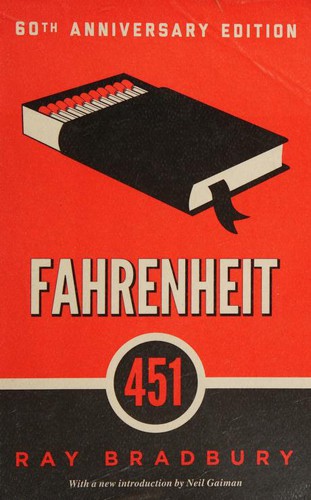
Fahrenheit 451
Simon & Schuster · 1953 · 256 pages
ISBN: 9781451673319
Review Editor
Marcus Webb
Summary
Ray Bradbury’s Fahrenheit 451 takes place in a future America that has perfected the art of avoiding discomfort. Books are illegal. Firemen don’t extinguish fires; they start them, burning any library they find. Guy Montag is a fireman who loves his work, or believes he does, until he meets Clarisse McClellan, his seventeen-year-old neighbor who asks him whether he is happy. It is a question that should be easy to answer. Montag discovers he cannot.
Published in 1953, the novel has aged in ways that might surprise even Bradbury. The “parlor walls” that substitute for family interaction, the earbuds that fill every waking moment with noise, the news reduced to slogans and sensation — these read less like speculation and more like observation. The mechanism of censorship Bradbury imagined was not a government decree but a gradual social withdrawal from anything that caused friction. Books were not banned because someone decided they were dangerous; they were abandoned because they made people feel inadequate, and then they were banned because society could no longer tolerate the reminder.
The novel’s title comes from the temperature at which paper ignites. It is a practical, technical fact that Bradbury transforms into a symbol of everything at stake. Knowledge burns. Memory burns. The future burns if the past is incinerated fast enough.
Character Arcs and Development
Montag’s transformation from true believer to fugitive is the engine that drives the novel. Bradbury writes his awakening not as a sudden conversion but as a slow dissolution of certainty. Clarisse is the catalyst, but she is only the first crack. Montag has, we learn, been quietly stealing books from the homes he burns, hiding them behind a ventilator grille, not knowing why. When he is finally forced to confront what he has been doing, he cannot stop.
His wife Mildred is a more harrowing character than she first appears. She is not malicious; she is simply gone, absorbed so completely into her wall-screen “family” that she cannot function outside the noise. When she overdoses on sleeping pills, the trauma is processed by anonymous medical technicians with machines that pump out the poisoned blood and replace it, no questions asked, the event forgotten by morning. Mildred has chosen the warmth of numbness, and Bradbury never quite lets us condemn her without also holding up a mirror.
Captain Beatty, Montag’s fire chief and primary antagonist, is perhaps the novel’s most intellectually interesting creation. He is a man who has read extensively and has concluded that ignorance is preferable. His long speeches are not the ravings of a simple tyrant; they are the rationalizations of someone who has been hurt by books and has decided the injury was the books’ fault. He wants Montag to see what he sees: that knowledge without happiness is torment. He is wrong, but he is not stupid, and that makes him genuinely frightening.
Faber, the retired English professor who becomes Montag’s secret guide, represents a different failure: the intellectual who retreated rather than resisted. His cowardice is his own burden. It is the “book people” at the novel’s end — wanderers who have memorized texts to carry them forward — who offer the most compelling moral image: preservation as an act of quiet, sustained courage.
Pacing
Fahrenheit 451 is a short novel, barely 250 pages in most editions, and Bradbury uses every one of them with precision. The prose moves in three distinct registers. The first section, “The Hearth and the Salamander,” establishes Montag’s comfortable life and begins to undermine it. It is dense, almost hallucinatory, and moves at the speed of unease. The second section, “The Sieve and the Sand,” accelerates as Montag reads frantically and Beatty circles closer. The third section, “Burning Bright,” is a sprint — Montag’s world collapses, and the novel does not pause to let him or the reader breathe.
This escalating compression is entirely intentional. Bradbury is mimicking the experience of reading a book you cannot put down while making a point about the value of exactly that experience. The novel practices what it preaches.
Deeper Thematic Exploration
The book’s central argument about censorship is sometimes misread as a parable about government control. Bradbury was at pains in later interviews to clarify that the more insidious threat he saw was not political but cultural: the self-imposed shrinkage of intellectual life in a society that prizes comfort above all else. The firemen are not enforcers of a decree from above; they are responding to popular demand. Minority groups found books offensive. Advertisers found them slow. People found them difficult. And so books disappeared, not with a bang but with a long, distracted whimper.
This insight is more troubling than a simple warning about totalitarianism because it assigns responsibility not to a tyrant but to us. The mechanism Bradbury describes — the social pressure to simplify, to abbreviate, to avoid complexity — has only intensified in the decades since publication. The novel does not suggest a solution beyond the choice, made quietly and persistently, to remember. The book people at the novel’s close are not an army. They are a library, walking.
Bradbury also explores what it means to live without metaphor. When the ability to make unexpected connections between ideas is eliminated, what remains is not peace but a kind of living death. Clarisse notices the world in a way her neighbors cannot: she watches rain, tastes dandelion sap, looks at the moon. These small acts of attention are, in Bradbury’s framework, the foundation of everything that makes life worth preserving. They require slowness. They require the willingness to sit with a page and let it speak.
Style and Voice
Bradbury’s prose is not what readers accustomed to contemporary genre fiction might expect. It is lyrical, impressionistic, more concerned with sensation and emotional truth than with plot mechanics. Sentences coil and stretch. Similes arrive unexpected and stay in the memory: “a book is a loaded gun in the house next door.” The language itself performs the argument, demonstrating that literature is not simply a vehicle for information but an experience inseparable from the form that delivers it.
Some readers find this style difficult. The first chapter, in particular, does not offer the conventional handholds of genre fiction — no clear quest, no convenient exposition. Bradbury drops the reader into Montag’s consciousness and trusts them to swim. Those who persist find that the prose rewards sustained attention in precisely the way the novel argues all reading does.
The dialogue is sometimes more rhetorical than naturalistic, particularly Beatty’s monologues. But this is a feature, not a flaw. These are characters in a book making arguments about books. The heightened register is appropriate to the stakes. Bradbury is not writing a procedural; he is writing an argument that has kept its urgency for more than seventy years.
Verdict
Fahrenheit 451 is one of the essential novels of the twentieth century, and its essentialness keeps renewing itself as the decades pass. It is not a comfortable book. It asks uncomfortable questions about the choices we make collectively and individually about what we attend to, what we protect, and what we let burn through simple inattention. Every generation rediscovers it and finds it describing their own moment, which is either evidence of Bradbury’s extraordinary prescience or a troubling sign about the persistence of the temptations he identified.
For readers new to the novel, it is worth resisting the urge to read it quickly. Its pacing rewards the kind of slow, attentive reading it celebrates. For readers returning to it, it repays rereading at every stage of life with different emphases and different fears. This is precisely what great literature does: it changes as we change, and it always has more to say.
A five-star masterpiece that belongs on every shelf, particularly the shelves we feel most compelled to protect.
Is Fahrenheit 451 still relevant today?
Remarkably so. The mechanisms of distraction and self-censorship Bradbury described in 1953 — the replacement of complex experience with entertainment, the shrinking of attention span, the social pressure to avoid controversy — map directly onto contemporary media culture. The novel has not aged into historical document; it has aged into prophecy that keeps fulfilling itself in new forms.
What does the title Fahrenheit 451 refer to?
Bradbury claimed that 451 degrees Fahrenheit is the temperature at which paper ignites and burns. Modern fire scientists have noted this figure is approximate and depends on paper type and conditions, but the symbolism is what matters: the title transforms a mundane technical fact into a threshold that separates civilization from its destruction.
Who is Clarisse McClellan and why does she matter?
Clarisse is Montag’s seventeen-year-old neighbor, a girl who pays attention to the world in ways her society has forgotten — she watches rain, wonders about dandelion sap, asks people if they are happy. She functions as the catalyst for Montag’s awakening, the living proof that it is possible to be curious and awake in a world designed to prevent both. Her fate is left deliberately ambiguous in the early novel, though she reappears in the radio play and film adaptations.
What is Captain Beatty’s role in the novel?
Beatty is Montag’s fire chief and primary antagonist, but Bradbury complicates him significantly. Beatty has read widely and has chosen ignorance — or rather, he has decided that the pain of knowing outweighs the comfort of not knowing. His speeches to Montag are sophisticated and internally coherent, making him a more unsettling villain than a simple enforcer of tyranny would be. He represents the intellectual who has turned his knowledge against knowledge itself.
Is Fahrenheit 451 about government censorship?
Bradbury repeatedly insisted it is not, at least not primarily. The censorship in the novel emerged from popular demand — minority groups found books offensive, advertisers found them inconvenient, and people found them difficult. The government enforced a consensus that society had already reached on its own. Bradbury’s warning was about the cultural willingness to simplify, which he saw as a more pervasive danger than political coercion because it assigns responsibility to everyone rather than a tyrant.
What are the “book people” at the end of the novel?
The book people are a community of individuals who have each memorized one or more texts in their entirety, becoming living libraries in the event of civilization’s collapse. They are not revolutionaries but preservationists, walking quietly through the wilderness, waiting for a moment when what they carry might be needed again. They represent Bradbury’s most hopeful image: that literature can survive even the most determined effort to destroy it, carried in human memory rather than on paper.
How long does it take to read Fahrenheit 451?
Most readers complete the novel in three to five hours. At roughly 250 pages it is short by contemporary standards, though Bradbury’s lyrical prose rewards slower reading than the length might suggest. The novel compresses its ideas densely enough that a careful reader will want to linger over passages, particularly Beatty’s speeches and the final sections as Montag flees the city.
How does Fahrenheit 451 compare to other dystopian classics like 1984?
Orwell’s 1984 depicts censorship as the instrument of totalitarian power, imposed from above by a government that needs control. Bradbury’s vision is more disquieting in some respects because the censorship emerges from below, from the collective preference for comfort over complexity. Where Winston Smith fights against an all-seeing state, Montag lives in a society that has decided, democratically and incrementally, to burn its own inheritance. Both novels are indispensable; they describe different roads to the same fire.
Book Details
- Title
- Fahrenheit 451
- Author
- Ray Bradbury
- Genre
- Science Fiction
- Publisher
- Simon & Schuster
- Year Published
- 1953
- Pages
- 256
- ISBN
- 9781451673319
- WritersReview Rating
- 5.0 / 5