
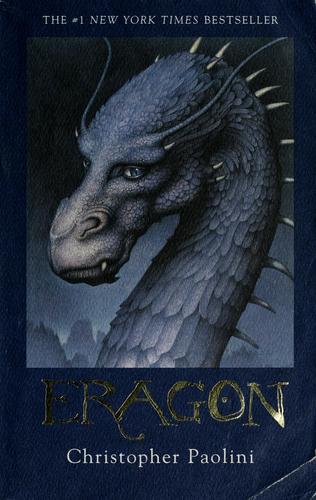
Eragon is a farm boy in the fictional land of Alagaësia who discovers a polished blue stone in the mountains — a stone that turns out to be a dragon egg, and hatches into a dragon who bonds with him. The arrival of the Ra’zac, mysterious agents of the Empire, destroys his home and kills his uncle, sending Eragon on a journey of revenge and destiny with the old storyteller Brom as his guide. Christopher Paolini began writing Eragon at fifteen, and his parents published it privately before it was picked up by Alfred A. Knopf — a publishing story that became part of the book’s mythology. The result is a fantasy novel that demonstrates both the considerable abilities of a teenage writer and the limitations of a story built primarily from beloved influences rather than original vision.
Character Arcs
Eragon moves from ignorant farm boy to competent dragon rider over the course of the novel, and Paolini tracks that development with reasonable consistency. Saphira, the dragon, is the book’s most interesting character — her voice has a quality of ancient, affectionate certainty that distinguishes her from the more familiar genre hero. Brom carries the weight of mystery and hidden knowledge that mentor figures in this tradition always carry, and his eventual revelation is affecting. Murtagh, a companion acquired along the way, has more complexity than the plot gives him room to develop. The villain, Durza the Shade, is effective as a threat without being particularly interesting as a character.
Pacing
The novel is long — over 500 pages — and its first half, focused on training and travel, moves slower than the second. Paolini clearly loves the world he has built and is willing to spend time in it regardless of plot momentum, which will satisfy readers who share that appetite and frustrate those who don’t. The action sequences are competently handled and the climax, which involves a large battle and several revelation payoffs, delivers what it promises. The book ends in a way that makes the sequel feel both necessary and earned.
Thematic Depth
The thematic material — freedom versus tyranny, the corruption of power, the weight of destiny — is present but not developed with particular originality or depth. Eragon is working in a tradition that has addressed these themes more rigorously, and Paolini’s engagement with them is sincere but somewhat surface-level. The worldbuilding is detailed and internally consistent, which is itself a real achievement for a writer of any age; the themes that animate the world are less fully realized than the world itself.
Style and Voice
Paolini’s prose is competent and occasionally ambitious, though the ambition sometimes produces passages that reach beyond his control. The invented names and terminology are consistent with the languages he developed for Alagaësia and give the world texture, even if they occasionally slow reading. The dialogue is generally functional; Brom’s voice is the most distinct. The book’s greatest stylistic achievement is its consistency: Paolini maintains a tone and register across 500 pages that never breaks the world’s internal logic, which is a significant craft accomplishment regardless of the writer’s age.
Verdict
Eragon is a genuinely impressive achievement for a fifteen-year-old writer and a serviceable fantasy novel for readers who love the genre. Its debts to Tolkien, McCaffrey, and Star Wars are evident and acknowledged, and readers who come to it expecting originality rather than earnest engagement with beloved traditions will be disappointed. Readers who want a well-built fantasy world with a dragon at its center, written with evident love for the genre, will find what they’re looking for.
Rating: 3.7 out of 5
Book Details
- Title
- Eragon
- Author
- Christopher Paolini
- Genre
- Young Adult
- Publisher
- Alfred A. Knopf
- Year Published
- 2003
- Pages
- 514
- ISBN
- 9780375826696
- WritersReview Rating
- 3.7 / 5