
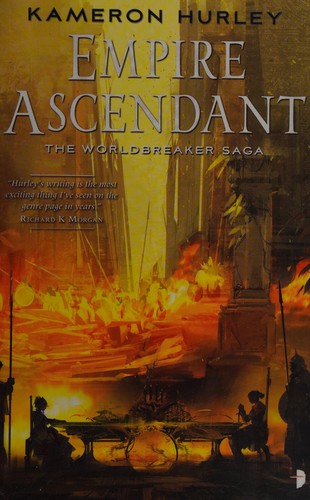
Empire Ascendant
Angry Robot Books · 2015 · 460 pages
ISBN: 9780857665591
Review Editor
Marcus Webb
Kameron Hurley’s Empire Ascendant, the second volume of the Worldbreaker Saga, picks up where 2014’s The Mirror Empire left off and immediately makes everything worse. Published in 2015 by Angry Robot Books, this 460-page epic fantasy drops readers into a world where parallel universes are colliding, genocide is state policy, and every character who survived book one now faces something uglier. If The Mirror Empire built the board and placed the pieces, Empire Ascendant is the moment someone flips the table.
The premise, for those coming in fresh: every two thousand years, the dark satellite Oma rises in the sky, tearing holes between parallel worlds. Through those holes pour the Tai Mora, refugees from a dying version of reality, led by Empress Kirana. Her invasion strategy is chillingly practical: because only one version of a person can exist in each world, the Tai Mora must kill their counterparts before they can cross over. The icy nation of Saiduan has already fallen. Now Kirana’s forces push south into Dorinah and toward the island-continent of Dhai, where a fractured, pacifistic people scramble to mount a defense they were never culturally built for.
Meanwhile, Lilia Sona, a young woman whose ability to channel Oma’s power makes her both valuable and dangerous, has become an accidental folk hero to the Dhai refugees she led out of slavery in Dorinah. Ahkio, the reluctant Kai (leader) of the Dhai, tries to hold his people together while navigating political factions that want him dead. And Roh, a gifted young scholar, survives as a slave in occupied Saiduan, translating ancient texts that may hold the key to stopping the apocalypse.
Character Arcs and Development
Empire Ascendant opens with a bold structural move: the first chapter belongs to Kirana, the Tai Mora Empress who served as the primary antagonist of book one. Hurley wastes no time complicating the reader’s allegiances. Kirana did not orchestrate a cross-dimensional invasion for power or glory. She did it to save her wife Yisaoh and their three daughters from a world that was literally falling apart. That motivation, so human and specific, makes her one of the most compelling figures in the book. You understand exactly why she will keep killing, and that understanding sits in your stomach like a stone.
Ahkio undergoes the most dramatic transformation. In The Mirror Empire he was hesitant, overwhelmed, dismissed by his own people as weak. Here Hurley traces his slow, painful education in the cost of leadership. As Kirana’s invasion becomes real, as Dhai settlements burn and refugees flood in, Ahkio begins bending toward the militant stance he once rejected. He does not become a warrior. He becomes someone willing to authorize violence, which is something more complicated and more honest about how leaders actually change under pressure.
Lilia remains the emotional spine of the series. Scarred, limping (she lost half a foot to acid burns in book one), and possessed of a furious determination that borders on recklessness, she pushes for an aggressive strategy against the Tai Mora while the Dhai leadership dithers. Her arc in this book forces her to reckon with what people project onto her. The refugees call her a savior, a reincarnation of the Dhai martyr Faith Ahya. Lilia knows she is not that person. She is angry, grieving, and making it up as she goes. The gap between the legend others need and the reality of who she is gives her chapters a crackling tension.
Roh’s storyline operates at a slower register, but it does essential work. Enslaved and stripped of everything, he questions assumptions about identity and belonging that the Dhai take for granted. His sections also carry much of the series’ lore: the ancient texts he translates reveal how the temples and satellites function, seeding crucial information for the trilogy’s endgame. Among the secondary characters, Maralah, the power behind Saiduan’s crumbling throne, stands out for her grim competence, fighting invaders, cold, and sexual discrimination simultaneously. Zezili, the Dorinah general sent south on a mysterious mission, tangles with the would-be King of Tordin in a subplot that opens the world’s geography and politics further south.
Pacing
This is where Empire Ascendant improves most significantly over its predecessor. The Mirror Empire suffered from a chaotic first third, throwing characters and worldbuilding at readers with little breathing room. Empire Ascendant, freed from the burden of introduction, moves with far more confidence. Hurley deploys a thriller’s sense of urgency from the opening pages, and the tension rarely lets up.
The book juggles at least six viewpoint characters, and the transitions between them feel motivated rather than arbitrary. One long, suspenseful stretch weaves multiple jailbreaks and reversals among characters on opposite ends of a continent, yet everything flows logically. The climaxes land harder because Hurley earns them this time around. That said, the sheer number of perspectives means no single character gets quite as much room as you might want. Some readers will feel that certain chapters contain entire novels’ worth of material compressed into a few scenes. The emotional beats hit, but a few of them could have hit harder with more space to develop.
Deeper Thematic Exploration
Empire Ascendant asks one question relentlessly: what are you willing to destroy in order to survive? Hurley poses this to every major character without exception. Kirana will exterminate an entire population to give her family a future. Ahkio will sacrifice his principles to keep his people alive. Lilia will risk her own body, burning through powers she barely understands, to stop an invasion that killed her mother. Even Roh, the gentlest of the viewpoint characters, finds himself making calculations about who deserves his loyalty and who has forfeited it.
What makes this more than a catalog of hard choices is Hurley’s refusal to let anyone off the hook. There are no clean hands in the Worldbreaker Saga. The Tai Mora are invaders committing genocide, but they are also refugees fleeing a dying world who will perish if they do not find new ground. The Dhai are victims of aggression, but their pacifism is partly self-serving, a cultural identity that conveniently ignores the violence done on their behalf by others. Dorinah’s matriarchy, which might sound like a progressive fantasy trope, turns out to be as brutal and hierarchical as any patriarchy. Hurley’s feminism is not the kind that puts women on pedestals. It is the kind that insists women are fully capable of tyranny, cruelty, and moral failure, which is a more radical statement than most fantasy is willing to make.
The parallel-universe conceit amplifies these themes beautifully. Because only one version of each person can exist per world, every Tai Mora crossing over is a murder. Kirana must kill the people who share her family’s faces before her family can safely arrive. This is genocide traced with something like suicide, and it gives the invasion a horror that goes beyond simple conquest. Empire Ascendant is a book about what happens when survival itself becomes a moral catastrophe, when the only options are variations of complicity.
Style and Voice
Hurley writes in a close third person that shifts fluidly between characters, and her prose is leaner and more controlled here than in The Mirror Empire. She has a talent for physical description that grounds the fantasy worldbuilding: carnivorous plants that snap at passersby, a vine-and-chrysalis public transportation system, temples with living skin that breathes and heals. The world of Raisa feels genuinely alien rather than Medieval Europe with the serial numbers filed off.
Her treatment of gender and sexuality deserves particular mention. The cultures of the Worldbreaker Saga each handle gender differently: Dhai recognize multiple pronouns and family configurations, Saiduan has three genders, Dorinah enforces a rigid matriarchy. Hurley integrates these systems into the narrative without making them feel like a lecture. A character from one culture will stumble over pronouns when dealing with someone from another, and those small moments do more worldbuilding than pages of exposition could. The diversity is deliberate and huge, but it never feels forced because it grows organically from the cultures Hurley has built.
Verdict
Empire Ascendant is a stronger, more confident book than The Mirror Empire, with better pacing, sharper character work, and thematic ambitions that justify its considerable length. It is also a deeply uncomfortable read. Hurley does not write comfort food fantasy, and this is a middle book in which the title announces that the bad guys are winning. If you want clear heroes and cathartic victories, look elsewhere. If you want a fantasy novel that treats its genre with the seriousness of political fiction, that builds a world unlike anything you have encountered before, and that refuses to simplify the moral arithmetic of survival, Empire Ascendant delivers. Readers who loved the worldbuilding of The Mirror Empire but found the first book’s structure uneven will find Hurley operating at a higher level here. Readers new to the series should start with book one; this is not a standalone. But for anyone hungry for epic fantasy that challenges rather than reassures, the Worldbreaker Saga is essential, and Empire Ascendant is where it hits its stride.
Frequently Asked Questions about Empire Ascendant
What is Empire Ascendant by Kameron Hurley about?
Empire Ascendant is the second book in the Worldbreaker Saga, an epic fantasy trilogy about parallel universes colliding. When the dark satellite Oma rises, it tears holes between worlds, allowing the Tai Mora people to invade from their dying reality. The book follows multiple characters trying to survive the invasion, including a reluctant leader, a young woman with dangerous magical powers, and a scholar enslaved in occupied territory.
Do I need to read The Mirror Empire before Empire Ascendant?
Yes. Empire Ascendant is a direct sequel that assumes familiarity with the characters, world, and events of The Mirror Empire. Hurley does not spend much time recapping, so readers who jump in at book two will find themselves lost quickly. Start with The Mirror Empire for the full experience.
What are the main themes in Empire Ascendant by Kameron Hurley?
The central themes include survival and its moral costs, the corrupting nature of power, cycles of violence, and the question of whether ends justify means. Hurley also explores gender and cultural identity through her multiple invented societies, each with distinct approaches to gender, sexuality, and political organization.
How long is Empire Ascendant and is it a difficult read?
Empire Ascendant runs 460 pages in paperback. It is a moderately challenging read due to its large cast of viewpoint characters, invented terminology, and complex political landscape spanning multiple nations and parallel worlds. Readers comfortable with dense epic fantasy like Malazan Book of the Fallen or the Stormlight Archive will feel at home, though Hurley’s prose is more accessible than either.
Is there a movie or TV adaptation of Empire Ascendant?
As of 2026, there is no movie or television adaptation of Empire Ascendant or any book in the Worldbreaker Saga. The series has a dedicated fanbase and critical recognition, but no adaptation has been announced.
What age group or reading level is Empire Ascendant appropriate for?
Empire Ascendant is firmly adult fiction. It contains graphic violence, sexual content, abuse, and morally complex situations involving genocide and slavery. The reading level is comparable to other adult epic fantasy. It is not appropriate for younger teens and is best suited for readers 17 and older who are comfortable with dark, challenging material.
How does Empire Ascendant compare to The Mirror Empire?
Most readers and critics consider Empire Ascendant the stronger book. The Mirror Empire suffered from a chaotic opening and the burden of introducing a complex world from scratch. Empire Ascendant benefits from established foundations, allowing Hurley to focus on pacing, character development, and plot. The storytelling is more assured, the climaxes more earned, and the thematic concerns more focused.
Should I read Empire Ascendant and is the Worldbreaker Saga worth it?
If you enjoy epic fantasy that refuses to simplify moral questions, builds genuinely alien worlds rather than recycling familiar settings, and features a diverse cast of deeply flawed characters, the Worldbreaker Saga is well worth your time. Empire Ascendant is the point where the series finds its best rhythm. Readers who prefer lighter, more comforting fantasy or who dislike large casts with multiple viewpoints may find it frustrating.
Book Details
- Title
- Empire Ascendant
- Author
- Kameron Hurley
- Genre
- Science Fiction
- Publisher
- Angry Robot Books
- Year Published
- 2015
- Pages
- 460
- ISBN
- 9780857665591
- WritersReview Rating
- 4.0 / 5