
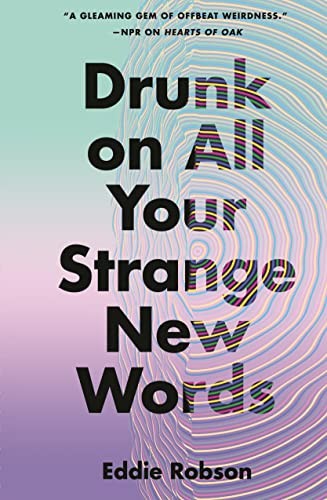
Drunk on All Your Strange New Words
Tordotcom · 2022 · 277 pages
ISBN: 9781250807342
Review Editor
Marcus Webb
Drunk on All Your Strange New Words is the debut science fiction novel from Eddie Robson, published by Tordotcom in June 2022. Robson is primarily known in the UK for his television and radio work, including the BBC comedy Welcome to Our Village, Please Invade Carefully and his extensive contributions to the Doctor Who audio universe. This novel marks his arrival as a fiction writer of considerable wit and invention, and it earned him the RUSA Reading List Award in 2023 and a spot on Oprah Daily’s list of the best science fiction books of the year.
The setup is genuinely irresistible. In a near-future New York, humanity has made first contact with a species called the Logi. These aliens communicate purely through telepathy, and a small number of humans can be trained to translate Logi thought into spoken language. The catch is that the process leaves human translators intoxicated. Not metaphorically. Actually drunk, in the staggering, slurring, charmingly impaired sense. Lydia, the novel’s narrator, has built her livelihood around this remarkable and inconvenient talent. She works for Fitz, the Logi cultural attache to Earth, and the two have developed a comfortable, if lopsided, working relationship over several years.
When Fitz turns up murdered in the apartment they share, Lydia becomes the obvious suspect. She was there. She was, as usual, intoxicated by the translation process. She remembers almost nothing of what happened. What follows is part locked-room mystery, part near-future thriller, and part workplace comedy: Lydia must clear her name while navigating a tangle of human politics, Logi cultural sensitivities, and a conspiracy that reaches much further into the alien diplomatic apparatus than she expected. The whole story fits inside 277 pages, and Robson keeps it lean, propulsive, and consistently alive. For a debut novel, the structural confidence is striking: Robson never overexplains, never stalls, and never loses sight of the tone he set on page one.
Character Arcs and Development
Lydia is the engine that makes this book run. She is from Yorkshire, she is scrappy, and she has no qualifications beyond her ability to survive the Logi translation process. She knows it. Robson writes her as genuinely self-aware about her limitations in a way that reads as charming rather than pathetic. She is not a brilliant detective. She is not a covert operative or a chosen hero. She is someone who, when backed into a corner, refuses to stop moving. Watching her accumulate information, make wrong guesses, and talk her way into and out of increasingly awkward situations constitutes the most consistent pleasure the novel offers. Her persistent refusal to accept her own uselessness is not just funny: it drives the entire plot forward.
Fitz, despite being murdered early in the story, does not vanish from it. One of Robson’s cleverest structural choices involves the residual presence of Fitz’s telepathic signal, which Lydia discovers she can still hear after his death in ways that should not be possible. Their relationship, reconstructed through Lydia’s memories and that ghostly ongoing connection, turns out to be more complex and more affecting than the opening chapters suggest. Fitz consistently stood up for Lydia when she embarrassed herself or arrived to diplomatic events visibly intoxicated. His quiet loyalty, revealed in pieces throughout the investigation, becomes one of the more genuinely touching threads in the book. The moments where Lydia hears what might be Fitz’s lingering thoughts carry a muted grief that grounds the story’s lighter registers.
The secondary cast is functional rather than deep. The police detectives investigating the case are drawn with enough personality to distinguish them, and several Logi figures add useful texture to the alien diplomatic world. But Robson rightly understands this book as a two-character story between Lydia and the memory of Fitz, and he does not overcrowd it. Readers who come to science fiction for rich ensemble casts may find the peripheral characters thinner than they would like. For a 277-page mystery, the economy feels right.
Pacing
The book moves fast. Robson comes from television writing, and that instinct shapes the rhythm throughout. Scenes run short. Dialogue carries the load. Exposition arrives on the move rather than in dedicated set pieces. The mystery unfolds through a series of revelations that feel genuinely surprising rather than telegraphed, and the novel’s compact length means there is little room for the plot to sag. Robson’s plotting is tight enough that every scene either advances the mystery or deepens Lydia as a character. Often it does both at once.
That said, a stretch in the second act does tighten in circles before it can expand. Lydia loops through the same set of suspects a few times before new information opens the picture, and readers who like a mystery to escalate continuously may notice the pause. It is a minor issue in an otherwise nimble book. The momentum never fully stops, and the final third is brisk and satisfying, with a resolution that earns its surprise without relying on information the reader never had access to. If you read at a comfortable pace, this is a weekend book. If you read fast, you might finish it in a single sitting.
Deeper Thematic Exploration
The central conceit of the novel, translation as intoxication, is not just a clever hook. Robson uses it to think about what communication actually costs. Every time Lydia translates for Fitz, she loses something: clarity, control, the ability to defend herself in the immediate aftermath. The fact that she keeps doing it says something about the human need for connection, but also about economic precarity. Lydia has no other options. The translation work leaves her impaired in public, professionally embarrassing, and physically uncomfortable. She does it because the Logi will pay and the alternative is unemployment. The intoxication, in this light, is not just comic relief. It is a portrait of what people routinely accept in exchange for a living.
The novel is also quietly serious about xenophobia. The Logi are presented as peaceful, culturally sophisticated, and genuinely open to coexistence. Many of the humans around them are not welcoming. Protest groups, conspiracy theorists, and opportunist politicians treat the alien presence as an ongoing threat rather than a diplomatic relationship. Robson does not underline this repeatedly. He weaves it into the texture of the world and lets Lydia’s perspective carry it. She has built her entire professional life around bridging species, and she operates daily in a culture that would prefer those species stay apart. The prejudice she runs into maps onto recognizable human patterns without the book ever needing to announce its parallels.
A third layer concerns truth and its circulation in a media-saturated world. Social media algorithms, a news cycle that rewards narrative over accuracy, and a public discourse that cannot distinguish between what is real and what is emotionally satisfying all figure into the conspiracy Lydia eventually uncovers. Robson handles this through the specifics of the plot rather than through authorial commentary. Gizmodo’s review perceptively noted the prescience of its near-future world: a culture evolved from the present-day politicization of truth, where everything that needs to exist can be faked, implanted, or re-recorded. The satirical edges are light but real. The book has more on its mind than its breezy surface suggests, and the ideas accumulate quietly until the ending, when the full shape of what Robson was after becomes visible.
Style and Voice
Robson’s prose is conversational, dry, and confident. The British humor is consistent without tipping into self-parody. The comparison to Douglas Adams that appears in several reviews is apt in one specific way: like Adams, Robson builds a world that is fundamentally absurd and then insists on taking its own logic completely seriously. The Logi communicate by telepathy and make humans drunk, and by page twenty you have accepted this as a normal feature of the setting because the book’s tone is so matter-of-fact about it. The absurdism is architectural rather than decorative. Nothing winks at the reader. This is just how things are.
Lydia’s first-person narration is the novel’s best sustained achievement. Her voice is sardonic without being exhausting, self-deprecating without becoming a running gag. The narrative POV stays close throughout, which works extremely well for a mystery: you know exactly as much as she does, and you feel every dead end alongside her. The constraint does mean the alien world stays somewhat opaque beyond what Lydia directly witnesses, which will frustrate readers who want extensive worldbuilding. For everyone else, the tightness of the perspective is a feature rather than a limitation. It keeps the book human even when the subject matter is anything but.
Verdict
If you want a quick, smart, character-driven science fiction novel that does not take itself too seriously but still has something real to say, this is it. Drunk on All Your Strange New Words is accessible to readers who do not normally pick up science fiction, inventive enough to reward genre regulars who are tired of the usual epic scale, and short enough that you can find out whether it is for you in about two sittings. Think cozy mystery energy dropped into first-contact diplomacy, with more thematic weight underneath than the jacket copy lets on. The RUSA award is deserved.
Readers who want hard science fiction with elaborate worldbuilding, or a sprawling ensemble with multiple plot threads, will likely find it too light. The mystery is well-constructed but not labyrinthine. Some of the social commentary stays at the surface. But for its size and ambition, Robson delivers a confident and quietly affecting debut. Lydia is the kind of protagonist you want to see again, in another book, in another tight spot, impaired and determined and refusing to give up.
Frequently Asked Questions about Drunk on All Your Strange New Words
What is Drunk on All Your Strange New Words by Eddie Robson about?
It is a science fiction mystery set in a near-future New York after humanity has made first contact with a telepathic alien species called the Logi. Lydia, a human translator for a Logi diplomat named Fitz, finds her boss murdered and herself the primary suspect. Because translating alien telepathy leaves her literally drunk, she cannot remember what she witnessed. The novel follows her investigation to clear her name while uncovering a much larger conspiracy involving Logi technology and human xenophobia.
Is Drunk on All Your Strange New Words part of a series?
As of its publication in 2022, it is a standalone novel. Eddie Robson has not announced a sequel, and the story wraps up completely within its 277 pages. Readers who finish it wanting more of Lydia and this world will need to wait and see whether Robson returns to the setting.
What are the main themes in Drunk on All Your Strange New Words?
The book works with several interconnected ideas. Language and communication sit at the center: translation is physically costly, and bridging species comes with real personal consequences. Xenophobia and political prejudice toward the Logi reflect recognizable human patterns. Economic precarity shapes why Lydia keeps doing a job that impairs her. And a strong undercurrent questions how truth survives in a media environment built around narrative over accuracy.
How long is Drunk on All Your Strange New Words and is it a difficult read?
The hardcover edition runs 277 pages. It is not a difficult read: the prose is conversational, the pacing is fast, and the chapters are short. Readers who are new to science fiction will find it very approachable. The vocabulary and concept-load are light. Those who read quickly can finish it in a single long sitting or over a weekend.
What awards did Drunk on All Your Strange New Words win?
It won the 2023 RUSA Reading List Award in the science fiction category, which recognizes genre fiction of exceptional merit for adult readers. Oprah Daily named it the number one science fiction book of 2022. It received broadly positive reviews from Publishers Weekly, Gizmodo, and BookPage, and earned strong reader ratings on Goodreads across more than three thousand ratings.
Is there a movie or TV adaptation of Drunk on All Your Strange New Words?
As of 2023, no film or television adaptation had been announced. The premise, a first-contact murder mystery with a distinctive protagonist, would translate well to a limited series format, and the book attracted enough critical attention to make an adaptation plausible eventually. Nothing has been confirmed.
How does Drunk on All Your Strange New Words compare to Eddie Robson’s other fiction?
This novel is Robson’s first full-length work of science fiction prose. He is better known in the UK for his television writing and for his work on Doctor Who audio dramas. Readers who want a prose comparison point would do well to look at John Scalzi’s lighter novels, Douglas Adams, or the cozy-mystery-inflected end of the speculative fiction genre. Robson shares with those writers a tendency to build absurd premises and then play them completely straight, letting the humor emerge from the gap.
Should I read Drunk on All Your Strange New Words and is it worth it?
Yes, if you like mysteries with personality, science fiction that does not require a reading guide, or protagonists who are flawed and funny and determined in equal measure. Lydia is one of the more memorable characters in recent speculative fiction, and the novel delivers on its central concept in ways that feel earned. The only readers who might not connect with it are those who want hard science fiction or a deeply complex mystery plot, rather than a sharp character study wrapped in both.
Book Details
- Title
- Drunk on All Your Strange New Words
- Author
- Eddie Robson
- Genre
- Science Fiction
- Publisher
- Tordotcom
- Year Published
- 2022
- Pages
- 277
- ISBN
- 9781250807342
- WritersReview Rating
- 3.9 / 5