
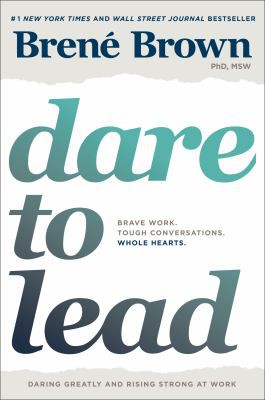
Dare to Lead
Random House · 2018 · 298 pages
ISBN: 9780399592522
Review Editor
Daniel Okafor
Brené Brown spent nearly two decades studying what she calls “the anatomy of courage.” Her TED talk on vulnerability has over 60 million views. Her earlier books, “The Gifts of Imperfection” and “Daring Greatly,” turned her into one of the most recognizable voices in American self-help. But “Dare to Lead: Brave Work. Tough Conversations. Whole Hearts.,” published in October 2018, is something different. It is Brown’s most deliberately practical book and her most explicitly addressed to people with authority over other people. If the earlier work was about becoming more human, this one is about what happens when you bring that full humanity into organizational life.
The book grew out of a research question Brown had been circling for years: what separates the leaders who create cultures where people do their best work from the ones who create environments where fear and self-protection quietly eat everything. Over four years, she and her team conducted more than two hundred hours of interviews with more than 150 people in senior leadership roles, from Fortune 500 executives to nonprofit directors to military officers to school principals. What she found, she says, surprised her. The common factor was not confidence, charisma, or strategic intelligence. It was courage, and specifically, a set of four skills she came to call the four pillars of daring leadership: rumbling with vulnerability, living into your values, braving trust, and learning to rise.
Brown’s central argument is that most leadership development programs spend enormous time and money on technical skills while completely ignoring what she calls the “soft skills” that are actually the hardest ones to practice. Asking for help, giving honest feedback, having the difficult conversation you’ve been avoiding for three months, sitting with uncertainty instead of pretending you have answers you don’t: these things require more courage than any strategic initiative, and they rarely appear in a curriculum. “Dare to Lead” is her attempt to teach them anyway, and to make a case that the organizations most willing to invest in this kind of leadership development are the ones that will outperform everyone else over time.
Character Arcs and Development
Brown is both the author of this book and one of its main characters. She is unusually transparent about her own struggles with the material, and this transparency is one of the things that makes the book work. She writes about the years she spent armoring up in her own career, the ways she used perfectionism and busyness as shields, and the moment she realized that the researcher who had built a career on studying vulnerability was not actually practicing it in any meaningful way. There is a passage early on where she describes being told by a skeptical executive that she was “basically the researcher for the Wizard of Oz,” and her willingness to sit with that critique rather than dismiss it sets the tone for everything that follows.
The leaders Brown interviewed populate the book as something like a Greek chorus: wise, flawed, recognizable, and unnamed. A CEO who wept in a board meeting and watched the room become more honest as a result. A woman who was told her directness would “never fly in corporate,” who eventually built a team that outperformed every comparable unit in her organization. A military officer who had to work out the difference between real courage and recklessness under live fire, and then figure out how to teach that difference to the people under his command. Brown draws these people precisely enough that they feel real rather than illustrative, which is a harder thing to do than it sounds in a book structured around frameworks and principles.
Secondary figures like workshop participants and students appear throughout in support of specific points. They are less developed as individuals, and occasionally they feel like extended footnotes rather than genuine narrative moments. But the best of them, especially the ones Brown returns to at the end of the book in her discussion of resilience and recovery, contribute meaningfully to the argument that the skills she is describing are learnable. The transformation arc Brown is tracing is not dramatic; it is specifically a story about small, repeated acts of courage accumulating over time into something that changes how an organization actually functions, and the cumulative effect of her examples makes that case convincingly.
Pacing
The first third of the book builds genuine momentum. Brown establishes her framework, introduces the four skills, and arrives at her chapter on “Rumbling with Vulnerability” with a kind of earned energy. The writing is conversational, the arguments are tight, and she allows herself to be funny at the right moments, a quality that is easy to underestimate in this genre. Then the book enters its denser middle section, where Brown works through the BRAVING Trust inventory (Boundaries, Reliability, Accountability, Vault, Integrity, Non-judgment, Generosity), a detailed framework for building and repairing trust in professional relationships. The inventory is practically useful, and the chapters that support it are thorough. But they arrive with a supporting apparatus of exercises, reflection questions, and worksheets that slows the narrative pace considerably. Readers who approach the book as a practical workbook will find this section valuable. Readers looking for narrative flow may find it hard going.
The final third recovers strongly. Brown’s chapters on failure, shame resilience, and learning to rise are the most emotionally direct writing in the book, and they make good on the promise of the opening. There is a specificity to her descriptions of what it actually feels like to fail in front of your team, to want to retreat into blame or self-justification, and to choose not to, that is rare in leadership writing. The book ends with the kind of earned quiet that the best memoirs have: not a triumphant conclusion but a genuine invitation.
Deeper Thematic Exploration
The book’s central tension is between what Brown calls “armored leadership” and “daring leadership.” Her list of armored behaviors is uncomfortably recognizable: driving perfectionism and treating it as a virtue, using control as a substitute for trust, bullying or blaming when things go wrong, weaponizing cynicism to avoid being seen as naive. Against these she sets the practices of daring leadership: staying curious instead of knowing, asking for help, taking accountability in public, sitting with the discomfort of not having all the answers. What makes Brown’s treatment of this distinction valuable is that she refuses to frame it as a simple moral binary. Armored behaviors are almost always the product of genuine fear, genuine past hurt, genuine experience of what happens to people who show up as themselves and get burned for it. She takes the defense mechanisms seriously even as she argues that they are ultimately more costly than the vulnerability they protect against.
The vulnerability thread runs underneath everything else in the book, connecting the four pillars to each other and to Brown’s larger body of work. What is most interesting here is how she grounds the argument in organizational rather than personal terms. Vulnerability is not, she argues, a feeling you practice alone; it is a relational act that changes the dynamic between people. When a leader admits uncertainty, others in the room feel permission to admit theirs. When a leader gives direct feedback and receives it in kind, the team learns that honesty is survivable. When someone says “I don’t know” in a meeting, the person who was about to pretend they did know can exhale. These micro-moments are the building blocks of psychological safety, and Brown is unusually precise about how they work and what prevents them.
Perhaps the most useful idea in the book is what Brown calls the difference between being “in the arena” and watching from the stands. The image comes from a Theodore Roosevelt quote she returns to throughout, and she uses it to make a specific argument: that the people most willing to criticize courageous leadership are the people who have opted out of the risk themselves. For leaders who have been told their directness is abrasive, their honesty is reckless, or their vulnerability is unprofessional, this framing cuts cleanly through the noise. It names a dynamic that operates in almost every organization but rarely gets named. And it asks a pointed question: whose opinion of your courage actually matters, and what does it cost you to let the wrong people define that?
Style and Voice
Brown writes the way she talks, which is to say conversationally, directly, and with the rhythm of someone who has told these stories many times in front of live audiences and knows which parts land. The academic scaffolding is present but worn lightly: footnotes and research citations sit under a surface that reads more like a long, thoughtful conversation than an academic text. She uses “you” constantly. She repeats her core phrases just enough to make them memorable without turning them into slogans: “clear is kind, unclear is unkind” appears three times in the book, which is about right. “Choose courage over comfort” works the same way.
Some readers find the voice too relentless in its warmth, too quick to reach for the affirmation. There are moments, particularly in the middle chapters, where the tone tips toward workshop handout. But the writing is at its best when Brown slows down and gets specific: her description of the physical sensation of staying in a difficult conversation instead of fleeing into explanation or justification is precise enough to be immediately recognizable to anyone who has ever tried to do it. She writes about discomfort with unusual accuracy, and in a genre that usually deals in abstractions, that specificity is valuable.
Verdict
If you manage people, build teams, or find yourself making decisions that affect others while pretending to be more certain than you are, this book is likely to be useful in concrete, specific ways. Brown gives you language for things that happen in organizations constantly but rarely get named, and vocabulary for conversations that most professionals have never had explicitly. The four-skill framework is memorable and practical, and the BRAVING Trust inventory is among the more practically valuable diagnostic tools available in the leadership genre. The book is not a cure for organizational dysfunction, and in environments where vulnerability is actively punished, it will read like a dispatch from a different world. But for readers in organizations where some appetite for this kind of honesty exists, “Dare to Lead” offers something rarer than most leadership books manage: real, research-backed permission to lead as a full human being rather than a performance of authority.
The book rewards a second reading and works better with a highlighter than as a straight narrative read. Brown’s research background means the claims are well-supported and the frameworks are firmly evidence-based rather than just asserted with confidence. For anyone who has ever felt the cost of playing small in a professional context, or wondered why their organization keeps producing the same defensive dynamics no matter how many new people come in, there is something here that will feel both accurate and actionable. Read it as a companion to the work rather than a substitute for it.
Frequently Asked Questions about Dare to Lead
What is Dare to Lead by Brené Brown about?
Dare to Lead is a leadership book by researcher and author Brené Brown, published in October 2018. Based on interviews with more than 150 senior leaders across industries, it argues that courage is a collection of learnable skills rather than a personality trait, and identifies four core skill sets for courageous leadership: rumbling with vulnerability, living into your values, braving trust, and learning to rise. The book makes a case that organizations which invest in these skills consistently outperform those that run on fear and self-protection.
What are the four skills of courageous leadership in Dare to Lead?
Brown identifies four foundational skills she calls the pillars of daring leadership. The first, rumbling with vulnerability, is about sitting directly with uncertainty and risk instead of armoring up. The second, living into your values, is about identifying the two or three values that actually guide your decisions and practicing them even when it is costly. The third, braving trust, uses her BRAVING inventory to build and repair trust in teams. The fourth, learning to rise, addresses how leaders recover from failure, setbacks, and criticism without retreating into shame or blame.
What are the main themes in Dare to Lead?
The book’s central themes are courage as a skill, vulnerability as strength, and the organizational cost of fear. Brown also explores psychological safety and what it takes to build environments where honest feedback is possible. Running underneath all of this is a sustained argument about the difference between performing confidence and actually having the trust that makes real collaboration possible. The book treats shame and its organizational manifestations, including perfectionism, the fear of looking foolish, and the silence in meetings where honesty should be, with unusual directness.
How long is Dare to Lead and is it a difficult read?
Dare to Lead is 298 pages. It is not a difficult read in terms of vocabulary or complexity, but the middle section is dense with frameworks, inventories, and exercises that reward slow reading and active engagement rather than cover-to-cover speed-reading. Brown writes in a clear, conversational style, and the book moves well in its first and final thirds. Readers who work through the BRAVING Trust inventory and the values exercises as they read rather than skipping them will get considerably more out of the book.
Is Dare to Lead based on real research or is it just Brené Brown’s opinion?
Dare to Lead is grounded in empirical research. Brown holds a PhD in social work and spent more than four years conducting interviews and research for this book, adding to more than two decades of prior work on shame, vulnerability, and human connection. The book includes footnotes and citations throughout, and its frameworks are derived from her research rather than asserted without evidence. Brown is transparent about where the data is strong and where she is drawing on her own interpretation and experience.
What level of professional or reader is Dare to Lead written for?
The book is written for anyone who manages people or works in organizational contexts, from first-time team leads to C-suite executives. Brown is clear that the skills she describes are relevant at every level where you have responsibility for other people or for organizational culture. Readers without any management experience will still find the book useful for understanding the dynamics of the teams and organizations they work within, but the book’s most specific value is for people who have direct influence over how a team functions day to day.
How does Dare to Lead compare to Brené Brown’s other books like Daring Greatly?
Daring Greatly, published in 2012, made the personal case for vulnerability as strength and introduced many of Brown’s core concepts to a wide audience. Dare to Lead builds on that foundation and translates it into an organizational context, with more emphasis on practical application, team dynamics, and the structural conditions that make courageous leadership possible or impossible. Readers who loved Daring Greatly will find Dare to Lead more dense and more prescriptive. Readers coming to Brown for the first time through Dare to Lead will understand the book without having read her earlier work, though Daring Greatly provides useful context.
Should I read Dare to Lead and is it worth it?
If you lead people or want to, yes. Dare to Lead is among the more practically useful leadership books of the past decade, and Brown’s research background gives it a credibility that much of the genre lacks. The book’s value depends somewhat on the organizational environment you are in: in contexts where psychological safety already has some purchase, the frameworks and language in this book can deliver real transformation. In environments where vulnerability is actively punished, the book will feel aspirational rather than actionable. Either way, it names things about organizational life that most leadership books avoid, and that alone makes it worth the time.
Book Details
- Title
- Dare to Lead
- Author
- Brené Brown
- Genre
- Business
- Publisher
- Random House
- Year Published
- 2018
- Pages
- 298
- ISBN
- 9780399592522
- WritersReview Rating
- 4.2 / 5