
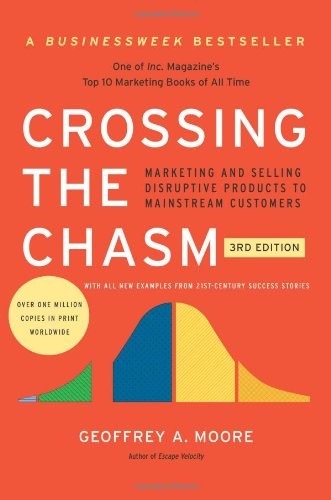
Crossing the Chasm
HarperBusiness · 2014 · 273 pages
ISBN: 9780062292988
Review Editor
Daniel Okafor
Geoffrey A. Moore first published Crossing the Chasm in 1991, and it promptly did something unusual for a business book: it spread entirely by word of mouth among the people it described. Engineers handed it to managers. VCs pressed it on founders. By the time Moore released his third revised edition in 2014, over a million copies were in circulation, and the term “crossing the chasm” had entered the business vocabulary as permanently as “disruption” or “pivot.” Stanford’s Technology Ventures Program called it “still the bible for entrepreneurial marketing” fifteen years after first publication. That kind of longevity is earned, not marketed.
The book’s subject is a specific and frustrating phenomenon: high-tech products that attract an enthusiastic early following, generate genuine excitement, and then quietly die before they ever reach a mainstream audience. Moore calls the gap between early adopters and mainstream customers “the chasm,” and he argues it is the single most dangerous place a technology company can find itself. The early-adopter market and the mainstream market want fundamentally different things, and most companies never figure out that they are playing two very different games at once.
Moore builds his framework on Everett Rogers’s diffusion of innovations research, which mapped how new ideas spread through populations. Rogers identified five adopter segments: innovators, early adopters, early majority, late majority, and laggards. Moore’s core insight was that these segments do not form a smooth bell curve. Between the early adopters and the early majority lies a gap in expectations, psychology, and purchasing behavior wide enough to swallow promising companies whole. Recognizing the chasm exists is step one. Figuring out how to cross it is what the rest of the book is about.
Character Arcs and Development
One of Moore’s most useful contributions is the richness of his character portraits. He renders each adopter segment as a distinct psychographic type with its own motivations, fears, and decision-making logic. The technology enthusiast is the person who wants to own anything with a new chip in it, will put up with clunky interfaces and missing features because the underlying technology is genuinely interesting, and asks the vendor hard questions not to obstruct a sale but because the answers matter to them. The visionary early adopter is more strategic: she sees a competitive advantage in this new technology and is willing to fund its development in exchange for getting there first. Neither of these people, Moore is at pains to show, is the customer you actually need to build a sustainable business.
The central tension of the book plays out between the visionary and the pragmatist. Visionaries want revolutionary change, custom solutions, and a close vendor relationship. Pragmatists want proven technology, references from industry peers, and a complete solution they can deploy without betting their careers on a vendor who might not exist in two years. These two groups are not just different customers; they are genuinely suspicious of each other. Pragmatists do not trust visionaries’ endorsements. Hearing an enthusiastic CTO rave about a product makes a pragmatist IT director more cautious, not less. This asymmetry is the engine of the chasm, and Moore describes it with the precision of someone who has watched it play out in meeting rooms for decades.
Moore illustrates this tension with case studies drawn from the tech industry of the late 1980s and early 1990s, updated in the 2014 revision with examples from cloud computing and enterprise software. Companies like Oracle and Sun Microsystems appear as examples of successful chasm navigation; various cautionary tales show what happens when companies mistake early-adopter enthusiasm for mainstream readiness. The case studies serve as the book’s narrative thread, giving the framework human stakes and making abstract dynamics feel like real problems with real consequences.
Pacing
The book’s structure follows the logic of a consulting engagement: define the problem, explain the cause, prescribe the solution. The first third, which establishes the chasm concept and characterizes the adopter segments, moves quickly and feels urgent. Moore is a confident diagnostician, and the diagnosis is compelling. You find yourself nodding in recognition whether you have lived this failure yourself or watched it happen to someone else.
The middle sections, working through target market selection, the whole product concept, and positioning frameworks, require more patience. The presentation shifts from storytelling to workshopping, and some readers lose momentum here. The 2014 edition softens this by weaving in examples from the SaaS era alongside older ones, though this creates occasional unevenness in tone where vintage 1990s Silicon Valley optimism sits next to analysis of cloud architecture. Treat the denser chapters as a working reference you return to rather than a narrative you read once, and you will get considerably more from them. The final sections, on distribution and pricing strategy, pick up energy again as the frameworks converge into a coherent launch playbook.
Deeper Thematic Exploration
Beneath the marketing framework is a book about why organizations consistently misread their customers. The chasm exists because the technology market is not a single population but a coalition of very different groups whose needs only briefly overlap. Companies that succeed in the early market mistake early-adopter enthusiasm for product-market fit, scale up their sales teams and marketing spend to pursue growth, and then run into a wall. The chasm is the place where excitement turns to confusion, where the product roadmap that a visionary champion loves turns out to be exactly wrong for the pragmatist buyer who needs something she can implement without disrupting her organization on Monday morning.
Moore’s solution is counterintuitive: to cross the chasm, you have to get smaller before you get bigger. You identify a very specific niche where your product, right now, solves a real and urgent problem for pragmatist buyers in a defined vertical. You focus every resource on dominating that niche completely, building the customer references and word-of-mouth that pragmatists actually trust. Then you expand to adjacent niches the way a bowler knocks over pins: one after another, using each one’s momentum to reach the next. Moore calls this the bowling alley strategy, and the D-Day analogy that runs through the book is equally vivid: pick one beach, land everything you have on it, establish the beachhead, and expand from there. Spreading your forces across the entire invasion at once is how you lose.
The concept of the “whole product” is the other idea worth sitting with. A pragmatist customer is not buying a core technology; she is buying a solution to a specific business problem. That solution includes documentation, support contracts, integrations with existing systems, trained implementation partners, and an ecosystem of complementary products that make everything actually work in her environment. Early-stage companies consistently underestimate this. They ship a technically excellent core product, call it done, and wonder why enterprise buyers are not adopting. The answer is usually that what shipped is a part of a product, not a complete one. Moore’s insistence on mapping the whole product before selecting a target market is one of the most practically useful ideas in the book, and it extends far beyond the technology industry to any market where the customer’s buying decision involves more than the product itself.
There is a fourth idea threaded through the book that rarely gets the attention the chasm metaphor does: the self-reinforcing nature of market leadership among pragmatists. Pragmatists buy from market leaders, Moore observes, and market leadership is largely a function of being perceived as the market leader. This is the tornado: the explosive growth that follows successful chasm crossing, where perception of dominance creates actual dominance through buying decisions, partnerships, and press coverage. The implication is that the company that crosses the chasm first in a niche does not just win the niche; it may be very difficult to displace. This idea makes the urgency of crossing the chasm feel even more acute, and it explains why the prescriptions are so specific about focus and resource concentration.
Style and Voice
Moore writes like a consultant who has sat through ten thousand product strategy meetings and has real opinions about what he saw. The prose is direct and confident without being arrogant, and he earns his authority by showing his work rather than asserting it. The analogies are his strongest tool: D-Day, bowling pins, tornadoes, chasms. These give you mental models you can actually use in a room with colleagues. When you find yourself describing a product strategy as “entering the bowling alley” to someone who has also read this book, that shorthand is doing work that a full sentence of explanation could not. Good business writing creates shared vocabulary, and Moore does this as well as anyone in the genre.
The 2014 revision is a genuine update, not a cosmetic one. Moore worked new examples into the existing framework rather than simply appending a new chapter at the end, and the result reads as a coherent whole rather than a book with a timestamp problem. Some passages retain the energy of the original 1991 text in ways that occasionally feel period-specific; the optimism about early-stage technology in the late eighties has a particular flavor. But the core argument is as current as anything written in the last five years about B2B go-to-market strategy, and the prose never retreats into the abstract management-theory register that makes so many business books unreadable by page fifty.
Verdict
If you build, fund, or advise technology products for business customers, this book belongs in your thinking. The chasm concept explains something most founders experience viscerally and can rarely articulate: the baffling moment when early traction fails to convert into growth, when a product that customers love somehow fails to sell to new customers who should love it just as much. Moore gives that experience a name, a cause, and a path forward. You will finish the book with a clearer sense of why your sales pipeline looks the way it does and what to do about it.
The book is less directly useful if your market is primarily consumer. The psychology Moore describes is most acute in B2B technology, where purchasing decisions move through risk-averse committees rather than individual buyers acting on personal preference. Consumer adoption follows different dynamics, and while the adopter-segment framework is still interesting, the prescriptions need significant translation to apply. If you are selling software, services, or hardware to enterprises, institutions, or professional buyers, you will find Moore’s framework clarifying in a way that most business books do not achieve. He does not give you a checklist; he gives you a way of seeing a market. That turns out to be considerably more useful, and considerably more durable.
Frequently Asked Questions about Crossing the Chasm
What is Crossing the Chasm by Geoffrey Moore about?
Crossing the Chasm is a marketing and strategy book that explains why high-tech products often fail to achieve mainstream success despite winning enthusiastic early adopters. Moore identifies a psychological and behavioral gap between early adopters (visionaries) and the early majority (pragmatists), calls it “the chasm,” and provides frameworks for bridging it. First published in 1991, it was revised in 1999 and again in 2014 with updated examples from the software and cloud computing era.
Who should read Crossing the Chasm?
The book is essential reading for founders, product managers, marketers, and investors working in B2B technology. It is also valuable for anyone selling disruptive or unfamiliar products into professional or enterprise markets, including life sciences, hardware, and professional services. Readers focused purely on consumer markets will find the adopter framework interesting but will need to adapt the prescriptions significantly, as Moore’s specific strategies are designed for business purchasing environments where risk-aversion and reference-checking dominate.
What is “the chasm” in Geoffrey Moore’s Crossing the Chasm?
The chasm is the gap between early adopters and the early majority in the technology adoption lifecycle. Early adopters (visionaries) are willing to take risks on unproven technology in exchange for competitive advantage. The early majority (pragmatists) buy only proven solutions with established customer references and a complete support ecosystem around them. These two groups have such different expectations and decision-making criteria that successfully selling to one group does not automatically lead to success with the other. Many promising technology companies stall permanently in this gap.
Is Crossing the Chasm still relevant today?
Yes, significantly. The underlying psychology of how different customer types evaluate and adopt new technology has not changed, and Moore’s 2014 revision updates the examples to include SaaS, cloud infrastructure, and platform businesses. The chasm concept remains the most useful available explanation for why enterprise startups with genuine early traction so often fail to scale into mainstream markets. Practitioners in venture capital and enterprise software regularly cite it as foundational, and the vocabulary it created is in daily use across the technology industry.
What is the “whole product” concept in Crossing the Chasm?
The whole product is Moore’s term for the complete solution a pragmatist customer actually needs, as opposed to the core product a startup ships. A pragmatist buyer is not purchasing technology; she is purchasing a solution to a specific business problem. That solution requires implementation support, training, integrations with existing systems, partner ecosystems, documentation, and ongoing service. Companies that ship only the core product and expect pragmatists to assemble the rest consistently underperform in mainstream markets, even when the core technology is genuinely superior.
How long is Crossing the Chasm and is it a difficult read?
The 2014 third edition runs 273 pages and is written for a general business audience, not an academic one. Most readers comfortable with business nonfiction will move through it in four to six hours. The first half is narrative and conceptual and moves quickly; the second half is more prescriptive and framework-heavy, which some readers find denser. The book rewards active reading with a notebook nearby, especially the chapters on target market selection and whole product definition, which contain the most actionable material.
How does Crossing the Chasm compare to The Innovator’s Dilemma and other innovation books?
It works well alongside Clayton Christensen’s The Innovator’s Dilemma, which explains why established companies fail to respond to disruptive innovations from the incumbent’s perspective. Moore focuses on the opposite problem: how do you get a disruptive product adopted in the first place? Everett Rogers’s Diffusion of Innovations provides the academic foundation Moore builds on; where Rogers describes how diffusion happens descriptively, Moore addresses the practitioner’s question of how to make it happen. Many readers find all three books complementary and read them together.
Should I read Crossing the Chasm and is it worth the time?
If you work in B2B technology in any capacity, yes, and probably sooner rather than later. The frameworks are most useful before you encounter the chasm, not after you are already stuck in it. If you are in early-stage enterprise sales, product management, or growth strategy, this book will clarify decisions you are already making by giving them a more precise vocabulary and a cleaner model. If you are building primarily consumer products, it is still worth reading for the adopter psychology framework, with the understanding that the specific prescriptions will not map directly onto your market.
Book Details
- Title
- Crossing the Chasm
- Author
- Geoffrey A. Moore
- Genre
- Business
- Publisher
- HarperBusiness
- Year Published
- 2014
- Pages
- 273
- ISBN
- 9780062292988
- WritersReview Rating
- 4.3 / 5