
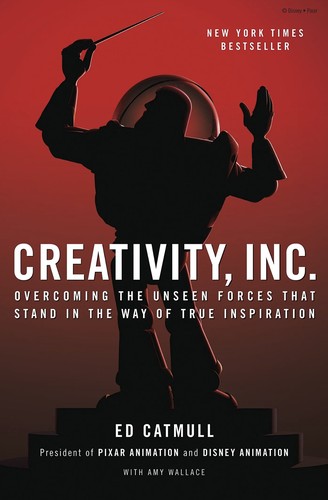
Creativity, Inc.
Random House · 2014 · 368 pages
ISBN: 9780812993011
Review Editor
Daniel Okafor
Ed Catmull spent a good part of his twenties trying to solve a problem that most people thought was impossible: making a computer-animated feature film. Not a short. Not a demo reel. A full movie, ninety minutes or more, rendered entirely by machine. He started working on the idea around 1974, when computer animation existed only as theory and wishful math, and did not see it realized until Toy Story opened in theaters in November 1995. Twenty-one years. That is the kind of obsessive patience that does not make for a conventional management book, and Creativity, Inc. is not a conventional management book.
Published in April 2014, it is the memoir of how Catmull built Pixar Animation Studios and what he learned about sustaining creative work inside an organization over time. He co-wrote it with journalist Amy Wallace. The book covers his path from a computer science PhD student at the University of Utah through his years at Lucasfilm, the founding of Pixar after Steve Jobs purchased that division in 1986, the making of a string of films from Toy Story through Brave, the Disney acquisition of Pixar in 2006, and his role overseeing both Pixar and Disney Animation thereafter. That is a lot of ground, and the book earns the right to cover it.
But the story is not really about movies. It is about one question: how do you build an organization where creative work can thrive, not once, not when conditions are perfect, but year after year across hundreds of people? Catmull has spent decades trying to answer that question with structures and processes rather than platitudes, and this book is the best account he has been able to give of what he found.
Character Arcs and Development
Because this is a memoir about a real organization, the people in it are real, and the most important arc belongs to Catmull himself. The version of him that opens the book is technically gifted but organizationally naive, someone who assumed, once Pixar achieved its first successes, that good outcomes meant good processes. He learns slowly and sometimes painfully that they do not. When Pixar became commercially successful in the late 1990s, he admits that he confused the absence of complaint with the absence of problems. That mistake had real consequences, and the book is honest about them.
John Lasseter, Pixar’s longtime creative director and the director of Toy Story, appears throughout as a necessary counterweight. Where Catmull thinks in systems and structures, Lasseter thinks in images and emotion. The tension between those orientations is one of the book’s more productive subjects. Catmull does not spend much time on what he cannot speak to fully, and Lasseter’s personal life stays largely off the page. What comes through is a portrait of a creative leader who understood instinctively what Catmull had to work out analytically, and the two covering for each other’s blind spots.
Steve Jobs is the third major presence in the book. Catmull does not write a eulogy. Jobs appears here as someone who was often wrong, sometimes brilliantly right, and genuinely changed by the experience of being part of Pixar for two decades. The portrait Catmull offers is specific: a man who started as an investor with forceful opinions and became, over time, a genuine collaborator who could be talked out of a position. Catmull describes watching Jobs at the 2011 Academy Awards, visibly ill but still sharp, still curious, still fighting, and the passage works because by that point the book has given you enough of their actual history to feel the weight of it.
Pacing
The book moves roughly in chronological order but pauses frequently for chapters that read more like essays. “Ugly Babies,” which is about protecting fragile early creative ideas from premature criticism, functions almost as a standalone piece. So does the chapter called “The Hidden,” which explores the organizational forces that damage creative work precisely because they are invisible until they have already done harm. These interruptions strengthen the first half of the book. In the second half, as Catmull turns to the Disney acquisition and the broader challenges of running two studios simultaneously, the essayistic chapters begin to accumulate, and some readers may feel the narrative energy drop.
The most alive passages are the ones where something went badly wrong. Catmull is better at failure than at success, which is saying something given how much success Pixar had. The description of what he calls the story crisis on Toy Story, the point at which the film was heading in a direction that no one liked but everyone had stopped saying clearly, is one of the sharpest passages in the book. It captures how creative dysfunction actually spreads through a team. The chapters on post-production and postmortems have a similar energy. Success gets treated somewhat more abstractly, which is a small cost for a book this candid about difficulty.
Deeper Thematic Exploration
The core argument here is that most creative organizations fail not because they lack talented people but because they are afraid of honesty. Fear of candid feedback, fear of admitting a problem, fear of looking uncertain or wrong in front of colleagues: these fears push organizations toward the appearance of function rather than actual function. The whole institutional architecture Catmull built at Pixar, from the Braintrust to the postmortems to the physical layout of the studio, is an attempt to fight that fear through structure.
The Braintrust is the most discussed of these structures. It is a group of senior Pixar filmmakers who watch in-progress cuts of each film and give the director completely candid feedback about what is not working. The structural key, and Catmull returns to this point several times, is that the Braintrust has no authority over the film. It can say anything. The director is not obligated to do anything with what it says. Catmull argues that decoupling the authority to criticize from the authority to decide is what makes the feedback genuinely useful, because it removes the defensive reaction that makes most organizational feedback useless. Whether this would work the same way in organizations without Pixar’s specific culture is a question the book raises but does not fully answer. Catmull is admirably honest about the fact that structures do not transplant cleanly.
A second theme, less discussed but more interesting, is the concept Catmull calls “unknown unknowns.” The phrase comes from public life, but he uses it seriously: the problems most likely to hurt an organization are the ones no one has identified yet, because they are invisible until they are active. Much of what he describes building at Pixar is a set of conditions under which problems surface before they become catastrophic. The postmortems, the candid reviews, the culture of honest disagreement: all of these are in some sense early-warning systems. The sobering conclusion Catmull reaches is that even with all this infrastructure, Pixar still encountered serious failures it had not seen coming. The book does not claim to have solved the problem. It claims to have made the problem slightly more manageable, which is more useful.
A third strand worth noting is Catmull’s skepticism about business frameworks in general. He is critical of the idea, common in management literature, that successful companies can identify the principles behind their success and hand them to other organizations. He makes this point not with contempt but with specificity: what worked at Pixar depended on particular people in a particular context, and pretending otherwise is how lessons become platitudes. It is a generous observation, and it applies equally well to this book.
Style and Voice
Catmull writes clearly and without flourish. The prose is functional rather than beautiful, which is the right call. A book arguing that ego management is central to creative work probably should not have a self-congratulatory narrator, and this one does not. Wallace’s contribution presumably helped with sentence rhythm and structure, and the individual chapters hold together better than most collaborative business writing. The book reads like someone who has spent years talking about these ideas in private and is now, for the first time, putting them on paper for an audience.
What distinguishes the voice is the willingness to stay uncertain. Catmull does not spend much time telling you what he has figured out. He spends considerably more time telling you what he got wrong, what he still does not understand, and what he suspects is true but cannot prove. In a genre where authority is usually performed through confidence, that stance is unusual, and it makes the moments where he is confident feel more credible.
Verdict
Read this book if you are interested in how creative organizations actually work over time, not in theory but in practice, with specific people making specific decisions in specific moments. Read it if you manage a team and want to think more rigorously about the gap between what people say in meetings and what is actually true. Read it if you work somewhere that makes things and you have noticed that the organization seems to work against the work in ways that nobody is quite naming directly.
It is not a perfect book. The second half loses some of the narrative drive of the first. Some chapters are still working through ideas rather than presenting fully formed conclusions. But the imperfection is part of why it is trustworthy. Catmull is not selling a method. He is reporting on a long attempt to solve a hard problem, being honest about what he found and what he did not, and leaving the reader to decide what is useful. In the business section, that kind of honesty is worth a great deal.
Frequently Asked Questions about Creativity, Inc.
What is Creativity, Inc. by Ed Catmull about?
Creativity, Inc. is a business memoir by Ed Catmull, co-founder of Pixar Animation Studios, written with journalist Amy Wallace. It traces Catmull’s career from graduate student to president of Pixar and Disney Animation, focusing on the organizational principles he developed to sustain high-quality creative work over decades. The book covers Pixar’s major films, the Disney acquisition, and Catmull’s long working relationship with Steve Jobs.
Is Creativity, Inc. only useful for people in the film industry?
No. The Pixar stories provide the narrative, but the management principles apply to any organization producing complex collaborative work: software teams, design studios, research groups, advertising agencies. Catmull’s thinking about candid feedback, psychological safety, and how fear quietly shapes organizational behavior is relevant well outside animation. Many readers in tech, design, and consulting have found it directly useful.
What is the Braintrust in Creativity, Inc.?
The Braintrust is Pixar’s internal peer review process for films in production. Senior filmmakers gather to watch unfinished cuts and give candid feedback to the director. The key design feature is that the Braintrust carries no authority: it can say anything, but the director decides what to do with the feedback. Catmull argues this separation is what makes the honesty possible, because no one is fighting for control of the outcome.
How does Creativity, Inc. handle the topic of failure?
Better than most business books. Catmull is more detailed and honest about what went wrong at Pixar than about what went right. He describes specific production crises, decisions that backfired, and structural problems that persisted for years before anyone named them clearly. He does not frame failure as secretly useful or as a step on the path to success. He treats it as something that happens and that organizations can learn to surface earlier if they build the right conditions.
How long is Creativity, Inc. and is it a difficult read?
The US hardcover edition is 368 pages. The book reads at an accessible, conversational level with no specialized knowledge of filmmaking or management theory required. Most readers finish it in three to five hours. The middle sections are denser than the narrative chapters, but the writing is clear throughout and does not require close technical attention.
What are the main themes in Creativity, Inc.?
The book’s main themes include the role of candor and honest feedback in keeping creative organizations healthy; how fear of failure shapes organizational behavior in ways that are hard to see and easy to underestimate; the concept of “unknown unknowns” and how leaders can build systems that surface hidden problems; the tension between individual creative vision and collective process; and the limits of frameworks for capturing what actually makes a creative culture work.
How does Creativity, Inc. compare to other business books like Good to Great or Radical Candor?
Creativity, Inc. is less systematic than either of those books and more honest about what it does not know. Catmull explicitly criticizes the idea that lessons from successful companies can be extracted and applied elsewhere wholesale. Readers who prefer a clean, actionable framework may find it unsatisfying. Readers who want a detailed, first-person account of a real organization trying to solve real problems over a long period of time will find it more useful than most books in the genre.
Should I read Creativity, Inc. and is it worth my time?
If you work in any kind of collaborative creative environment, yes. The book contains genuine ideas, not just compelling stories dressed up as principles. It is honest about its limitations, which makes the advice it does give more credible. If you want a step-by-step management system, you will leave partially unsatisfied. If you want to spend a few hours thinking seriously about how creative organizations work, fail, and sometimes get better, this is one of the more useful places to start.
Book Details
- Title
- Creativity, Inc.
- Author
- Ed Catmull
- Genre
- Business
- Publisher
- Random House
- Year Published
- 2014
- Pages
- 368
- ISBN
- 9780812993011
- WritersReview Rating
- 4.3 / 5