
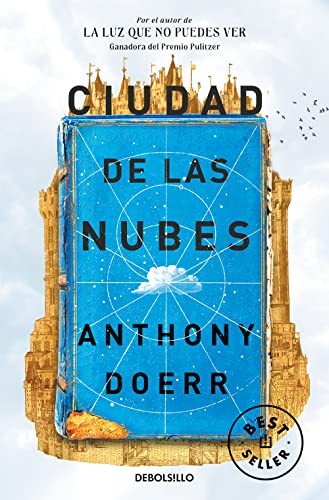
Cloud Cuckoo Land
Scribner · 2021 · 688 pages
ISBN: 9788466362641
Review Editor
Claire Beaumont
Summary
Anthony Doerr’s Cloud Cuckoo Land, published in 2021, is a novel about the persistence of stories across time. It weaves together five separate narrative strands spanning fifteen hundred years: Anna, a young seamstress in fifteenth-century Constantinople as the city falls to the Ottomans; Omeir, a Bulgarian farm boy conscripted into the Ottoman siege army; Zeno, an elderly classics scholar in a small Idaho library in 2020 who has spent his life translating a lost ancient Greek text; Seymour, a troubled teenager in the same Idaho town who becomes radicalized; and Konstance, a young woman aboard a generation ship heading to an Earth-like exoplanet in a possible future.
The thread connecting all five stories is a fictional ancient Greek text called “Aethon,” a comic adventure story about a shepherd who wishes to find the mythical city of Cloud Cuckoo Land from Aristophanes, an actual ancient comedy. This invented text, which Doerr writes in full as a story within the novel, has survived across fifteen centuries in various fragmentary forms, and each of the novel’s characters encounters it at a moment of particular need.
The ambition of the project is extraordinary: Doerr is writing about the way stories survive catastrophe, about what it means to preserve a text across centuries, and about the relationship between individual human lives and the vast sweep of time. Cloud Cuckoo Land was a finalist for the National Book Award in 2021 and is, in the view of many critics, a more formally daring work than All the Light We Cannot See, though it has attracted a slightly smaller readership because the ambition requires more patience.
Character Arcs and Development
Anna is the novel’s most fully realized historical character. Her world, fifteenth-century Constantinople before and during the Ottoman siege, is rendered with the same sensory density that Doerr brought to World War Two France, and her relationship with books and learning, which she pursues in secret because women of her class and time had no sanctioned access to libraries, gives her arc a particular urgency. Her encounter with fragments of the Aethon text is genuinely moving, partly because of how much it costs her to have it.
Zeno is the novel’s quiet emotional center. A gay man of his generation who spent much of his life hiding who he was, he has channeled his passion and his loneliness into the translation of an ancient comic text, and the scenes of Zeno working with a group of children on a stage adaptation of the story are among the warmest and most affecting Doerr has written. His backstory, which involves a friendship formed in a Korean War prisoner-of-war camp, is handled with restraint and great tenderness.
Seymour, the radicalized teenager, is the novel’s most contemporary and most difficult character. Doerr traces his radicalization with psychological accuracy and without sensationalism: Seymour has genuine grievances, genuine neurodiversity, and genuine kindness, and the process by which he is shaped into someone capable of violence is drawn with uncomfortable clarity. Konstance, aboard the generation ship, provides the novel’s furthest perspective in time and the most speculative: her story asks what a text means to someone who encounters it centuries after all its original context has been lost.
Pacing
The novel’s five-strand structure means that pacing is experienced differently than in a conventional novel. Each strand has its own rhythm: Anna’s sections have the immersive slowness of historical fiction in a fully rendered period; Seymour’s have the heightened anxiety of a contemporary thriller; Konstance’s have the strange temporality of science fiction; Zeno’s have the warmth and autumn light of an old man approaching the end of a long, mostly secret life. Doerr manages these registers with considerable skill, and the transitions between strands rarely feel jarring.
The novel is long, at nearly 700 pages, and some readers will find the multiple strands more difficult to sustain than the dual structure of All the Light We Cannot See. The sections set aboard the generation ship are the most likely to test patience, as Konstance’s situation is by design more isolated and less action-driven than the other storylines. But the payoff, when the strands begin to connect in ways the reader has not anticipated, is significant. Doerr has designed the novel’s convergences carefully, and the connections across centuries feel earned rather than contrived.
Deeper Thematic Exploration
The central argument of Cloud Cuckoo Land is that stories are one of the most important technologies humanity has developed: that they survive catastrophe, carry wisdom across time, and provide consolation and meaning to people who encounter them in moments of extremity. This is not a modest argument, and Doerr makes it without embarrassment. The survival of the Aethon text across fifteen centuries, through fire and war and shipwreck and the fall of civilizations, is the novel’s central plot device and its central metaphor.
The novel also thinks carefully about what texts lose and gain through transmission. Zeno’s translation of the Aethon story is itself an act of love and interpretation, and the novel shows how each person who encounters the text brings their own circumstances to bear on it. Anna reads it as a young woman desperate to escape her circumstances. A prisoner of war reads it as a way of sustaining hope. Konstance reads it as the last survivor of a catastrophe, with no living community to share it with. Each reading is different, and together they constitute an argument about what literature is for.
Environmental catastrophe is an implicit thread running through the novel’s contemporary and future sections: the radicalization of Seymour is driven partly by his grief at the destruction of a nearby forest, and Konstance’s generation ship has left an Earth that is no longer habitable. Doerr handles this with restraint, allowing the environmental themes to be present without overwhelming the more intimate human stories. But the novel’s final shape makes clear that this is not incidental: the question of whether stories can help us survive what we are doing to the planet is one the novel takes seriously.
Style and Voice
Doerr writes in five distinct voices across the novel’s five strands, each calibrated to its period and character. The ancient Greek sections, the Aethon text itself, are written in a deliberately archaic comic style that manages to be genuinely funny as well as parodic. Anna’s sections have a medieval texture that avoids the usual pitfalls of historical fiction pastiche, feeling inhabited rather than costumed. Zeno’s sections have the gentle, slightly formal prose of an older man looking back on a long life. Seymour’s are sharp and anxious. Konstance’s are spare and strange.
What unifies the novel’s varied voices is Doerr’s characteristic attention to the physical world and his ability to render both beauty and violence with equal precision. The scenes of Constantinople under siege are among the most visceral war writing he has done, and the scenes of Zeno’s library in Idaho are among the warmest. Both modes feel equally reliable, and the reader trusts Doerr to render whatever world he is in with full attention.
Verdict
Cloud Cuckoo Land is the more ambitious of Doerr’s two major novels, and the case can be made that it is the better one. Its five-strand structure is a genuine formal achievement, its thematic argument about the function of stories is carried out with both intellectual rigor and emotional warmth, and its character work, particularly Zeno and Anna, is as fine as anything Doerr has written. It will ask more of readers than All the Light We Cannot See, and it will reward the investment proportionally.
This is a novel for anyone who has ever been saved by a book, or who has wondered what stories are actually for, or who has felt the weight of what might be lost as the world changes. Doerr has written something generous and serious and genuinely hopeful, and hope earned through this kind of craft and care is worth having.
Frequently Asked Questions about Cloud Cuckoo Land
What is Cloud Cuckoo Land by Anthony Doerr about?
Cloud Cuckoo Land weaves together five narrative strands across fifteen hundred years of history. The stories follow Anna, a seamstress in fifteenth-century Constantinople; Omeir, a Bulgarian soldier in the Ottoman siege army; Zeno, an elderly classics scholar in modern Idaho; Seymour, a radicalized teenager in the same town; and Konstance, a young woman aboard a generation ship in the future. All five characters are connected by a fictional ancient Greek text called Aethon, a comic adventure story about finding the mythical city of Cloud Cuckoo Land, which has survived across centuries in fragments and provides consolation and meaning to each of them in different ways.
How does Cloud Cuckoo Land compare to All the Light We Cannot See?
Cloud Cuckoo Land is generally considered Anthony Doerr’s more formally ambitious novel, spanning fifteen hundred years and five narrative strands rather than two. It has attracted a slightly smaller readership because the structure requires more patience and the investment is spread across more characters and time periods. However, many critics and readers who engage fully with it regard it as the richer and more thematically ambitious work. All the Light We Cannot See is more immediately gripping; Cloud Cuckoo Land is more expansive and more interested in the long arc of human history.
What is the ancient text called Aethon in Cloud Cuckoo Land?
Aethon is a fictional ancient Greek comic text that Doerr invented and wrote in full as part of the novel. It is presented as a real ancient text in the world of the novel, supposedly written by Diogenes of Sinope, about a shepherd who tries to find the mythical city of Cloud Cuckoo Land after being transformed into various animals. The text has survived in fragments across fifteen centuries, and each of the novel’s five characters encounters it at a moment of particular need. Doerr was inspired by real fragmentary ancient texts and by Aristophanes’ comedy The Birds, which features a city called Cloud Cuckoo Land.
Is Cloud Cuckoo Land difficult to read?
Cloud Cuckoo Land is more demanding than most contemporary literary fiction because of its five-strand structure and fifteen-hundred-year time span. Readers need to track five separate sets of characters, three distinct historical periods, and an invented ancient text that appears throughout. However, Doerr manages the transitions between strands skillfully, each strand has a distinct voice and rhythm, and the connections that gradually emerge between them are genuinely surprising and satisfying. Readers who are patient with structural complexity will find the novel rewards sustained attention.
What is the theme of stories and books in Cloud Cuckoo Land?
The novel’s central argument is that stories are among humanity’s most important technologies: that they survive catastrophe, carry wisdom across time, and provide consolation to people who encounter them in moments of extremity. The survival of the Aethon text across fifteen centuries, through fire and war and the fall of civilizations, is both the novel’s central plot device and its central metaphor. Doerr makes this argument not as a romantic abstraction but by showing concretely what the text means to each character who encounters it, and how its meaning changes depending on who is reading and why.
Was Cloud Cuckoo Land nominated for any awards?
Cloud Cuckoo Land was a finalist for the National Book Award for Fiction in 2021. It was also longlisted for several other major prizes and named one of the best books of 2021 by numerous publications including The New York Times, Time magazine, and The Washington Post. While it did not win the National Book Award, its recognition confirmed Doerr’s status as one of the most significant American literary novelists working today.
Who is Zeno in Cloud Cuckoo Land?
Zeno Ninis is an elderly classics scholar living in Lakeport, Idaho, who has spent decades translating the fragmentary ancient Greek text known as Aethon. He is a gay man of his generation who spent much of his life hiding who he was, channeling his passion and loneliness into the translation project and into working with a group of local children on a stage adaptation of the story. His backstory involves a friendship formed in a Korean War prisoner-of-war camp that shaped his relationship to the text. He is the novel’s quiet emotional center and one of Doerr’s finest characters.
Should I read Cloud Cuckoo Land or All the Light We Cannot See first?
If you have not read either, start with All the Light We Cannot See. It is slightly more accessible in structure and its WWII setting is a familiar context for most readers, making the emotional investment easier to establish quickly. Cloud Cuckoo Land rewards the reader who comes to it with some sense of what Doerr can do, and its more ambitious structure is easier to appreciate with a prior experience of his work. That said, both novels stand alone entirely, and there is no narrative connection between them beyond Doerr’s characteristic themes and sensibility.
Book Details
- Title
- Cloud Cuckoo Land
- Author
- Anthony Doerr
- Genre
- Literary Fiction
- Publisher
- Scribner
- Year Published
- 2021
- Pages
- 688
- ISBN
- 9788466362641
- WritersReview Rating
- 5.0 / 5