
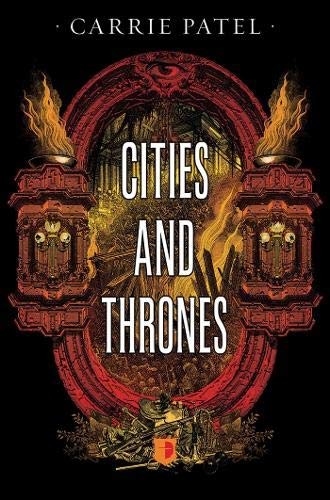
Cities and Thrones
Angry Robot · 2015 · 448 pages
ISBN: 9780857665539
Review Editor
Marcus Webb
Imagine a city buried beneath the earth, sealed away from everything the old world once knew, where the ruling class has decided that the most dangerous thing a citizen can do is read. That is the premise behind Carrie Patel’s Recoletta trilogy, and Cities and Thrones, the second installment published in 2015 by Angry Robot, takes that premise and cracks it wide open. Where the first book, The Buried Life, played out as a gaslit whodunit inside the underground city of Recoletta, this sequel expands the scope dramatically. A revolution has toppled the old order. The forbidden histories that leaders spent centuries suppressing are now loose in the world. And nobody, from the newly installed government to the foreign powers circling like vultures, has any idea what comes next.
The story picks up in the aftermath of the coup that ended The Buried Life. Recoletta is under new management, led by the revolutionary Sato, who seized power with populist fury but now faces the far harder work of actually governing. Inspector Liesl Malone, who helped bring down the old regime, finds herself reluctantly serving the new one as head of the city’s police force. Meanwhile, Jane Lin, the laundress turned unlikely spy, has fled Recoletta entirely with her companion Fredrick, landing in a neighboring city-state where she must navigate unfamiliar politics just to survive. Between these two women, Patel weaves a story about what happens after the revolution, when the slogans stop and the compromises start.
At the center of everything sits a hidden library, a cache of pre-Catastrophe knowledge that multiple factions want to control or destroy. The Catastrophe, whatever it was, ended the world above and drove humanity underground. For generations, the ruling class used fear of that event to justify censorship on a civilizational scale. Now that the old censors are gone, the question of what to do with dangerous knowledge becomes the engine that drives every character’s choices.
Character Arcs and Development
Liesl Malone is the book’s moral center, and Patel gives her a genuinely difficult position to inhabit. In The Buried Life, Malone was the stubborn detective who would not stop pulling threads even when her superiors told her to let go. Here, she is one of those superiors, and she discovers that holding power feels nothing like speaking truth to it. She reports directly to Sato, a leader whose idealism is curdling into paranoia, and Malone must decide over and over where the line falls between loyalty and conscience. Patel is smart enough to make those decisions cost something. Malone loses allies, burns bridges, and occasionally makes calls that the reader can see are wrong before Malone herself does. That gap between her self-image and her actions gives the character real weight.
Jane Lin benefits enormously from the expanded setting. In the first book, her role as a seemingly invisible laundress who overhears things felt a bit thin at times. Here, exiled from everything familiar, Jane comes into her own. She is resourceful, observant, and willing to play a longer game than anyone around her expects. Patel sends her to the city of Madina, a trade hub above ground, and watching Jane adapt to a society with completely different rules about class and power is one of the book’s pleasures. She is not suddenly a fighter or a genius strategist; she is someone who pays attention, and in a world where everyone else is busy posturing, that turns out to be a formidable skill.
The men in their orbits, the spy Roman Arnault and the steadfast Fredrick Anders, are drawn with less complexity. Roman remains the charismatic rogue whose true loyalties stay conveniently murky, and Fredrick is loyal to the point where you want to shake him and ask what he actually wants for himself. They serve the plot well enough, but Patel clearly saves her sharpest character work for Malone and Jane. The villain of the piece, if there is one, is less a single person than a set of competing institutions, each convinced that controlling information is the key to controlling everything else.
Pacing
Cities and Thrones moves with purpose, though not always with urgency. The first act, which establishes the new political landscape and splits the narrative between Recoletta and Madina, takes its time. Patel has a lot of world-building to do, introducing new cities, factions, and power dynamics, and she handles it by draping exposition across scenes of political maneuvering. This works better than it sounds, because the politics are genuinely interesting, but readers who came for the mystery-thriller pace of The Buried Life may find the opening third slower than expected.
The middle section picks up considerably once the hunt for the hidden library becomes the focal point. From there, the book builds momentum steadily, with betrayals and reversals stacking up in a way that rewards close attention. The final act is propulsive and ends on a note that is less a cliffhanger than a launching pad, setting up the trilogy’s conclusion, The Song of the Dead, with real stakes and unresolved tensions that feel earned rather than manufactured.
Deeper Thematic Exploration
At its core, Cities and Thrones is a novel about the politics of knowledge. Who gets to decide what the public knows? What happens when suppressed information is released all at once? And is there ever a legitimate reason to keep dangerous truths hidden? These are not abstract questions in Patel’s world. The Catastrophe destroyed civilization, and the rulers of Recoletta built their entire system of government on the premise that preventing another one required keeping citizens ignorant of the past. The revolution dismantled that system, but it did not answer the underlying question: was the censorship wrong on principle, or just wrong in practice?
Patel refuses to give a simple answer, and that restraint is the book’s greatest strength. Sato, the revolutionary, begins with a genuine belief that free access to knowledge will liberate the people. By the midpoint of the novel, she is making her own decisions about what information to suppress, and the reader can trace exactly how she got there, one pragmatic compromise at a time. Malone watches this happen and recognizes the pattern from the old regime, but recognizing a problem and knowing how to fix it are different skills entirely.
There is also a sharp thread about the relationship between revolution and governance. Patel is clearly interested in the gap between tearing something down and building something better. Nearly every faction in the book, from Sato’s government to the foreign oligarchs to the underground resistance, believes it has the right answer for Recoletta’s future. None of them do, and the collisions between their competing visions generate most of the novel’s tension. The book suggests, without being heavy-handed about it, that the hardest part of any revolution is the morning after.
Style and Voice
Patel writes clean, functional prose that prioritizes clarity over ornamentation. Her sentences tend toward the short and direct, which suits the thriller elements of the story well. She has a particular talent for conveying political dynamics through dialogue; her characters talk the way people in power actually talk, circling around their real intentions, testing each other with half-truths, saying one thing while meaning three others. The scenes between Malone and Sato crackle with this kind of subtext.
The world-building is handled with a light touch. Patel gives you enough detail to see Recoletta’s gaslit corridors and Madina’s sun-bleached markets, but she trusts the reader to fill in gaps rather than cataloguing every architectural feature. This works to the book’s advantage in most scenes, though there are moments, particularly in the newer cities, where a few more concrete details would help anchor the reader’s imagination. The narrative alternates between Malone’s and Jane’s perspectives, and the voice shifts subtly between them: more clipped and restrained for Malone, more observational and wondering for Jane.
Verdict
Cities and Thrones is a smart, ambitious sequel that trades the tighter focus of The Buried Life for a broader canvas and more complex politics. It asks real questions about power, knowledge, and the cost of revolution, and it has the integrity not to offer easy answers. The character work on Malone and Jane is strong enough to carry the narrative through its slower stretches, and the expanded world-building rewards readers who are willing to invest in the series as a whole.
If you enjoy science fiction that is more interested in political intrigue than laser battles, this is your kind of book. Readers who loved the mystery structure of The Buried Life should know going in that this sequel leans harder into political thriller territory. The pacing is occasionally uneven, and the male characters could use more depth, but these are minor complaints against a novel that is doing something genuinely interesting with its setting and themes. Pick this up if you want fiction that treats politics as the messy, compromised, deeply human business it actually is, and if you are ready to commit to the trilogy, because the ending will absolutely send you reaching for The Song of the Dead.
Frequently Asked Questions about Cities and Thrones
What is Cities and Thrones by Carrie Patel about?
Cities and Thrones is the second book in the Recoletta trilogy, set in an underground city called Recoletta in a post-apocalyptic world. After a revolution topples the old government, Inspector Liesl Malone struggles to keep order under the new regime while Jane Lin flees to a neighboring city-state. At the center of the conflict is a hidden library of forbidden pre-Catastrophe knowledge that multiple factions want to control.
Do I need to read The Buried Life before Cities and Thrones?
Yes, you should read The Buried Life first. Cities and Thrones is a direct sequel that picks up immediately after the events of the first book. Key character relationships, the political situation in Recoletta, and the significance of the Catastrophe are all established in The Buried Life, and jumping in at book two would leave you missing important context.
What are the main themes in Cities and Thrones by Carrie Patel?
The book explores the politics of knowledge and censorship, asking who gets to decide what information the public can access. It also examines the gap between revolution and governance, showing how idealists become compromised once they hold power. Class divisions, the ethics of secrecy, and the tension between security and freedom run through every major plot thread.
How long is Cities and Thrones and is it a difficult read?
Cities and Thrones is 448 pages and reads at a moderate pace. The prose is straightforward and accessible, so the reading level is not demanding. However, the political intrigue involves multiple factions and shifting alliances, which requires some attention to keep track of who is working with or against whom.
Is there a movie or TV adaptation of Cities and Thrones?
There is no movie or TV adaptation of Cities and Thrones or any book in the Recoletta trilogy as of 2026. The series has a dedicated readership but has not been optioned for screen adaptation. Carrie Patel does work as a narrative designer at Obsidian Entertainment, the video game studio, but that work is separate from her novels.
What age group or reading level is Cities and Thrones appropriate for?
Carrie Patel wrote Cities and Thrones for adult readers. It contains political violence, themes of authoritarianism and revolution, and some scenes of physical danger, but nothing gratuitously graphic. Mature teens who enjoy political science fiction would likely handle it fine, but the political complexity is aimed at an adult audience.
How does Cities and Thrones compare to The Buried Life and The Song of the Dead?
The Buried Life reads more like a detective mystery set in a unique world, while Cities and Thrones shifts into political thriller territory with a broader scope. The sequel expands beyond Recoletta to introduce new cities and factions, making it feel bigger but occasionally slower. The Song of the Dead, the trilogy’s conclusion, reportedly brings the threads together with higher stakes. Many readers consider Cities and Thrones the most politically ambitious of the three.
Should I read Cities and Thrones and is it worth it?
If you enjoyed The Buried Life and want to see Patel’s world open up, Cities and Thrones delivers. It is best suited for readers who enjoy political intrigue, morally gray characters, and science fiction that prioritizes ideas over action. If you need fast pacing throughout or prefer standalone novels, this might test your patience in the early chapters. But for readers willing to invest in the full trilogy, it is a rewarding middle chapter that deepens everything the first book started.
Book Details
- Title
- Cities and Thrones
- Author
- Carrie Patel
- Genre
- Science Fiction
- Publisher
- Angry Robot
- Year Published
- 2015
- Pages
- 448
- ISBN
- 9780857665539
- WritersReview Rating
- 3.8 / 5