
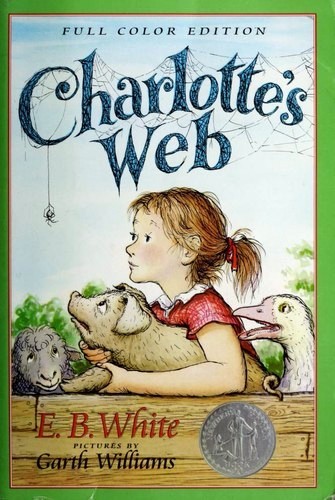
Charlotte’s Web
Harper & Brothers · 1952 · 184 pages
ISBN: 9780064410939
Review Editor
Hannah Bright
Charlotte’s Web, published on October 15, 1952, by Harper and Brothers, is a children’s novel by E.B. White, the American essayist who spent decades writing for The New Yorker and who co-wrote The Elements of Style with William Strunk Jr. The book’s illustrations, by Garth Williams, match the prose exactly: warm and precise and a little melancholy. Together they created one of the most read books in American publishing history, a story that has sold more than 45 million copies worldwide and been translated into dozens of languages.
The novel opens on a farm in rural Maine. Fern Arable, eight years old, learns that her father plans to kill the runt of a new litter of pigs. She argues him out of it with the kind of clear moral logic that children sometimes find easier than adults do. She names the pig Wilbur and raises him herself until he outgrows the household and moves to the nearby Zuckerman farm. There he settles into a stall in a barn full of geese, a fat old rat named Templeton, some sheep, and a spider named Charlotte A. Cavatica, who lives in the corner of the doorway and has been watching everything.
The trouble, which Wilbur learns about from the other animals, is that pigs on farms have a particular relationship with autumn. Charlotte hears about the problem and decides to help. She has a plan involving her web and the words she can spin into it. She also has other plans, which she keeps to herself, because she understands the nature of time in a way that Wilbur does not yet. The book begins as a story about a pig saved by a girl and becomes something more complicated and more true as it goes.
Character Arcs and Development
Wilbur is one of the most convincingly innocent characters in American children’s fiction. He wants food, warmth, company, and the reassurance that everything will be fine. White does not give him false courage or a sudden discovery of inner strength. His development is quieter than that. Over the course of the novel, Wilbur learns to hold the knowledge of something frightening without being undone by it. He does not transform into a different kind of animal. He becomes a slightly more complete version of himself, which is all most creatures manage, and in the context of this story, it is enough.
Charlotte is his opposite: self-possessed, strategic, and clear-eyed about the facts of the world. She eats insects to survive and acknowledges this without apology or embarrassment. When she decides to help Wilbur, she approaches the problem with method and patience, setting each word into her web with the care of someone who understands that doing the work well is the point. White traces the cost of Charlotte’s sustained effort through small physical details accumulated across the book’s second half. He does not announce what is happening. He lets the details accumulate and speak for themselves, and the effect is considerably more powerful than any announcement would have been.
Fern’s arc is the novel’s quietest and possibly its most melancholy thread. In the early chapters she sits on a milking stool for hours, fully absorbed in a barn world that adults cannot reach. By the county fair, her attention has begun shifting toward a boy at the next table. The barn recedes. White presents this as natural and inevitable, which is exactly what makes it feel like a small loss. Children reading the book will not register what Fern is giving up. Adults reading alongside them will recognize it immediately. Templeton the rat rounds out the ensemble with reliable comic effect: cheerfully selfish, dependably mercenary, and willing to help only when offered adequate compensation, which makes him more honest than most.
Pacing
At 184 pages, with short chapters designed for children reading independently for the first time, Charlotte’s Web does not waste motion. The opening pages begin in crisis and then settle into the pleasures of the barn: the food, the seasons, the developing friendship between Wilbur and Charlotte. A county fair sequence about two-thirds of the way through widens the world briefly, introduces new crowds and smells, and resolves a strand of Wilbur’s situation in a way that could almost be mistaken for an ending. White uses this moment deliberately. He lets the reader exhale before turning the corner.
The final section of the book drops a register and becomes more deliberate. White understands that certain passages ask something different from the reader, and he builds space for that. He takes his time with what deserves time. The pacing in those final chapters is controlled and measured, and the restraint costs White nothing in terms of impact. It costs the reader quite a lot.
Deeper Thematic Exploration
Charlotte’s Web is a book for children about something most adults already know: that the creatures you love cannot always be protected, and that this fact does not make loving them a mistake. White, who alternated between New York and his farm in Maine for most of his adult life, understood that farms make the cycle of life and death visible in a way that contemporary life tends to obscure. He chose not to obscure it. He trusted young readers with the actual shape of the material.
The friendship between Wilbur and Charlotte carries the book’s central argument with quiet persistence. Charlotte chooses to spend her finite energy doing something difficult and good for someone she loves. White does not let her do this cheaply or without consequence. The cost appears gradually, written into the physical details of her appearances across the novel’s final third. When that cost comes due, White handles it without false comfort, without narrative rescue, and without any suggestion that everything happens for a reason. What he offers instead is the observation that Charlotte’s effort mattered, and that mattering is a real form of continuation, which turns out to be more sustaining than a rescue would have been.
Language and writing run through the novel as a second preoccupation. Charlotte saves Wilbur through words: SOME PIG, TERRIFIC, RADIANT, HUMBLE. These words carry no inherent power. Spun in silk at the top of a barn doorway, they work because the humans who read them project meaning onto them. Farmers, journalists, fairgoers: they arrive expecting something miraculous and find precisely what they brought with them. White, who spent his career thinking carefully about how prose functions and how much of its effect depends on the reader’s willingness to be persuaded, is gentle but pointed about this. Words persuade people who are ready to be persuaded. That is their gift and their limitation at once.
The novel’s final pages consider legacy with characteristic restraint. What endures and what is irreplaceable: White holds both truths in the same frame, refuses to resolve the tension between them, and closes on an image that manages to hold grief and continuity together without letting either one cancel the other out.
Style and Voice
E.B. White spent decades writing essays and editorials before he turned to children’s fiction, and the discipline of that work shows on every page of Charlotte’s Web. His sentences favor the concrete noun over the decorative adjective. The barn has a specific smell. The food has weight. The afternoon light falls on the straw in a particular way that White names and moves on from rather than lingering to admire. These details accumulate without becoming ornate, and they give the book the quality of a real place remembered with precision rather than a setting built to serve a plot.
White balances comedy and seriousness with an ease that most writers cannot maintain. The goose’s excitable repetitions, Templeton’s labor-organizer negotiations over food, the sheep’s deadpan delivery of the bleakest information: they keep the book genuinely funny right up to the moment it asks something harder of you. The tonal shifts never feel abrupt because White earns each one with the sentences before it. His prose in the novel’s final section is spare enough that the silence between sentences carries its own meaning. Reading those pages with care is a lesson in what economy can accomplish when a writer has the craft and the nerve to use it.
Verdict
Charlotte’s Web earns its place in the canon the hard way: by telling the truth about something difficult, in language precise enough to hold a child’s understanding and an adult’s at the same time, without shortchanging either reader. If you read it aloud with a child, you will each be following a different story through the same text. The child follows Wilbur. You follow Charlotte. Both versions are complete, and the conversation afterward is typically worth more than the reading time.
Its weaknesses are real but minor. Fern recedes from the story in a way that can feel abrupt rather than gradual, and readers who want a protagonist with conventional agency may find Wilbur’s passivity frustrating at times. But these choices follow from what the book is actually about. This is not a story of overcoming. It is a story about what friendship looks like when one person has more to give than the other, and what the recipient carries forward after.
Read it to a child old enough to follow it. Read it again yourself if it has been a while. You will find the same book you remember and a different one layered beneath it, and the one underneath will be better than either version you expected.
Frequently Asked Questions about Charlotte’s Web
What is Charlotte’s Web by E.B. White about?
Charlotte’s Web follows Wilbur, a pig saved from slaughter by a young girl named Fern, who later makes his home in a barn where he befriends Charlotte, a spider who lives near the doorway. When Wilbur’s life is again threatened by the approach of autumn, Charlotte devises a plan to save him by spinning words into her web. The novel explores friendship, sacrifice, and what it means to lose someone who has given you everything they had.
Is Charlotte’s Web sad? Does it have a difficult ending?
Yes, Charlotte’s Web deals honestly with loss and mortality, and many readers find parts of it genuinely moving. E.B. White handles the difficult material with restraint rather than melodrama. Most children find the experience affecting rather than traumatic, and many parents report that the book opens conversations about loss and friendship that would otherwise be hard to start. White does not soften the reality, but he handles it with enough care that it does not feel cruel.
What are the main themes in Charlotte’s Web?
The central themes are friendship and sacrifice, the reality of mortality, the power of language and persuasion, and the transition from childhood into adolescence. White treats all of these seriously without making the book feel heavy. He wrote for children without condescending to them and for adults without shutting children out, which is why the book works for both simultaneously and rewards rereading at different ages.
How long is Charlotte’s Web and what age is it for?
Charlotte’s Web is 184 pages long, with short chapters well-suited to readers just starting to read chapter books on their own. It targets ages 7 to 10 and typically suits children in grades 2 through 4. Many families read it aloud to younger children as well. The reading level is accessible, but the emotional content gives it lasting appeal well into adulthood, which is part of why it has remained in print for more than seventy years.
Is there a movie or TV adaptation of Charlotte’s Web?
Yes. An animated film was released in 1973 by Hanna-Barbera, featuring the voice of Debbie Reynolds as Charlotte. A live-action film followed in 2006, with Dakota Fanning as Fern and Julia Roberts voicing Charlotte. Both are reasonably faithful to the spirit of the book, though most readers find White’s prose considerably richer than what either adaptation captures. The 1973 animated version remains a particular favorite for readers who grew up with it.
What awards did Charlotte’s Web win?
Charlotte’s Web received the Newbery Honor designation in 1953, recognizing it as a distinguished contribution to American literature for children. While it did not win the Newbery Medal outright, it has since been recognized by the American Library Association as one of the most important children’s books of the twentieth century. It appears on virtually every canon list of essential reading for young people and has sold more than 45 million copies in dozens of languages.
How does Charlotte’s Web compare to E.B. White’s other children’s books?
E.B. White wrote three novels for children: Stuart Little (1945), Charlotte’s Web (1952), and The Trumpet of the Swan (1970). Charlotte’s Web is the strongest of the three by general critical consensus. Stuart Little is lighter and more episodic, with a looser narrative structure. The Trumpet of the Swan is longer and more varied in quality. If you are reading White for the first time, Charlotte’s Web is the right place to start, and for most readers it remains the most lasting of the three.
Should I read Charlotte’s Web aloud to my child?
Yes, without reservation. The book reads beautifully aloud, and sharing it gives parents and children a common vocabulary for conversations about friendship, care, and loss that can otherwise be difficult to open. Reading together also lets adults offer context in the moment if a child needs it. Most families who read it aloud together remember the experience long afterward, which is about as reliable a recommendation as a book can earn.
Book Details
- Title
- Charlotte’s Web
- Author
- E.B. White
- Genre
- Children's
- Publisher
- Harper & Brothers
- Year Published
- 1952
- Pages
- 184
- ISBN
- 9780064410939
- WritersReview Rating
- 4.8 / 5