
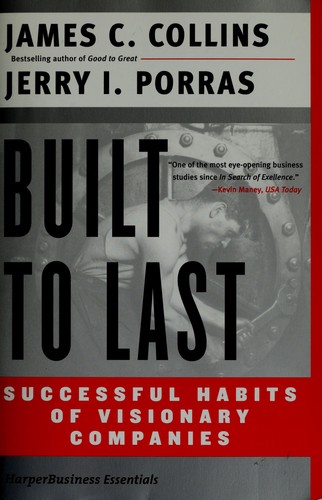
Built to Last
HarperBusiness · 1994 · 368 pages
ISBN: 9780060516406
Review Editor
Daniel Okafor
Built to Last emerged from a six-year research project at Stanford Business School in which Jim Collins and Jerry Porras compared eighteen “visionary” companies — firms like 3M, Boeing, Disney, HP, and Merck — with a matched set of less successful counterparts, looking for what distinguished the long-lasting winners. Their findings, published in 1994, shaped management thinking for the following decade and generated concepts — BHAGs (big, hairy, audacious goals), “clock-building vs. time-telling,” the “cult-like culture” — that became standard vocabulary in business schools and boardrooms. The book holds up as a serious research effort, though subsequent events have complicated some of its conclusions in ways Collins himself has acknowledged.
Character Arcs
Built to Last is a comparative research book, not a narrative, and its “characters” are organizations rather than people. Collins and Porras are interested in institutional persistence — what allows a company to endure over decades and through leadership transitions — rather than in the stories of individual founders or CEOs. When individuals appear, they’re illustrative of the institutional characteristics being described. Walt Disney appears as an example of a founder who built systems and processes (the “clock”) rather than depending on his own vision (the “time”). Sam Walton appears in the comparisons to study what Wal-Mart did that competitors didn’t. The book deliberately de-emphasizes the “genius CEO” story in favor of institutional explanations.
Pacing
The book is organized thematically around its research findings, with each chapter addressing one characteristic the visionary companies shared. This works as structure but can become repetitive — by the fifth or sixth chapter explaining why X characteristic distinguishes visionary companies from comparison companies, the argumentative rhythm becomes predictable. The BHAG chapter is among the most energetic; the chapter on “try a lot of stuff and keep what works” is the most practically useful. The research methodology section is carefully presented, and Collins and Porras are notably explicit about what their method can and can’t prove.
Thematic Depth
The book’s core insight — that lasting companies are built around an ideology and a set of enduring values, not around a specific product or charismatic leader — challenged the prevailing emphasis on individual leadership and strategic planning. The distinction between “clock-building” (creating an institution that can generate great ideas) and “time-telling” (having great ideas yourself) is a genuinely important one. The research on BHAGs — ambitious long-term goals that galvanize organizations — has been widely applied and widely misapplied. The finding that lasted least well is the implicit assumption that the visionary companies identified in 1994 would remain visionary. Motorola, Ford, and Citibank appeared in the original sample; all subsequently struggled significantly.
Style and Voice
Collins writes with evangelical enthusiasm for his findings — a quality that makes his books engaging and occasionally exhausting in equal measure. Built to Last is the most research-grounded of his books, and the enthusiasm is modulated by the discipline of presenting evidence. The writing is clear and accessible, with a talent for memorable formulations (BHAG, “cult-like culture”) that have proven durable in management vocabulary. Some readers find the evangelical tone appropriate to the subject; others find it at odds with the claimed objectivity of the research framework.
Verdict
Built to Last is a serious research effort that produced genuinely important insights about what makes organizations last, and it should be read with the understanding that some of its specific conclusions have not survived the test of time. The core findings about institutional identity, core ideology, and the importance of building enduring systems rather than depending on leaders remain sound and well-supported. The specific companies cited should be treated as illustrations rather than endorsements — some have thrived, others have collapsed. Collins’s subsequent Good to Great should be read alongside this book.
Rating: 3.9 out of 5
Book Details
- Title
- Built to Last
- Author
- Jim Collins
- Genre
- Business
- Publisher
- HarperBusiness
- Year Published
- 1994
- Pages
- 368
- ISBN
- 9780060516406
- WritersReview Rating
- 3.9 / 5