
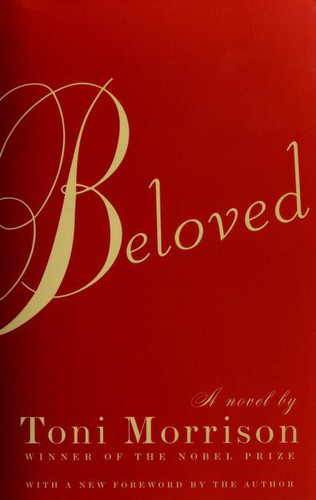
Beloved
Vintage International · 1987 · 321 pages
ISBN: 9781400033416
🏆 Pulitzer Prize for Fiction (1988)
Robert F. Kennedy Memorial Book Award
Anisfield-Wolf Book Award
Review Editor
Eleanor Marsh
Toni Morrison published Beloved in 1987, her fifth novel, and the one that would change her career and American literature along with it. The book won the Pulitzer Prize for Fiction in 1988 and played a significant role in Morrison’s Nobel Prize in Literature in 1993. Set in Cincinnati in 1873, eight years after the end of the Civil War, the novel tells the story of Sethe, a formerly enslaved woman living with her daughter Denver in a house haunted by something violent and unresolved. The story Morrison chose to tell is based loosely on the real case of Margaret Garner, an enslaved woman who in 1856 killed her two-year-old daughter rather than allow her to be returned to slavery. Morrison took that historical fact and built around it a novel about memory, guilt, love pushed to its most extreme expression, and the question of whether survival and freedom can coexist with what a person has done and what has been done to them.
The plot, once it reveals itself, is not complicated. Sethe escaped from Sweet Home, a Kentucky plantation, while pregnant. She sent her three older children ahead to her mother-in-law Baby Suggs in Cincinnati and arrived later, nearly dead, having given birth to Denver on the banks of the Ohio River with the help of a white girl named Amy Denver. Twenty-eight days of freedom followed. Then the slave catchers came, and Sethe, cornered in a woodshed, cut her older daughter’s throat rather than let her be taken back. That act is the novel’s center of gravity, and everything in the book orbits it.
Morrison does not present this story chronologically. She fractures the timeline, loops backward and forward, lets memories surface the way they actually do: unbidden, in fragments, triggered by a smell or a color or a word. The reader pieces the story together gradually, and the effect is not confusion but immersion.
Character Arcs and Development
Sethe is one of the most fully realized characters in American fiction, and Morrison achieves this by refusing to simplify her. She is a mother who killed her child out of love so fierce it became indistinguishable from violence. The scar on her back, which she has never seen, is described by others as a tree, a chokecherry tree, and that image captures something essential about Sethe: the damage is part of her body, growing as she grows, both beautiful and terrible depending on who is looking.
Her arc across the novel moves from isolation to something approaching reintegration. When Paul D arrives at 124 Bluestone Road, another survivor of Sweet Home, he offers Sethe the possibility of a future. But Beloved’s arrival disrupts that possibility. Beloved attaches herself to Sethe with an appetite that is bottomless and consuming. Sethe gives herself over entirely, neglecting Denver, neglecting her own body, until she is physically diminished. The rescue comes from the community, from the women of Cincinnati who gather outside 124 and sing, and from Denver, who grows from a frightened girl into someone capable of asking for help.
Denver’s arc is the novel’s quiet triumph. She begins as a lonely, frightened teenager and by the end has stepped off the porch, asked the neighborhood women for food and work, and begun building a life outside her mother’s orbit. Paul D is drawn with equal care. When he tells Sethe near the end, “You your best thing, Sethe. You are,” it is not a platitude. It is a man who has spent the entire novel learning how to say it and mean it.
Pacing
Morrison’s pacing is deliberate and nonlinear, and it demands patience. The novel does not move forward so much as it spirals, returning to the same events from different angles. The first hundred pages can feel disorienting; Morrison drops the reader into the middle of Sethe’s life without much explanation and trusts that the pieces will accumulate into coherence.
The middle section, when Beloved has established herself in the household, has a claustrophobic intensity. The final movement, when Denver breaks free and the community intervenes, releases that pressure with considerable force. The pacing serves the emotional architecture even when it tests the reader’s endurance.
Deeper Thematic Exploration
The question at the heart of Beloved is whether the kind of love Sethe felt for her children can survive its own extremity. Sethe killed Beloved because she loved her. That love was real, and the act it produced was monstrous, and Morrison refuses to resolve that contradiction.
Morrison is also writing about what slavery does to memory. The characters are ambushed by what Morrison calls “rememory,” memories that exist in physical space, that refuse to stay in the past. Trauma is not something that happened; it is something that keeps happening.
Community is the novel’s other great subject. Baby Suggs preached in a clearing in the woods, telling formerly enslaved people to love their own flesh. The community failed Sethe once; their return at the novel’s end is an act of repair presented without sentimentality.
Morrison dedicated the book “Sixty Million and more,” a reference to the estimated number of Africans who died during the slave trade. Beloved herself may represent all those unnamed dead, and her hunger speaks to a collective grief that no individual act of memory can satisfy.
Style and Voice
Morrison’s prose operates at a level of sustained intensity that few novelists have matched. Her sentences can be short and blunt (“124 was spiteful”) or long and rhythmic, building through repetition into something closer to music than conventional narrative. She shifts between voices, between first and third person, with a fluidity that feels organic rather than experimental.
Morrison writes Black American experience without apology, without translation for a white audience. The dialect, the cultural references, the specific textures of Black life in post-Civil War Ohio are presented as self-evident, and the effect is one of total immersion.
Verdict
Beloved is a novel that earns every claim made for it. It is the kind of book that changes what you think fiction can do. You should read it if you are willing to be challenged, discomforted, and moved in ways that do not resolve neatly.
The novel’s difficulty is real but overstated. Morrison is never obscure for the sake of obscurity. If you have put off reading it because you have heard it is hard, know that the difficulty is the difficulty of feeling something fully. Beloved asks you to hold contradictory truths at the same time, and to sit with the knowledge that some wounds do not heal but can, with enough courage and enough community, be survived.
Frequently Asked Questions about Beloved
What is Beloved by Toni Morrison about?
Beloved is set in Cincinnati in 1873 and follows Sethe, a formerly enslaved woman haunted by the ghost of her dead daughter. Sethe escaped from a Kentucky plantation and killed her two-year-old daughter rather than allow her to be returned to slavery. The novel explores the aftermath of that act and the ways that slavery’s trauma continues to shape the lives of those who survived it.
Is Beloved based on a true story?
The novel draws on the real case of Margaret Garner, who escaped slavery in Kentucky in 1856 and killed her two-year-old daughter rather than allow her to be re-enslaved. Morrison encountered Garner’s story while editing The Black Book (1974) at Random House. The novel uses her decision as the emotional center of a fictional narrative.
What are the main themes in Beloved?
The novel explores memory and trauma, motherhood and its limits, community and responsibility, and identity and selfhood. Morrison examines how slavery persists in survivors’ bodies and minds, creating what she calls “rememory.” The Black community both fails Sethe and eventually saves her.
How long is Beloved and is it a difficult read?
The paperback runs 324 pages. The reading difficulty comes from structure: Morrison tells the story nonlinearly, revealing events gradually through fragments of memory. The prose is accessible and often beautiful, but the emotional content is intense. Most readers who commit to the first hundred pages find the story’s momentum carries them through.
Is there a movie or TV adaptation of Beloved?
Yes. A film adaptation was released in 1998, directed by Jonathan Demme and starring Oprah Winfrey as Sethe, Danny Glover as Paul D, and Thandiwe Newton as Beloved. The film received mixed reviews and struggled commercially but features strong performances.
What age group or reading level is Beloved appropriate for?
Beloved is written for adult readers. It contains graphic depictions of slavery, including whipping, rape, and infanticide. It has been assigned in high school AP and college courses. For independent reading, it is best suited to readers 16 and older prepared for challenging material.
How does Beloved compare to Toni Morrison’s other novels?
Beloved is generally considered Morrison’s greatest achievement, though Song of Solomon and Sula have passionate advocates. It is more formally ambitious than most of her earlier novels. Morrison followed it with Jazz and Paradise, forming what is sometimes called her “Beloved trilogy.”
Should I read Beloved and is it worth it?
If you care about American literature, American history, or what fiction can do with painful material, yes. It will challenge you and likely unsettle you. What it provides is a reckoning with history that is honest, structurally inventive, and written in prose of extraordinary precision and beauty.
Book Details
- Title
- Beloved
- Author
- Toni Morrison
- Genre
- Literary Fiction
- Publisher
- Vintage International
- Year Published
- 1987
- Pages
- 321
- ISBN
- 9781400033416
- Awards
- 🏆 Pulitzer Prize for Fiction (1988) Robert F. Kennedy Memorial Book Award Anisfield-Wolf Book Award
- WritersReview Rating
- 5.0 / 5