
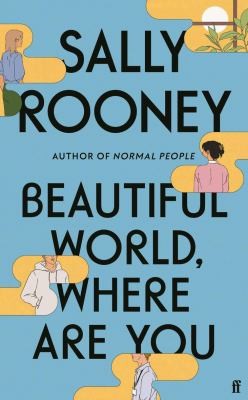
Beautiful World, Where Are You
Faber & Faber · 2021 · 352 pages
ISBN: 9780571365425
Review Editor
Claire Beaumont
Summary
Sally Rooney’s third novel, Beautiful World, Where Are You, published in 2021, returns to the territory of her first two books but with a difference in register: the characters are older now, the romantic complications more self-conscious, and the philosophical undertow more explicit. The novel follows Alice, a successful novelist reeling from a breakdown, and her friend Eileen, a literary magazine editor in Dublin. Alice has retreated to a coastal town in the west of Ireland, where she begins a tentative relationship with Felix, a warehouse worker she met on a dating app. Eileen, meanwhile, is conducting a years-long will-they-won’t-they with her old friend Simon, a man she has been in love with since childhood.
The novel is structured partly through email correspondence between Alice and Eileen, long, discursive letters that do much of the thematic lifting Rooney’s earlier novels handled through close third-person narration. These emails cover everything from the state of contemporary civilization to the nature of friendship, romantic love, and the difficulty of being a person in a historical moment that feels, with some justification, like it might be coming apart. The letters are vivid and argumentative and sometimes brilliant, and they give the novel an unusual texture: part epistolary novel, part intimate character study, part extended essay on what it means to live a good life when you are aware of how much suffering the world contains.
Rooney’s previous novels, Conversations with Friends and Normal People, were widely praised for their cool emotional precision and their willingness to take young women’s interiority seriously. Beautiful World, Where Are You is somewhat less concentrated in its pleasures, but it has a maturity and a philosophical ambition that her earlier work gestured toward without fully pursuing.
Character Arcs and Development
Alice is the novel’s most interesting character and the one Rooney seems most personally invested in. Her breakdown, her ambivalence about her own success, her self-consciousness about being a famous writer who writes about class while benefiting from literary celebrity: these are all rendered with great honesty and some courage. Alice’s emails have a manic intellectual energy that makes her a pleasure to read even when she is being self-indulgent. Her relationship with Felix is the novel’s most surprising element: Felix is not a typical Rooney romantic interest. He is blunt, sometimes unkind, unimpressed by literary achievement, and the relationship between them is built on mutual bafflement and mutual attraction in roughly equal measure.
Eileen is a softer, more familiar type in Rooney’s fiction: the woman who wants the thing she already half has and can’t quite commit to claiming it. Her relationship with Simon is beautifully drawn, even if the arc it traces is more conventional than Alice’s story. Simon himself is notable as the rare Rooney character who has a stable religious faith, and the novel handles his Catholicism with more sympathy and seriousness than one might expect from contemporary literary fiction.
The friendship between Alice and Eileen is the novel’s emotional core, and Rooney writes it better than almost anything else in the book. The letters they exchange have the specific texture of a long, deep female friendship: the history and the competition and the mutual comprehension that goes beyond what either of them could explain to an outsider. When the four of them finally converge in the final section, the relationships have been so carefully built that the conclusions feel genuinely earned.
Pacing
The novel moves in two registers, and they alternate with enough regularity to feel deliberate. The close third-person sections following the two couples have the same crisp, observational rhythm Rooney’s readers will recognize from Normal People: precise, almost clinical in their attention to gesture and subtext, with dialogue that does enormous work. These sections move quickly and efficiently. The email sections are another matter: long and sometimes very long, they pause the action entirely in favor of extended reflection.
Some readers will find this alternation jarring or will find the emails too essayistic, too openly intellectual for a novel that is also trying to be a romantic story. This is a fair criticism. Rooney is using the email form to say things she wants to say directly about civilization and beauty and what it means to write fiction in a time of crisis, and the seams between this ambition and the novel’s more intimate concerns are occasionally visible. But the pacing problem, if it is one, is inseparable from the novel’s ambitions, and what you gain from the essays is a sense of a writer thinking seriously about what she is doing and why.
Deeper Thematic Exploration
The central question the novel asks, and asks repeatedly through Alice’s letters, is something like: how do we justify attention to private life and private feeling when the world is in the state it is in? How do you write a novel about romantic love, or read one, when there is so much suffering that falls outside the frame of any novel? These are not new questions for literary fiction, but Rooney poses them with unusual directness and without easy resolution. Alice does not conclude that private life is justifiable; she does not conclude that it isn’t. The novel sits with the discomfort.
The title comes from a Friedrich Holderlin poem, and there is something of the Holderlin tradition in the novel’s elegiac mode: a sense of beauty as something already receding, or perhaps as something that can only be fully seen in retrospect. The characters are all, in different ways, trying to hold onto something that feels like it might be slipping: youth, idealism, the possibility of a good private life in an increasingly inhospitable public world.
Class is handled here with more explicitness than in Normal People, where it was always present but rarely named. Felix’s working-class background and Alice’s literary celebrity create a genuine asymmetry in their relationship, and the novel is attentive to what this costs both of them, in different ways. Simon’s Catholicism functions partly as a marker of class as well as faith: he comes from a background where the church meant something, and his faith is part of how the novel thinks about tradition and continuity in an era that has largely discarded both.
Style and Voice
Rooney’s prose is one of the most recognizable in contemporary literary fiction: short declarative sentences, minimal punctuation in the Jamesian mode (no quotation marks for dialogue), and an extraordinary attention to what characters do with their bodies. A Rooney character is always noticing where someone’s hands are, what their expression is doing, how a silence is inhabited. This physical awareness is one of the things that makes her fiction feel so immediate, and she has lost none of it in her third novel.
The emails give Rooney a space to write in a different register, one that is more consciously literary and more explicitly argumentative. The Alice of the emails is clearly close to Rooney herself in certain respects, and there is something both risky and admirable about letting that proximity show. Whether you find the emails brilliant or self-indulgent will probably determine how much you enjoy the novel as a whole. They are genuinely one or the other, and possibly both at once.
Verdict
Beautiful World, Where Are You is not Sally Rooney’s best novel, but it is her most ambitious, and its ambitions are worth taking seriously. It tries to be a novel of ideas and a novel of feeling simultaneously, and it mostly succeeds, even if the two modes don’t always fuse as cleanly as one might wish. The characters are vivid, the friendship between Alice and Eileen is one of the best things Rooney has written, and the questions the novel asks about art, civilization, and private life are ones that will stay with you.
Readers who loved Normal People primarily for its romantic intensity may find this cooler and more cerebral. Readers who found Normal People emotionally overwhelming in ways they couldn’t quite account for will probably find this more approachable. It is a novel by a writer who has become very aware of her own fame and is trying, with considerable intelligence, to write her way through what that means.
Frequently Asked Questions about Beautiful World, Where Are You
What is Beautiful World, Where Are You by Sally Rooney about?
Beautiful World, Where Are You follows two best friends, Alice and Eileen, and their respective romantic entanglements. Alice is a novelist recovering from a breakdown who begins a relationship with Felix, a warehouse worker she met on a dating app, while living in a small Irish coastal town. Eileen is conducting a slow, uncertain romance with her lifelong friend Simon in Dublin. The novel alternates between close third-person narration of the couples and long email exchanges between Alice and Eileen about art, civilization, friendship, and what it means to live well in a troubled world.
How does Beautiful World, Where Are You compare to Normal People?
Beautiful World, Where Are You is Sally Rooney’s third novel and shares Normal People’s close attention to physical detail, emotional subtext, and the dynamics of romantic relationships between young Irish people. It is generally considered more ambitious and more philosophical than Normal People, partly because of the long email exchanges between the two main characters, which cover topics like the state of civilization and the ethics of writing fiction. Readers who prefer pure romantic intensity may find Normal People more gripping; readers who enjoy Rooney thinking aloud about bigger questions may prefer this one.
Who are the main characters in Beautiful World, Where Are You?
The four main characters are Alice, a famous novelist recovering from a mental breakdown; Eileen, Alice’s best friend and a literary magazine editor in Dublin; Felix, a warehouse worker who begins a relationship with Alice; and Simon, Eileen’s childhood friend with whom she has been in love for years. The friendship between Alice and Eileen is the emotional center of the novel, while the two romantic relationships provide the plot.
What do the emails in Beautiful World, Where Are You discuss?
The emails between Alice and Eileen discuss an unusually wide range of subjects, including the Bronze Age collapse, the nature of beauty, the ethics of writing about private life, the state of contemporary civilization, romantic love, religion, friendship, and what it means to live a good life when the world contains so much suffering. The emails are deliberately essayistic and represent Rooney’s most explicit engagement with philosophical questions in her fiction. Whether one finds them brilliant or self-indulgent tends to determine overall feelings about the novel.
Is there a TV or film adaptation of Beautiful World, Where Are You?
As of this writing, no film or television adaptation of Beautiful World, Where Are You has been announced or produced. Rooney’s first two novels have both been adapted: Conversations with Friends became a Hulu series in 2022, and Normal People became a critically acclaimed Hulu and BBC Three series in 2020. Given the track record, adaptation of Beautiful World, Where Are You is plausible but has not been confirmed.
What is the title Beautiful World, Where Are You referring to?
The title comes from “The Gods of Greece,” a poem by the German Romantic poet Friedrich Holderlin, which asks where the gods and the beauty of the ancient world have gone. Rooney uses it to frame the novel’s central preoccupation: the difficulty of holding onto beauty, meaning, and private happiness in a world that seems to be losing something important. The elegiac quality of the title sets the tone for the novel’s philosophical mood.
How long is Beautiful World, Where Are You and is it hard to read?
Beautiful World, Where Are You is approximately 352 pages and is not technically difficult to read. Rooney’s prose is clear and accessible, without demanding specialist knowledge. The novel does ask for a certain patience with the long email sections, which are more essayistic and less plot-driven than the third-person narration. Readers who come to it expecting the same propulsive quality as Normal People may need to adjust their expectations for the sections that are more explicitly philosophical.
Should I read Beautiful World, Where Are You if I loved Normal People?
Yes, with some adjustment of expectations. Beautiful World, Where Are You has the same close attention to emotional detail and physical observation that made Normal People so compelling, and the same willingness to take its characters’ inner lives seriously. But it is a more expansive and more explicitly philosophical novel, and the romantic storylines are less central than the friendship between Alice and Eileen. If you loved Normal People primarily for Connell and Marianne’s relationship, you may find this cooler. If you loved Rooney’s prose and her attentiveness to how people navigate desire and intimacy, you will find plenty to love here.
Book Details
- Title
- Beautiful World, Where Are You
- Author
- Sally Rooney
- Genre
- Literary Fiction
- Publisher
- Faber & Faber
- Year Published
- 2021
- Pages
- 352
- ISBN
- 9780571365425
- WritersReview Rating
- 4.0 / 5