
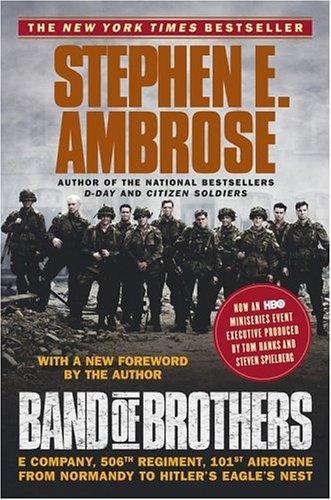
Band of Brothers
Simon & Schuster · 1992 · 333 pages
ISBN: 9780743224543
Review Editor
Thomas Calloway
Stephen Ambrose did not set out to write Band of Brothers. He was gathering oral histories for the National D-Day Museum in New Orleans in the late 1980s when he stumbled onto a reunion of Easy Company veterans, the men of E Company, 506th Parachute Infantry Regiment, 101st Airborne Division. What he heard over the course of those conversations convinced him that the story of this particular group of American soldiers required its own book. Published in 1992 by Simon and Schuster, Band of Brothers is the result, and it remains one of the most honest and affecting accounts of what American soldiers actually experienced in the European Theater of World War II.
The book follows Easy Company across roughly three years: from the bruising summer training at Camp Toccoa in Georgia in 1942 through the parachute drop into Normandy on June 6, 1944, through Operation Market Garden in the Netherlands, through the frozen horror of Bastogne during the Battle of the Bulge, and finally into Germany and Austria in the spring of 1945. Ambrose draws almost entirely on first-person sources: letters, diaries, after-action reports, and most of all the hours of recorded interviews he conducted with surviving company members. The result reads with the momentum of narrative while resting on documented testimony. You are not reading what Ambrose imagined happened. You are reading what the men said happened.
The subtitle, “E Company, 506th Regiment, 101st Airborne: From Normandy to Hitler’s Eagle’s Nest,” tells you the scope. About 140 men cycle through the company roster over the course of the war, arriving as replacements, departing wounded or dead or transferred. Ambrose tracks them all and returns repeatedly to the core of men who started together at Toccoa, the ones who knew each other before the shooting started and who, by the end, knew each other in ways that peacetime friendships rarely produce.
Character Arcs and Development
Richard “Dick” Winters is the book’s central figure, and he is one of the more compelling portraits in American military writing. A Pennsylvania Quaker by upbringing, Winters discovered in combat that he had a talent for command that he had not previously suspected. What makes him interesting is not his competence alone but the way he exercises it: by preparation, by caring for his men before caring for himself, and by leading from the front only when it was necessary rather than as performance. When Easy Company spent weeks in the Bastogne woods with no overcoats in temperatures that dropped to ten below zero, it was Winters who tracked down winter gear through the supply system and got it to his men. That kind of leadership shows up in details, not speeches.
Lewis Nixon, Winters’s closest friend throughout the war and after, provides a striking counterpart. Nixon is brilliant, sardonic, and given to drinking. He and Winters are temperamentally opposite in almost every way, and their friendship, which Ambrose captures through accumulated small moments rather than any single dramatic scene, gives the book an emotional anchor. What holds them together is mutual trust and honesty of a kind that the war made possible between men who had seen each other at their worst.
Herbert Sobel, the company’s original commander, deserves close attention because he shapes everything that follows him. Sobel was a bully, an erratic tactician, and a taskmaster who pushed the men relentlessly during training in Georgia and later in England. The men despised him, and their eventual mutiny against him, in which noncommissioned officers submitted a collective complaint that risked court-martial, is one of the book’s more remarkable episodes. But Ambrose is fair: Sobel’s brutal training regimen, for all its cruelty, produced a company in exceptional physical condition with an intimate knowledge of each other’s capabilities. The irony that the man they hated most prepared them for survival is one Ambrose underlines without hammering on.
Carwood Lipton, the company’s first sergeant for much of the war, receives some of the book’s finest passages. Steady, observant, and tactful where others are blunt, Lipton is the kind of leader who holds an organization together without calling attention to himself. Ambrose interviewed him at length, and the portrait that emerges is of a man whose particular genius was keeping fractured situations from becoming broken ones.
Pacing
Ambrose structures the book chronologically, one chapter per campaign phase, and this serves readers who are not already fluent in European Theater history. The context builds as you go. The D-Day chapter and the Bastogne chapters are the book’s two peaks, and Ambrose drives them with the urgency the situations require: short sentences, close focus on the immediate and the physical. You feel the cold at Bastogne the way you feel cold in a good novel, as a presence rather than a fact.
The sections between these set pieces move more slowly. The period between Market Garden and Bastogne in particular has less narrative momentum than the dramatic engagements on either side of it. There is also the challenge of names: with more than a hundred characters cycling through, a reader new to the material may need to refer frequently to the roster Ambrose includes as an appendix. This is partly a structural limitation of the oral-history form. Ambrose is committed to giving credit to as many men as possible, and that breadth sometimes competes with the forward pull of the story. It is worth it, but it requires patience.
Deeper Thematic Exploration
At its center, Band of Brothers is a sustained inquiry into what holds people together under conditions designed to pull them apart. Ambrose does not romanticize war. He describes cold, hunger, fear, and killing with specificity, and he is clear about the psychological damage that combat inflicted on many of the men, damage that followed some of them home for the rest of their lives. But he is equally interested in why men went back into that cold and fear again and again, often when they had legitimate reasons not to.
The answer the book arrives at, through the accumulation of testimony, is that they did it for each other. Not for abstract patriotism, not for ideology, and not because they had no choice. They did it because the man to their left and the man to their right depended on them, and letting those men down was something they found they could not do. The title comes from Shakespeare’s Henry V, a speech before Agincourt, and Ambrose’s choice is not casual. He is arguing that unit cohesion and mutual obligation, what soldiers call brotherhood, can produce individual acts of willingness that no external motivation could reliably create in the same people.
The Bastogne section tests this thesis most severely. Easy Company held a defensive position around Bastogne for weeks in December 1944, surrounded, undersupplied, and in temperatures that made the ground too hard to dig proper foxholes. They were wearing summer uniforms. Relief was uncertain for days at a time. They held. Ambrose does not frame this as heroism in any comfortable sense. He lets the veterans describe it themselves, and what comes through is something more specific and more interesting than heroism: a refusal to leave people who depended on them, made bearable by the fact that those people were refusing to leave them too.
There is also a thread about leadership that rewards sustained attention. Ambrose contrasts Sobel’s fear-based command with Winters’s example-based approach, with Ron Speirs’s high-risk audacity, with Lipton’s patient management. The book’s implicit argument is that the most effective military leadership works from within the group rather than above it, that authority becomes most powerful when it is inseparable from trust. This is not a new idea, but grounded in specific people and specific moments rather than in abstract argument, it lands differently than it does in a business book or a philosophy text.
One passage Ambrose handles with particular restraint is Easy Company’s discovery, near the end of the war, of a Jewish forced labor camp near Landsberg, Germany. The men, who had by this point fought across Western Europe for nearly a year, are shaken in a way that combat had not shaken them. Ambrose uses the scene to ask, quietly, what the war was ultimately for beyond the immediate tactical objectives. He does not over-explain. He lets the veterans describe what they found, what they felt, what they did for the survivors. Then he moves on. It is one of the book’s most quietly shattering passages.
Style and Voice
Ambrose writes clear, direct American prose with no interest in ornament, and that restraint turns out to be exactly right for this material. The voices of the men he interviewed come through the text because his prose does not compete with them. His sentences run short to medium, and he reaches for longer constructions only when a battle sequence requires sustained momentum. The writing serves the story rather than announcing itself.
The limitation, as narrative, is that the book sometimes reads more like oral history than biography. Ambrose’s fidelity to his sources occasionally tips from thoroughness into cataloguing. Readers seeking a tightly focused character study of Winters, or a single braided narrative, may find the breadth of the cast a recurring friction. But readers who want to know what every man in the company did and felt, who want the full record rather than the selected highlights, will find the approach satisfying. Ambrose made a choice to honor all of them, and the book’s texture reflects that choice throughout.
Verdict
Band of Brothers is one of the essential books about American soldiers in the Second World War. You do not need prior knowledge of military history to connect with it. If you are interested in what makes people reliable under prolonged pressure, what kinds of relationships sustain ordinary individuals through extraordinary hardship, or simply in a meticulously documented account of one of the defining military campaigns of the twentieth century, this book belongs on your list. The HBO miniseries that Steven Spielberg and Tom Hanks produced in 2001 is excellent on its own terms, but it compresses and dramatizes what the book renders in texture and specificity. Start with the book.
Readers who want tighter psychological focus on a smaller number of figures may sometimes want more than Ambrose gives them. The format’s commitment to breadth is real. But if you stay with it, the names that seem interchangeable in the first chapters become distinct and significant by the end. Ambrose earned that. So did the men.
Frequently Asked Questions about Band of Brothers
What is Band of Brothers by Stephen Ambrose about?
Band of Brothers follows Easy Company, 506th Parachute Infantry Regiment, 101st Airborne Division across the European Theater of World War II, from their initial training at Camp Toccoa, Georgia in 1942 through the parachute drop into Normandy on D-Day, Operation Market Garden in the Netherlands, the Battle of the Bulge at Bastogne, and the advance into Germany and Austria in 1945. Ambrose based the book on interviews, letters, and diaries collected from surviving company members.
Is Band of Brothers by Stephen Ambrose a true story?
Yes, it is a work of narrative nonfiction drawn from primary sources: recorded interviews Ambrose conducted with Easy Company veterans, as well as their personal letters, diaries, and after-action military reports. Ambrose circulated drafts among the surviving men and incorporated their corrections. The people are real, the events are documented, and the dialogue comes from firsthand accounts rather than reconstruction.
What are the main themes in Band of Brothers?
The central themes are unit cohesion and mutual obligation: why men who have good reasons to preserve themselves choose instead to protect the people next to them. The book also examines leadership and how different command styles produce different results in combat; the psychological cost of sustained combat exposure; and the transformation that occurs when civilians become soldiers who have depended on each other through extreme conditions. Ambrose returns throughout to the question of what holds a group of people together when the situation gives them every reason to fall apart.
How long is Band of Brothers and is it a difficult read?
The book runs 333 pages in the standard paperback edition. It reads at a solid but accessible pace: Ambrose writes clear, direct prose aimed at a general readership rather than a specialist military audience. The main challenge is keeping track of the large cast of characters, more than a hundred men rotate through the company during the war, and readers who are new to WWII history may want to refer to the roster appendix. That said, it is not a difficult or technical book, and most readers move through it quickly once the early chapters establish the core characters.
Was Band of Brothers made into a TV show?
Yes. Steven Spielberg and Tom Hanks co-produced a ten-part HBO miniseries in 2001 also titled Band of Brothers. Damian Lewis played Dick Winters and Ron Livingston played Lewis Nixon. The series won six Emmy Awards and a Golden Globe for Best Miniseries. It follows the same chronological arc as the book but necessarily compresses and dramatizes certain events. The book and the miniseries work well in either order, though the book provides considerably more texture and a larger cast of named individuals.
What age group is Band of Brothers appropriate for?
The book is written for adult readers and deals with combat, death, psychological trauma, and the discovery of a concentration camp, all described with directness rather than graphic sensationalism. Most readers encounter it in their late teens or older. It is commonly assigned in high school and college history courses. Mature readers in the 14 to 15 age range who have an interest in history handle it well, but parents of younger teens should be aware that the subject matter is serious and the descriptions of combat and its aftermath are honest.
How does Band of Brothers compare to other Stephen Ambrose books?
Ambrose wrote extensively about World War II and American history, including D-Day (1994), which covers the full Normandy invasion in panoramic scope, and Citizen Soldiers (1997), which broadens the focus to the American soldier’s experience across the entire European campaign. Band of Brothers is more intimate than either of those, focusing on a single company across the full arc of the war. Readers who want to go deeper after finishing it often move to D-Day for the larger context, or to his biography of Dwight D. Eisenhower for the command-level perspective on the same events.
Should I read Band of Brothers and is it worth it?
If you have any interest in World War II, in leadership under pressure, or simply in people doing hard things together, yes. The book delivers something that most military histories do not: a sustained, close-up view of what the war actually felt like for the people who fought it, built from their own words. It is not a feel-good book. Some of it is uncomfortable. But it is honest in the way that only first-person testimony can be honest, and it earns its ending in a way that not many books do. You will come out of it knowing the names and caring about the outcomes, which is exactly what Ambrose wanted.
Book Details
- Title
- Band of Brothers
- Author
- Stephen E. Ambrose
- Genre
- History
- Publisher
- Simon & Schuster
- Year Published
- 1992
- Pages
- 333
- ISBN
- 9780743224543
- WritersReview Rating
- 4.5 / 5