
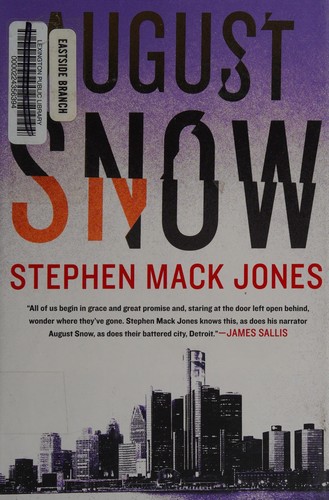
August Snow
Soho Crime · 2017 · 312 pages
ISBN: 9781616957186
Review Editor
James Voss
August Snow arrived in 2017 as the debut novel from Stephen Mack Jones, a Detroit-area poet and playwright who spent decades writing for the stage before turning to crime fiction. The result is something that does not come along every year in the mystery genre: a hard-boiled detective novel written from the inside, by someone who knows the city he is writing about not as a setting but as a home. Jones has lived the Detroit he describes. That intimacy shows on every page.
The book takes its name from its protagonist, August Snow, a former Detroit Police Department detective who did what most cops never do: he blew the whistle on the whole operation. After uncovering corruption that reached from his precinct all the way to city hall, Snow was fired. He sued the department for wrongful termination and won. The settlement came to twelve million dollars, and the entire corrupt administration fell with it. Now he is back in Mexicantown, the predominantly Mexican-American neighborhood on Detroit’s southwest side where he grew up, the son of a Black cop and a Mexican-American painter who taught him to see the city in two languages at once.
Snow’s plan for his return is both practical and quietly quixotic. He wants to use his settlement money to fix things. Buy up distressed properties in his childhood neighborhood. Renovate and reinvest. Give back to the people who gave him a foundation. His neighbors are the kind of cast that makes a novel feel inhabited rather than populated: Rosa Ochoa, who runs a catering operation out of a kitchen that does not accept defeat; Father Grabowski, the parish priest who has outlasted three sets of city leadership and fights for his corner with the energy of someone who has stopped being surprised by anything; and a loose constellation of old friends who look out for each other with the fierce, practiced loyalty of people who have seen what happens when no one does.
Things begin to move when Eleanore Paget, a wealthy finance executive with a troubled investment bank, tracks Snow down and offers him a job. She wants someone to investigate suspicious activity inside her own firm. Snow turns her down. He is not in that business anymore. The next morning, Paget is found dead. The official verdict is suicide. Snow does not believe it for a second. What starts as a personal obligation, the feeling that he owed something to a woman who came to him for help, deepens into a full investigation that pulls him through layers of Detroit’s criminal economy: financial fraudsters, human trafficking networks, and old grudges with patience and resources.
Character Arcs and Development
The title character is the engine of this novel, and Jones builds him carefully. August Snow does not fit the standard tragic mold of the hard-boiled detective, the man haunted by a dark past he cannot outrun, moving through the city like a wound. He is something stranger and considerably more interesting: a genuinely content person who nonetheless cannot stop himself from doing what is right. He has money, community, purpose, and the kind of peace that comes from having made a stand and survived it. What he lacks is the ability to look away when something wrong sits in front of him.
That moral stubbornness is the most compelling thing about him. Snow is not a crusader who woke up one morning committed to justice. He is a man raised by two people who believed in accountability, and the belief became structural, too deep to abandon when it gets expensive. This makes him sympathetic without making him saintly. He carries himself with the measured confidence of someone who has been tested and came through, but Jones keeps him anchored in moments of doubt, dark humor, and real tenderness. When Snow talks to his late mother, standing at her grave in a Detroit winter, the scene earns its emotion without announcing it.
The supporting characters give the novel its warmth and its stakes. Rosa and the Mexicantown community are not backdrop. They are the argument the book is making. These are people who stayed when everyone else left, who continue to build something worth protecting, who resent being treated as symbols of urban decline when they are in fact its most stubborn refutation. When they face danger in the book’s second half, the plot stops being about a dead banker and becomes about something much larger.
Eleanore Paget, despite limited time on the page, registers as a full human being. Jones sketches her as someone who saw the machinery too clearly and lacked the backup to stop it. Her death functions less as a plot device than as a statement about what integrity costs in an environment built on its absence.
Pacing
The novel moves well for most of its length. Jones has a theater writer’s instinct for scene structure, and he sequences his chapters like a good play: arrivals, confrontations, retreats, regroupings. The Mexicantown sections especially come alive. When Snow is among people he trusts, in places he knows, the prose opens up and the novel breathes with something close to joy.
The middle section, as Snow works through the mechanics of the financial investigation, occasionally slows under the weight of procedural detail. A few scenes run long on exposition when the reader would rather be moving. This is a familiar challenge in debut mysteries, and Jones manages it better than most. Once the investigation’s shape becomes clear and the threats become personal, the book accelerates convincingly through its final act. The confrontations the novel has been building toward deliver with satisfying force.
Deeper Thematic Exploration
At its core, August Snow is a novel about what Detroit asks of the people who love it. Jones has no interest in poverty tourism or ruin aesthetics. He is interested in the specific weight of staying: what it costs, what it builds, and what it says about a person’s values. The Sunday potlucks that double as neighborhood organizing meetings, the restaurant that serves exceptional food out of a building held together by stubbornness and pride, the ex-cop who takes a settlement check and walks back into the neighborhood instead of out of it. These are not symbols. They are choices, and Jones treats them as such.
Race sits at the center of this story without becoming its thesis statement. August Snow’s biracial identity, Black and Mexican-American, is lived experience rather than symbolism. It shapes the languages he speaks, the spaces he belongs to, the way different people read him on sight. Jones handles this with the economy of a writer who has thought about it for years and does not need to perform the thinking. The novel’s most effective observations on race are embedded in small moments: a glance that lasts half a beat too long, a sentence that ends differently than it started, a choice Snow makes almost reflexively that tells you exactly what the world has taught him about being who he is in the city he loves.
The question of wealth and responsibility runs through every chapter. Snow’s twelve million dollars is not a fantasy of freedom. It is an obligation. He could leave Detroit and never look back, and the novel’s entire emotional architecture rests on the fact that this option never seriously occurs to him. He uses the money not to insulate himself from the neighborhood but to make himself more present within it, more accountable to the people and the place. In a genre that often treats wealth as a license for autonomy, this inversion carries real moral weight.
The financial crimes at the story’s center connect these themes outward. The manipulation, the offshore flows, the extraction of value from Detroit’s assets: these are not abstract antagonists. They are the structural opposite of what Snow is trying to build in Mexicantown. Paget died because she saw the machinery and lacked backup. Snow survives because he built his backup before he needed it.
Style and Voice
Jones spent years writing poetry and plays before turning to fiction, and the prose carries those disciplines. His sentences have weight and internal rhythm. He knows how to pace a paragraph the way a poet times a line. Detroit’s winter seeps into the texture of the writing, not only in descriptions of cold and ice but in the way characters move through the city: heads down, purposeful, accustomed to difficulty without being defined by it.
Snow’s first-person voice is the book’s signature achievement. He observes with sharp intelligence, finds the absurdity in violent situations without minimizing their danger, and talks to himself with the honesty of someone committed to not fooling himself about his own motives. Critics have compared the voice to Raymond Chandler’s, and the resemblance is real, but Jones writes with more warmth than Chandler and more interest in community than Parker. The better comparison might be George Pelecanos writing about Washington, D.C.: a novelist whose love for a complicated city produces work that is alive in ways purely plot-driven thrillers cannot manage.
Verdict
August Snow is a very strong debut that delivers considerably more than most first mysteries promise. Its protagonist is genuinely original, its setting is rendered with specificity and love, and its thematic ambitions lift it above genre entertainment without making it feel like homework. The Hammett Prize and the Nero Award were well earned.
Pick this up if you want a detective novel that trusts you to care about more than the solution to a crime. If you are interested in Detroit, in race and class in contemporary America, or in the question of what obligation a person has to the place that shaped them, Jones has written something worth your time. Readers who prefer tighter, faster-moving thrillers may find the first act deliberate, but most will be won over long before August Snow and his Mexicantown community get fully into motion. A series very much worth starting from the beginning.
Frequently Asked Questions about August Snow
What is August Snow by Stephen Mack Jones about?
August Snow follows a half-Black, half-Mexican-American former Detroit police detective who blew the whistle on a corrupt department, won a twelve-million-dollar wrongful termination lawsuit, and returned to his Mexicantown neighborhood to rebuild it with his settlement money. When a wealthy banker named Eleanore Paget is found dead the morning after asking Snow for help investigating her own firm, Snow ignores his retirement and starts digging. The investigation pulls him into financial fraud, organized crime, and dangerous old enemies.
Did August Snow by Stephen Mack Jones win any awards?
Yes. August Snow won the 2018 Hammett Prize for Crime Fiction, given by the North American Branch of the International Association of Crime Writers for literary excellence in the field, and the 2018 Nero Award. The book was also nominated for the 2018 Shamus Award for Best First Private Eye Novel, named a 2018 Michigan Notable Book, and recognized by Strand Magazine’s Critics Awards as a Best First Novel nominee.
What are the main themes in August Snow?
The book explores community loyalty and the choice to stay in a neighborhood that others have abandoned, race and biracial identity in a city shaped by racial history, financial corruption and the extraction of urban wealth, and the question of what obligation a person has to the place that shaped them. Detroit itself functions almost as a character, and the novel treats the city’s decline and stubborn persistence as moral subjects rather than background scenery.
How long is August Snow and is it a difficult read?
August Snow runs 312 pages and reads quickly. The prose is crisp and grounded in the hard-boiled detective tradition, though Jones brings a poet’s rhythm to the language. Most readers can finish it in two or three evenings. The financial crime sections in the middle require a little patience, but nothing that demands specialist knowledge. Fans of crime fiction and character-driven storytelling will find the pace feels right.
Is there a movie or TV adaptation of August Snow?
As of 2025, no film or television adaptation of August Snow has been released, though the novel gained early attention as a Hollywood prospect. Given its cinematic Detroit setting, richly drawn protagonist, and serial structure, it would be strong material for a prestige TV series. For now, the story lives in the four-book series: August Snow, Lives Laid Away, Dead of Winter, and Deus X.
What age group or reading level is August Snow for?
August Snow is written for adult readers. It contains violence, strong language, and mature themes including organized crime, human trafficking, and institutional corruption. It is not a cozy mystery and does not soften its subject matter. Readers who enjoy contemporary crime fiction in the tradition of Raymond Chandler or George Pelecanos will be at home from the opening pages.
How does August Snow compare to Stephen Mack Jones’s other books?
August Snow is the first in a four-novel series, followed by Lives Laid Away, Dead of Winter, and Deus X. Critics who have followed the entire run note that Jones deepens the world of Mexicantown and the character of August Snow with each book. The debut is the natural starting point, and the quality holds across the series. Jones has also worked extensively as a poet and playwright, and those influences are visible in his prose style throughout all four novels.
Should I read August Snow and is it worth it?
Yes, particularly if you enjoy detective fiction that takes its setting and its characters seriously. August Snow won two major prizes for good reasons: it combines the pleasures of the genre, a resourceful protagonist, a satisfying investigation, a world you want to spend time in, with genuine literary ambition about race, community, and what it costs to do the right thing. Readers from literary fiction backgrounds may be surprised by how much they enjoy it; readers from genre mystery will be glad they found it.
Book Details
- Title
- August Snow
- Author
- Stephen Mack Jones
- Genre
- Mystery & Thriller
- Publisher
- Soho Crime
- Year Published
- 2017
- Pages
- 312
- ISBN
- 9781616957186
- WritersReview Rating
- 4.2 / 5