
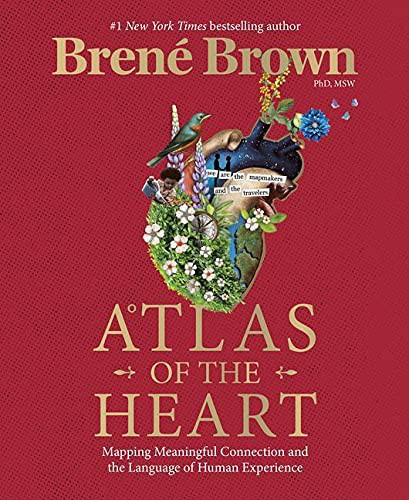
Atlas of the Heart
Random House · 2021 · 336 pages
ISBN: 9780399592553
Review Editor
Sofia Reyes
Brené Brown has built a career out of making people uncomfortable in the best possible way. Her TED talk on vulnerability has been watched well over forty million times, her books have sold in the tens of millions, and somewhere along the way she became one of the most recognizable voices in American psychology. With Atlas of the Heart, published in November 2021 by Random House, she takes on something she has been circling for two decades: the language of emotion itself.
The premise is surprisingly specific. Brown and her research team found that most adults can reliably name only three emotions in real time: happy, sad, and angry. Everything else gets absorbed into those three buckets, or defaults to the word “fine.” This is not just an impoverishment of self-expression. According to Brown’s research and the broader psychological literature, the inability to name what we feel precisely prevents us from processing those feelings, communicating them to others, or doing much of anything useful with them. Atlas of the Heart sets out to fix that. Brown catalogs eighty-seven distinct emotions and experiences, organizes them into thirteen thematic categories, and writes a field guide to each one.
The book is not a self-help workbook. You will not find action items at the end of each chapter or blank pages for journaling. What Brown offers instead is something rarer: a rigorously sourced, surprisingly funny vocabulary lesson about the interior life. She wants you to tell the difference between envy and jealousy, between sadness and grief, between awe and wonder. Her argument is that this precision matters more than most of us have assumed, and she makes a credible case for it across 336 pages.
Character Arcs and Development
Because Atlas of the Heart is narrative non-fiction built on qualitative research, the figures who populate it are Brown herself, the unnamed research participants whose voices run throughout the text, and the reader whom Brown addresses directly. All three carry more weight than you might expect.
Brown has always put herself into her work, but here she does it with more granularity than in her earlier books. She does not simply tell you she struggles with vulnerability; she gives you the specific, often embarrassing textures of that struggle. When she describes the gap between what we think we are feeling and what we might actually be feeling if we had better words for it, she uses her own marriage, her friendships, and her moments of professional failure as examples. These are not generic anecdotes. They have specific details: a particular argument with her husband, Steve, about a late-night phone call; the exact moment she noticed contempt rather than anger in her own chest.
The research participants appear as voices rather than fully drawn people. You get quotations, sometimes striking ones, but no complete portraits. Brown made a deliberate choice to protect confidentiality, which means the human figures in this book remain somewhat impressionistic. This is a real limitation. The book would land harder emotionally if you followed specific individuals over time. Instead, the reader must do the connecting work themselves, bringing their own experiences to the framework Brown provides.
What compensates is Brown’s consistent address to the reader. She uses “you” throughout, and it rarely feels presumptuous. She writes as if she already knows you have been misidentifying your anxiety as anger, your envy as contempt, your disappointment as defeat. The effect is oddly precise, like a thoughtful clinician explaining why the exact location of the pain matters before suggesting a treatment.
Pacing
The thirteen-chapter structure is both the book’s architecture and its occasional drag. Brown moves through the categories in a logical order: she begins with the emotions we experience when things become uncertain or overwhelming (stress, anxiety, worry), then works through comparison, loss, empathy, love, and on through the harder territories of resentment, shame, and grief. Within each chapter, the format repeats: here is the emotion, here is how people confuse it with similar emotions, here is what the research says, here are some stories.
This consistency is useful for reference purposes. You can return to the chapter on anger when you need to figure out whether what you are feeling is anger, frustration, contempt, or disgust. But reading the book straight through, the rhythm becomes predictable around the middle chapters. The chapters on joy and gratitude, and later the ones on grief and loss, are the strongest because Brown writes about them with evident personal investment. The middle chapters on comparison and boredom move more efficiently but with less heat. Readers who engage actively, pausing to reflect between sections, will get considerably more out of this book than readers who barrel through it in long sittings.
Deeper Thematic Exploration
The central argument of Atlas of the Heart is not, at its core, about feeling better. It is about connection. Brown writes that language is “a portal to meaning-making, connection, healing, learning, and self-awareness.” If you cannot name what you are feeling, you cannot share it accurately. If you cannot share it accurately, genuine connection becomes impossible. You end up performing emotions that approximate what you mean, and the people around you respond to the performance rather than to you.
This is a more radical claim than it might first appear. Brown is saying that the epidemic of loneliness in contemporary life is partly an epidemic of emotional inarticulacy. People are not just isolated geographically or structurally; they are isolated internally, unable to find the right words even for themselves. The solution she offers is a vocabulary expansion project, but the stakes she assigns to it are significant. She is not promising that naming your feelings will make your problems go away. She is arguing that without naming them, you cannot begin to work with them at all.
The book takes on the widespread conflation of empathy and sympathy, which has become one of its most frequently shared passages online. Brown argues that sympathy keeps a safe distance while empathy requires crossing into someone else’s experience. To respond to someone’s grief with “at least you have your health” is sympathy trying to find a silver lining. Empathy is something closer to: “That sounds incredibly painful. I am with you in this.” The distinction sounds simple. Practicing it is not, and Brown gives you the language to at least notice when you are falling into the easier option.
There is also a thread throughout the book about what Brown calls “places we go when we fall short.” This covers shame, embarrassment, humiliation, and guilt, and she returns here to the territory of her most recognized earlier work. Her core distinction holds: guilt says “I did something bad,” shame says “I am bad.” Guilt can motivate repair; shame tends to close people down. She adds more nuance this time, drawing on what the research now shows about the physiological differences between these states and the social conditions that produce each. The shame chapter, in particular, is worth reading even if you skip others.
Running underneath all thirteen categories is a critique of what Brown sees as emotional mislabeling as a cultural habit, the way we collapse complex feelings into simpler, more defensible categories. Anxiety becomes stress. Grief becomes sadness. Shame becomes anger. Each compression has consequences. The original emotion does not disappear; it just becomes less legible, harder to address, and more likely to surface sideways.
Style and Voice
Brown writes the way she speaks, which is both her greatest strength and the quality that most divides her readers. Her prose is informal, parenthetical, and often funny. She is not above a well-placed “ugh” or a section that reads like a text message from a very well-read friend. This warmth is genuine and earns real trust from readers who have spent time with her podcasts or talks.
But the style can veer into something that reads more like a transcript than writing. Some passages feel dictated rather than drafted, and sentences occasionally carry the rhythm of a lecture rather than a book. The physical design, full of large-format text, photography, and white space, serves as partial compensation. The designed spreads signal “significant concept ahead” in ways the prose sometimes does not quite deliver. Readers who engage with the physical hardcover will have a qualitatively different experience than those who read the ebook; the latter loses the visual rhythm that helps the more encyclopedic passages feel less like a list.
Brown at her sharpest produces definitions that genuinely clarify. Her description of awe as “the feeling we get in the presence of something vast that challenges our ability to understand it,” and her careful unpacking of how awe always involves a kind of surrender, are the kinds of distinctions that stick. You will notice them in your own experience afterward. The book’s best moments have that quality: not just explaining something you already knew, but giving you a more accurate name for something you had been approximating with a different word.
Verdict
Atlas of the Heart is most useful to readers who feel they have the emotional range but lack the vocabulary to work with it. If you know something is wrong but cannot quite locate what it is, if your relationships involve recurring miscommunications that seem tied to emotional misidentification, or if you have found Brown’s earlier books more convincing in theory than in practice, this one gives you the specific tools the earlier ones were pointing toward without fully providing.
It is less rewarding if you are looking for a propulsive narrative or an argument that builds to a single dramatic conclusion. The structure is encyclopedic, and reading it feels encyclopedic. Some people will find this reference-like quality a feature and return to it repeatedly; others will find the middle sections slow going. Brown’s willingness to be specific, to distinguish grief from sadness and envy from jealousy and awe from wonder, is what makes this book worth your time. The specificity is the whole point. You may not agree with every distinction she draws, but you will come away more precise about your own experience than you were before, and that precision, she argues persuasively, is where genuine connection begins.
Frequently Asked Questions about Atlas of the Heart
What is Atlas of the Heart by Brené Brown about?
Atlas of the Heart is a 2021 non-fiction book in which research professor Brené Brown catalogs eighty-seven distinct human emotions and experiences, organizes them into thirteen categories, and argues that naming our feelings precisely is the foundation of genuine connection with others. Brown draws on her own qualitative research, interviews, and personal stories to show how emotional inarticulacy keeps people isolated even when they are surrounded by others. The book is less a self-help manual than a vocabulary guide for the interior life.
How many emotions does Brené Brown identify in Atlas of the Heart?
Brown identifies eighty-seven emotions and experiences across thirteen categories, ranging from stress and anxiety to awe, nostalgia, shame, and grief. She chose this specific set based on her research team’s findings about the emotions people most commonly misname or fail to distinguish from one another. Each entry includes a working definition, common points of confusion with similar emotions, and research on what distinguishes them.
What is the difference between empathy and sympathy in Atlas of the Heart?
Brown describes sympathy as maintaining distance from another person’s pain, often by offering comfort or a silver lining from outside the experience. Empathy involves crossing into the other person’s perspective without immediately trying to fix it. The response “at least you still have your health” after a loss is sympathy; sitting with someone in their grief without trying to resolve it is empathy. Brown draws this distinction as one of the book’s central practical insights because so many people genuinely want to connect but reach for the easier option by default.
How does Atlas of the Heart compare to Brené Brown’s earlier books like Daring Greatly?
Daring Greatly and The Gifts of Imperfection focus on the themes of vulnerability and shame as general principles and offer a broader emotional argument. Atlas of the Heart is more granular: instead of making the case for vulnerability, it hands you the specific language to work with your own emotions at a finer level. Readers who found Brown’s earlier books compelling in theory but wanted more practical tools tend to find Atlas of the Heart the most immediately useful of her works. It is also more visually designed than her previous books, with the physical object playing a meaningful role in the reading experience.
Is Atlas of the Heart a difficult read, and how long is it?
The hardcover edition runs 336 pages and is designed for a general audience rather than an academic one. Brown’s prose is informal and accessible, so the book is not a demanding read in terms of sentence complexity. The challenge is more structural: with eighty-seven emotions organized across thirteen chapters, reading it straight through can feel repetitive in the middle sections. Many readers find it works better as a reference book to dip into than as a cover-to-cover read, though the chapters on love, grief, and shame reward sustained attention.
Is there a TV show or documentary based on Atlas of the Heart?
Yes. HBO Max produced a five-episode unscripted documentary series also called Brené Brown: Atlas of the Heart, which premiered in 2022 after a portion screened at SXSW in March of that year. Brown hosts the series and extends several of the book’s concepts through interviews and storytelling. The series is an accessible companion to the book but covers less ground than the written version.
What awards did Atlas of the Heart by Brené Brown win?
The book won the 2022 Goodreads Choice Award for Best Nonfiction, one of the most widely voted reader-choice awards in publishing. It was also a number one New York Times bestseller, a number one USA Today bestseller, a Wall Street Journal Business bestseller, and an Amazon Best Book of December 2021. The commercial reception reflected genuine reader enthusiasm: it spent multiple weeks at the top of major bestseller lists following its November 2021 publication.
Should I read Atlas of the Heart by Brené Brown?
If you have ever caught yourself unable to explain what you are feeling, defaulted to “I’m fine” when something is clearly not fine, or found that the same emotional misunderstandings keep showing up in your relationships, this book is worth your time. Brown’s specific focus on naming distinguishes it from most self-help writing, which tends to be long on encouragement and short on vocabulary. If you prefer narrative non-fiction with strong characters and a building argument, it may feel too structured and reference-like. But for anyone who wants to get better at reading their own interior life, Atlas of the Heart does the work that most books only promise to do.
Book Details
- Title
- Atlas of the Heart
- Author
- Brené Brown
- Genre
- Self-Help
- Publisher
- Random House
- Year Published
- 2021
- Pages
- 336
- ISBN
- 9780399592553
- WritersReview Rating
- 4.1 / 5