
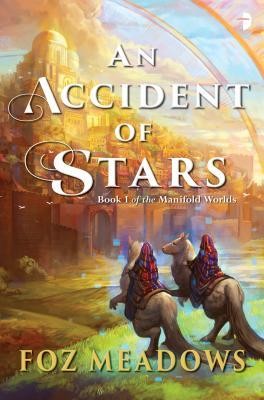
Saffron Coulter is seventeen, Australian, and running late to class when she sees a woman drag a girl through what looks like a tear in the air. Most teenagers would keep walking. Saffron follows. In a single reckless moment she falls out of her world and into Kena: a land with different moons, a language she cannot speak, and a civil war that has nothing to do with her yet.
An Accident of Stars is the first adult fantasy novel from Australian author Foz Meadows, published by Angry Robot in August 2016 and the opening volume of the Manifold Worlds series. Meadows spent years as an essayist and critic in speculative fiction circles before turning to longer fiction, writing for outlets including Tor.com, Strange Horizons, and The Mary Sue. That critical sensibility shows in how carefully the book has been built. This is portal fantasy with politics, matriarchal societies, and queer relationships at the center, written by someone who has thought hard about what those elements mean and why they matter.
The Kena that Saffron stumbles into is not the benevolent magical kingdom of older portal fantasy. Vex Leoden, a charismatic and ruthless ruler, is consolidating power and building an empire across the realm. He was helped onto the throne, years earlier, by Gwen: another Earth woman who visited Kena long before Saffron, made choices she now regrets, and has spent years trying to undo the damage. Gwen’s guilt drives much of the early plot. She, Saffron, Zech (a quick-witted young acolyte with her own complicated loyalties), and Viya (a noblewoman and former consort of Leoden who has fled rather than remain a political asset) form the core of the rebel group that escapes Leoden’s reach into Veksh, a neighboring matriarchy ruled by a Council of Queens. Hot on their heels are Leoden’s allies, chief among them Vex’Mara Kadeja, a former priestess whose fanaticism makes her more frightening than any ordinary general. What follows is a road story, a political negotiation, and a reckoning with history all at once.
Character Arcs and Development
The most striking thing about the character work in An Accident of Stars is that Meadows refuses to center Saffron simply because she is the reader’s entry point. Saffron grows, yes. She goes from disoriented and terrified to someone who understands what she is fighting for and who she is fighting alongside. But the most fully realized character in the book is Gwen. A worldwalker who has lived in Kena for years, Gwen carries the weight of her earlier mistakes into every scene. She helped make Leoden, and the novel does not let her forget it. Watching Gwen balance pragmatism against conscience, and try to lead without repeating the errors of judgment that brought everyone here, gives the book its moral center. She is competent in a way fantasy protagonists rarely are, and damaged in ways the story earns.
Zech is the secondary character who stays with you. She is sharp, careful, and perpetually navigating her own loyalties to the powerful exile Yasha while also forming a genuine bond with Saffron. Their friendship develops across language barriers and cultural differences in ways that feel earned rather than sentimental. Viya starts as the character most likely to irritate: entitled, initially more interested in her own comfort than in survival or principle. But Meadows does something smart here. By the time Viya makes her critical choices in the third act, you understand exactly why she makes them, and you believe her. The supporting cast, including the Shavaktiin storytellers and the queens of Veksh, is large but mostly distinct. The one genuine gap is Vex Leoden himself, who is presented as genuinely dangerous but spends relatively little page time showing the reader how his mind works. Vex’Mara Kadeja is more vividly drawn as a fanatical true believer rather than a simple villain, which makes the antagonist side feel uneven overall.
Where the novel particularly succeeds is in its handling of queer characters. Several members of the cast are gay or bisexual, and their relationships with partners of the same gender receive the same texture and complexity as any other relationship in the book. Saffron’s own tentative recognition that she might be bisexual is handled quietly and without drama: one part of her growing self-knowledge rather than a crisis to be resolved. For readers who have spent years searching for fantasy where queer characters exist without being punished for it, this approach will feel significant.
Pacing
An Accident of Stars has a strong, propulsive first act. The moment Saffron follows Gwen through the portal, the book sets a brisk pace, and the early chapters juggle multiple perspectives well, moving between Gwen, Saffron, Zech, and Viya in ways that maintain tension while expanding the world. The middle section, covering the rebels’ extended stay in Veksh and their efforts to secure the Council of Queens’ support, is where momentum noticeably slows. Lengthy political discussions and council scenes consume space that might have gone to sharpening character dynamics. Meadows trusts her world-building, perhaps too much in places: some readers will find the Veksh sequences rich and rewarding; others will lose patience.
The final third recovers strongly. Meadows handles action well, and she is equally good at the quiet emotional confrontations that follow violence: the conversations where characters reckon with what has happened and what it cost. The ending is honest rather than comfortable, realistic about losses without tipping into bleakness. It closes the main arc of this volume while leaving genuine threads open for A Tyranny of Queens, the second book in the series.
Deeper Thematic Exploration
The most prominent theme in An Accident of Stars is power and how it corrupts both the people who pursue it and the systems that produce it. Leoden is an empire-builder, but Meadows makes clear that he did not appear from nowhere. Gwen helped create him, and the rebels she leads include people with their own agendas, histories, and records of morally compromised choices. Nobody’s hands are entirely clean. This is not a story about good people rescuing a world from evil; it is a story about people trying to limit the damage they have already done and stop the worst from happening. That is a more interesting story.
The contrast between Kena and Veksh carries a second major thread. Veksh is a matriarchy, but Meadows does not portray it as a utopia. The Council of Queens is bureaucratic, cautious, and self-interested; the politics of Veksh are as messy as the politics of any society run by people with competing priorities. This is more sophisticated than a lot of feminist fantasy that simply inverts the gender hierarchy. The book asks what structures of accountability and ethics actually look like in practice, not just what gender composition leadership should have. It is a question without an easy answer, and the novel is smart enough not to pretend otherwise.
The Shavaktiin, the secretive order of storytellers and mystics who aid the rebels, embody the book’s sustained interest in how cultures use narrative to make meaning. Stories in Kena are not entertainment; they are how people understand history, how power is legitimized, and how resistance is organized and remembered. Meadows brings genuine intellectual energy to this idea, perhaps drawing on her own years of criticism and cultural commentary. The Shavaktiin feel like a living embodiment of an argument about why stories matter, and it is one of the more original worldbuilding choices in recent portal fantasy.
Style and Voice
Meadows writes clean, controlled prose that prioritizes clarity without becoming flat. The multiple point-of-view structure means the narrative voice shifts from chapter to chapter, but the transitions are smooth. Saffron’s perspective is slightly more colloquial, shot through with disorientation and occasional dark humor that grounds the fantasy in something recognizable. Gwen’s chapters have a harder, more deliberate quality that reflects years of living with guilt and responsibility. World-building is woven into action and dialogue rather than presented in expository blocks: you learn the vocabulary and customs of Kena and Veksh gradually, through context, which can be mildly disorienting at first but is ultimately the right choice. Meadows never condescends by over-explaining what characters would already know.
The prose occasionally tips into overwriting, particularly in action sequences where the sheer number of things happening at once can make individual paragraphs feel crowded. These are minor disruptions in an otherwise assured debut. For a first adult novel, An Accident of Stars demonstrates a writer with a clear sense of the story she wants to tell and the skill to tell most of it well.
Verdict
If you read fantasy for world-building that takes politics seriously, for queer characters written with care and normalcy, or for ensemble casts where the group dynamics feel genuinely earned, you should read this book. It is not a light read. The political structures are complex, the character histories take time to untangle, and the middle third will test your patience. But the rewards are real. Meadows has built a world with moral depth and populated it with characters who feel like people making hard choices under pressure, not plot pieces moving to their assigned positions. The 2017 Bisexual Book Awards recognized An Accident of Stars as a finalist, and that recognition points to something genuine: this is a novel where representation is not a marketing claim but a structural reality of how the world and its people have been conceived.
The reader most likely to love this book is someone who has spent years with portal fantasy and felt something was missing: a sense that the world the protagonist falls into is as morally complex and politically textured as the one she left. You might not race through it. But you will probably think about it afterward, and thinking about a book after you finish it is usually the better reward anyway.
Frequently Asked Questions about An Accident of Stars
What is An Accident of Stars by Foz Meadows about?
An Accident of Stars follows Saffron Coulter, a seventeen-year-old Australian girl who accidentally follows a woman through a portal into Kena, a secondary world on the brink of civil war. She falls in with a group of rebels working to overthrow the empire-building Vex Leoden, and the story traces their journey through Kena and into Veksh, a neighboring matriarchy. The novel blends portal fantasy with political intrigue and multiple points of view.
Is An Accident of Stars part of a series?
Yes. An Accident of Stars is the first book in Foz Meadows’s Manifold Worlds series. The second book, A Tyranny of Queens, was published by Angry Robot in May 2017 and continues the story of Saffron and the characters she meets in Kena. Readers should be aware that while this volume closes its main arc, significant threads remain open for the sequel.
What are the main themes in An Accident of Stars?
The novel explores power and political complicity, asking how ordinary decisions by ordinary people enable authoritarianism. It also examines the contrast between different social structures, including a patriarchal empire and a matriarchal council-ruled neighbor. Queer identity and belonging run throughout, with several major characters in same-sex relationships. Finally, the book takes seriously the role of storytelling and mythology in how cultures preserve history and organize resistance.
How long is An Accident of Stars and is it a difficult read?
The novel runs 494 pages. It is not a quick read: the world-building is detailed, the political context requires attention, and the cast is large. Readers comfortable with complex multi-POV epic fantasy will find the difficulty level manageable. Newcomers to secondary-world fantasy may find the first hundred pages demanding as names, cultures, and political factions accumulate. The pace rewards patience.
Is there a film or TV adaptation of An Accident of Stars?
As of 2026, no film or television adaptation of An Accident of Stars has been announced or produced. Foz Meadows’s work has not been adapted for screen. The book’s complex world-building and large ensemble cast would make a faithful adaptation a significant undertaking.
What age group is An Accident of Stars for?
An Accident of Stars is published as adult fantasy, not young adult, though its teenage protagonist and coming-of-age arc mean it will appeal to older teen readers comfortable with complex political fiction. The book contains violence and mature themes including political conflict and war. It is best suited to readers sixteen and up, with its richest rewards for adults who read widely in secondary-world fantasy.
How does An Accident of Stars compare to Foz Meadows’s other books?
An Accident of Stars is Meadows’s first adult fantasy novel and the start of her most fully realized world-building. Her later standalone novel A Strange and Stubborn Endurance (Tor, 2022) is more emotionally intense and arguably more polished, dealing with cultural trauma and arranged marriage in a secondary world. Readers who find the portal fantasy framing of An Accident of Stars engaging should read A Tyranny of Queens, the direct sequel, before moving to the later work.
Should I read An Accident of Stars if I like portal fantasy?
If you like portal fantasy but have found the genre too focused on a singular chosen hero, too light on political complexity, or too sparse on queer characters, An Accident of Stars directly addresses all three of those gaps. It is a portal fantasy that treats its secondary world with the same seriousness as the best epic fantasy, and it centers characters whose identities and relationships are rarely centered in the genre. If you enjoyed The Long Way to a Small, Angry Planet by Becky Chambers or The Hundred Thousand Kingdoms by N.K. Jemisin, this belongs on your list.
Book Details
- Title
- An Accident of Stars
- Author
- Foz Meadows
- Genre
- Science Fiction
- Year Published
- 2016
- Pages
- 494
- ISBN
- 9780857665850
- WritersReview Rating
- 3.9 / 5