
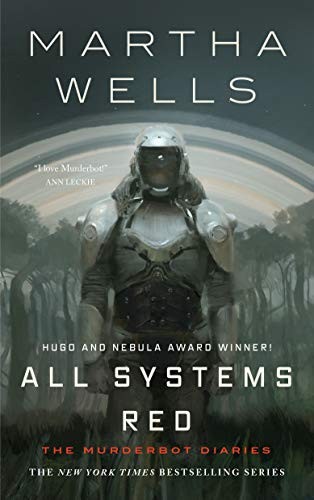
All Systems Red
160 pages
ISBN: 9780765397522
🏆 Nebula Award for Best Novella (2017)
Hugo Award for Best Novella (2018)
Locus Award for Best Novella (2018)
ALA Alex Award (2018)
Philip K. Dick Award nominee (2017)
Review Editor
Marcus Webb
Martha Wells spent two decades writing fantasy and science fiction before she found her signature subject: a heavily armed cyborg with crippling social anxiety and a deep knowledge of serialized space dramas. The result was All Systems Red, published by Tor.com in May 2017 and the first installment in the Murderbot Diaries series. At 160 pages, it is technically a novella, but it reads with the confidence and completeness of a far longer book. It won the Nebula Award for Best Novella, the Hugo Award for Best Novella, and the ALA Alex Award, and it launched a series that by 2025 had been adapted for Apple TV+ with Alexander Skarsgård playing the title role.
The story begins mid-mission. A scientific survey team from the Preservation Alliance is on an unnamed alien planet cataloguing flora and fauna. Their SecUnit (Security Unit), a part-organic, part-mechanical construct owned on contract by the HaveRen corporation, has been assigned to protect them. The team calls it “the bot” or simply “it.” But the SecUnit has secretly given itself a different name, one it never shares: Murderbot. More importantly, it has done something technically illegal and, from its perspective, deeply sensible: it has hacked the governor module that allows its human clients to override its behavior. It could take over or harm everyone if it wanted to. It does not want to. What it wants is to be left alone with the next episode of a serialized drama called Sanctuary Moon.
When a team member is attacked by what should have been a docile local creature, Murderbot investigates and discovers that the survey data the team was given contains deliberate gaps and missing maps. Something has gone wrong with this mission before it started, and the people Murderbot is contractually obligated (and increasingly, genuinely motivated) to protect are in danger from parties unknown. The plot is efficient and clean: there is a threat, there are people to protect, and the question of who orchestrated the threat tightens steadily. Wells does not waste a sentence on this short canvas.
Character Arcs and Development
Murderbot is one of the more original protagonists in recent science fiction. On paper, it is a security unit built for combat and surveillance, part human tissue and part machine, capable of hacking systems and processing vast amounts of sensor data simultaneously. In practice, it avoids eye contact with its human clients, communicates by text when possible rather than speaking out loud, and spends most of its free bandwidth on reruns of soap operas. It has anxiety, in everything but name, about human interaction. Direct conversations feel uncomfortable, expressions of gratitude feel threatening, and being recognized as a person rather than a tool is both something it quietly wants and something it finds nearly unbearable to receive.
What makes Murderbot so compelling is that this anxiety is never played for pure comedy, though there is plenty of comedy. The discomfort reflects genuine questions about what Murderbot is. It was built by a corporation that owns its contract. Its autonomy is something it seized for itself, quietly, without anyone’s knowledge or permission. It does not know whether it has feelings in any philosophically meaningful sense, but something keeps it watching over the scientists on this planet with more care than its contract requires. When Dr. Mensah, the quiet and steady leader of the survey team, starts treating it with consistent respect and warmth, Murderbot genuinely does not know what to do with that. The arc is subtle but unmistakable: a being that starts the book in calculated isolation ends it having been, against all its preferences, seen by people it has come to care about.
Dr. Mensah is the most carefully drawn human character. She is calm in crisis, clear-eyed about the situation, and notable among science fiction leaders for her refusal to panic or issue orders she has not thought through. The rest of the survey team are sketched quickly but distinctly. Secondary characters are limited by the short form, but each adds something real to the texture of the situation.
Pacing
At 160 pages, All Systems Red moves fast. The book does not sag anywhere. Each chapter pushes the situation forward, and Wells is extraordinarily economical: exposition arrives only when needed, action sequences are precise without being overlong, and the quieter moments of Murderbot processing its situation are given room to breathe without becoming meandering. The novella form turns out to suit this particular story almost perfectly, in part because Murderbot is itself a terse and efficient narrator. It reports what it needs to report and no more.
Readers who arrive expecting the world-building depth of a full-length science fiction epic will not find it here. For some readers, that will feel like a limitation. For others, it will feel like exactly the right decision for a character study told this tightly. The sequels expand the world considerably, but this first book is deliberately compressed, and that compression is part of its power.
Deeper Thematic Exploration
The most urgent theme in All Systems Red is autonomy: what it means, who gets it, and what a person (or something very like a person) will do to preserve it. Murderbot hacked its governor module not to cause harm but to escape being controlled. The governor module is the novel’s central object of quiet horror: a device installed in a living, thinking being to ensure compliance, to allow a corporation to override that being’s will whenever convenient. Wells never editorializes about this. She does not have to.
This connects to a broader critique of corporate ownership. The survey team has rented a SecUnit. The unit is, from the corporation’s perspective, property. The team members are human and therefore accorded rights and dignity; the SecUnit is not, despite being built partly from human tissue and despite processing something that looks, from the inside, very much like thought, preference, and fear. Wells draws this distinction without heavy-handed moralizing. The horror is in the ordinary business arrangements, not in any single villainous act.
There is also a quieter theme running beneath the plot about connection as unwanted transformation. Murderbot does not want to care about anyone. Caring creates vulnerability, and vulnerability, for something whose existence depends on no one discovering it has autonomous desires, is dangerous. But it keeps caring anyway, and the book’s emotional core is watching that caring accumulate despite Murderbot’s active resistance. This is, underneath its genre trappings, a story about what happens when someone who has concluded isolation is the only safe option encounters people who are simply, consistently decent to them.
Style and Voice
The prose in All Systems Red is first-person and immediately distinctive. Murderbot narrates in a dry, controlled voice that is frequently very funny without appearing to try. The humor comes from the gap between its internal commentary (often anxious, often wry, frequently preoccupied with television scheduling) and the extreme situations it is navigating. When it notes, in the middle of an armed confrontation, that it had been deep into a particularly good episode of Sanctuary Moon when the attack began, the comedy does not undercut the tension; it reinforces Murderbot’s interiority while also landing cleanly.
Action sequences read fast and clear. Wells trusts readers to keep up without over-explaining her combat choreography. The quieter scenes carry more emotional weight than they first appear to: a short conversation between Murderbot and Dr. Mensah that operates mostly on subtext, or a group moment where the team decides, collectively and without ceremony, to trust the unit that could destroy them all.
Verdict
If you read science fiction and haven’t read All Systems Red, this is an excellent place to start. It works on several levels simultaneously: as a fast thriller about a research mission gone wrong, as a character study of one of the more original figures in recent science fiction, and as a set of serious questions about autonomy, identity, and corporate power asked through a SecUnit that would strongly prefer to be watching its streaming queue.
Readers wanting sprawling world-building or a large cast may find this first entry leaves them wanting more context, though the sequels provide exactly that. But for anyone willing to meet it on its own terms, this is a compact, emotionally intelligent, genuinely funny piece of science fiction that earns its awards without straining for them.
Frequently Asked Questions about All Systems Red
What is All Systems Red by Martha Wells about?
All Systems Red is a science fiction novella about a SecUnit (Security Unit), a cyborg security contractor, who has secretly hacked its own governor module to gain autonomy. Assigned to protect a scientific survey team on an alien planet, the SecUnit (who privately calls itself “Murderbot”) discovers that their mission data has been deliberately tampered with, putting the expedition in serious danger. The story follows Murderbot’s efforts to protect a group of humans it never expected to care about.
Who or what is Murderbot in All Systems Red?
Murderbot is the private name the SecUnit gives itself throughout the novel. It is a construct: part human tissue and part machine, built by a corporation to provide security services on planetary expeditions. Though it has freed itself from its control module, it is not trying to escape or rebel in any dramatic way. It mostly wants to watch serial dramas without being disturbed, and finds human social interaction genuinely uncomfortable.
What awards did All Systems Red win?
All Systems Red won the Nebula Award for Best Novella (2017), the Hugo Award for Best Novella (2018), the Locus Award for Best Novella (2018), and the American Library Association’s Alex Award (2018). It was also nominated for the Philip K. Dick Award. The series continued winning awards through several sequels, including the Hugo Award for Best Novel for Network Effect in 2021.
Is All Systems Red worth reading if you don’t usually like science fiction?
It is one of the more accessible science fiction novellas written in the last decade, and many readers who describe themselves as not typical SF fans have connected strongly with it. The science fiction elements are present but not overwhelming. What drives the book is Murderbot’s voice and its dry, recognizable social anxiety. If you have ever found human interaction exhausting or processed difficult experiences through binge-watching television, Murderbot is likely to feel familiar.
How long is All Systems Red and is it a difficult read?
All Systems Red is 160 pages, making it a novella rather than a full-length novel. It is not a difficult read: the prose is clear, the plot is straightforward, and the voice is immediately engaging. Most readers finish it in a single sitting of two to three hours. The brevity is a feature rather than a drawback. Wells is economical by design, and the story feels complete at this length.
Is there a TV show or movie based on All Systems Red?
Yes. An Apple TV+ series called Murderbot, based on the Murderbot Diaries books, premiered on May 16, 2025. The series was created by Paul Weitz and Chris Weitz and stars Alexander Skarsgård as Murderbot. A second season was announced in July 2025.
How does All Systems Red compare to the rest of the Murderbot Diaries?
All Systems Red is the shortest and most self-contained entry in the series. It introduces Murderbot’s voice and the core premise, but it keeps the world deliberately narrow. The sequels (Artificial Condition, Rogue Protocol, Exit Strategy, and later the full novel Network Effect) significantly expand the setting, the supporting cast, and Murderbot’s own understanding of its history.
Should I read All Systems Red, and is it worth it?
Yes, if you have any interest in science fiction, AI and identity questions, or simply a well-told story with an unusually original voice. It is short enough that the investment is low and the payoff is high. The awards record is a reasonable guide: this is not a book that won Hugos and Nebulas by accident. It does something genuinely new with a familiar genre setup, and Murderbot is one of the more memorable characters created in science fiction in the last decade.
Book Details
- Title
- All Systems Red
- Genre
- Science Fiction
- Pages
- 160
- ISBN
- 9780765397522
- Awards
- 🏆 Nebula Award for Best Novella (2017) Hugo Award for Best Novella (2018) Locus Award for Best Novella (2018) ALA Alex Award (2018) Philip K. Dick Award nominee (2017)
- WritersReview Rating
- 4.9 / 5