
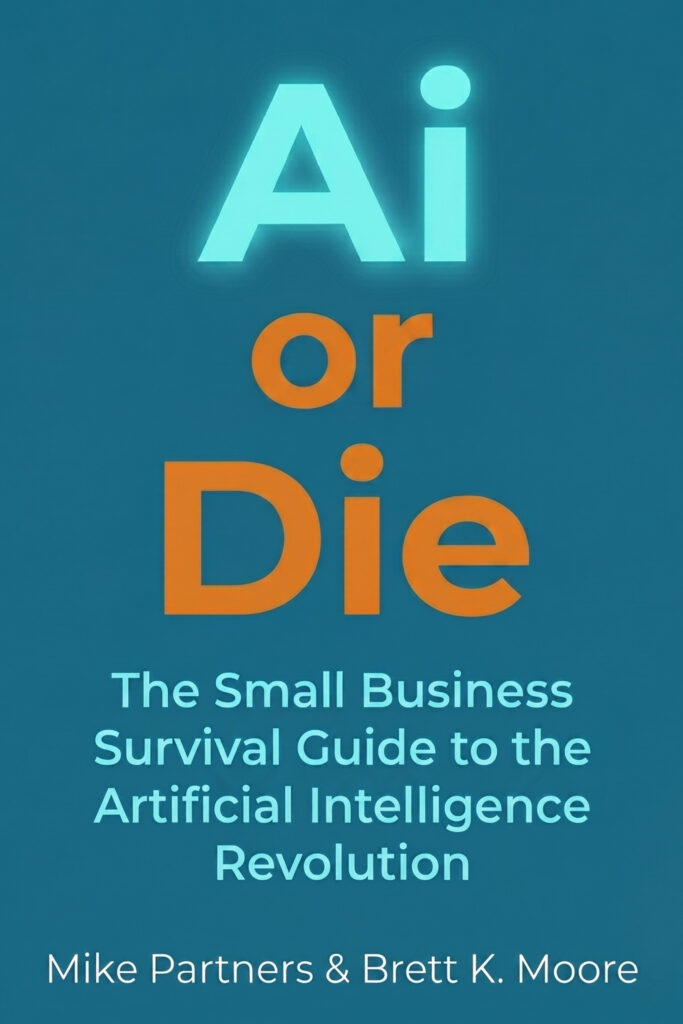
AI or Die
Legacy Publishing Inc. · 2025 · 250 pages
ISBN: 9798950846014
Review Editor
Daniel Okafor
The opening line of AI or Die lands before the first chapter even begins: in February 2024, Klarna launched an AI customer service system that handled 2.3 million conversations in thirty days, replacing the equivalent of 700 full-time employees, cutting resolution times by 67 percent, and saving the company $39 million in a single year. Not over five years. In one month. Mike Partners and Brett K. Moore use that story not as a flourish but as a threshold — the moment they want you to walk through before anything else is said. What follows is one of the more practically useful books written about artificial intelligence for small business owners, and one of the more honest about what the moment actually demands.
Partners brings unusual credibility to this subject. He has built AI systems that track dark fleet vessel movements in the Persian Gulf, process 1,200 data points in real time for commodity trading desks, and identify gold and oil deposits before anyone sets foot on the land through a system he calls Magma Vision. He also runs AiExpert.org and works with a five-person cleaning company in the same week he works with a family office managing generational wealth. That dual vantage point is the book’s structural advantage. He is not explaining AI from a position of theory. He is explaining it from a position of having built it at both ends of the scale spectrum and observed what the difference actually is. His conclusion: the tools are identical. The principles are identical. The only thing that differs is the scale of the problem you point them at.
That argument is the book’s spine, and it holds. The same AI models that power JPMorgan’s deployment across 200,000 employees are available as a $20 monthly subscription. The automation logic behind enterprise workflow optimization runs on Make.com for $16 per month. What separates the businesses capturing most of the value created by AI from those dividing the remainder is not access to better tools. It is having moved from experiment to production while everyone else was still attending webinars. The McKinsey finding that Partners returns to repeatedly — 75 percent of all economic value created by AI is being captured by 20 percent of companies — is not, in his framing, a statement about inevitability. It is a statement about urgency.
Argument and Structure
AI or Die is organized in five parts that move logically from the case for urgency to practical implementation to long-term strategic positioning. Part One establishes the competitive math. Part Two examines how large companies have already deployed AI at scale — JPMorgan’s COiN system, which replaced 360,000 hours of annual legal document review; UPS’s ORION routing system, which saves 100 million delivery miles and 10 million gallons of fuel per year; Delta’s predictive maintenance program, which reduced unplanned aircraft removals by 30 percent. These are not aspirational examples. They are documented operational deployments that Partners uses to extract transferable principles, not to inspire awe.
Part Three brings those principles down to small business scale with specific financial modeling. The law firm example is representative of the book’s analytical approach: implement an AI document processing assistant at $1,800 per year, recover five hours per week per professional, convert 40 percent of recovered capacity to billable work at $150 per hour, add the direct cost savings — total EBITDA impact, $273,000. Tool cost, $1,800. That is a 152x return. Partners is careful to note that your numbers may be half of this and the return is still extraordinary. This kind of specific, conservative modeling is what separates the book from the generalist enthusiasm that characterizes much AI business writing.
Part Four covers implementation: how to audit your operations for automation targets, how to prioritize using an Effort-Impact matrix, how to sequence implementations so that early wins build internal momentum rather than creating organizational resistance. Part Five addresses the five-year horizon — what categories of work are at genuine displacement risk by 2030, what categories become more valuable, and how to position on the right side of that line. The structure is clean and the progression is logical. Each section does what it promises.
Key Concepts
The most practically useful framework in the book is the One-Day Audit combined with the Effort-Impact Matrix. Partners asks business owners to track every task performed in a day and categorize it as either “I’m the only one who can do this” or “this is repeatable and someone else could do it.” Most owners, he observes, find that 60 to 80 percent of their daily work lands in the second category. That second category is the automation target list. The Effort-Impact Matrix then plots those tasks on two axes — implementation difficulty and annual cost impact — and identifies the upper-left quadrant, high impact and easy to implement, as the starting point. The specificity of this framework is its virtue. It is not a philosophy. It is a decision-making tool.
The three long-term moats Partners identifies in the final section are the most strategically substantive part of the book. The first is the data asset: every customer interaction an AI system handles generates proprietary data that makes the system more effective over time and that a new competitor cannot purchase. The second is process clarity: implementing AI requires documenting processes to the point where a machine can execute them, and that documentation makes the business more scalable, less dependent on any individual, and more valuable to a potential buyer. The third is human capital: the employee who learns to work alongside AI in 2026 is dramatically more capable in 2030, and building an AI-fluent team is an asset that compounds. These are not new ideas in isolation. Partners makes them concrete by connecting them to the specific operational work described in earlier chapters.
The regulatory section is notably clear-eyed. Partners explains that the EU AI Act came into full force in August 2026 and applies to any business whose AI output is used in the EU, regardless of where the business is headquartered — a point many US small businesses miss. His practical guidance is simple: document what AI you use, what it does, and how humans review its outputs. One paragraph per tool. Two hours of work that covers years of exposure. That kind of specific, proportionate guidance is where the book consistently earns its authority.
Influence and Voice
Partners writes in a direct, compressed style that prioritizes clarity over elegance. Sentences are short. Paragraphs make one point and move on. The rhetorical mode is closer to a high-quality business memo than to business narrative, which is the right choice for the material. He quotes Dario Amodei of Anthropic — speaking at Davos in early 2026 — on the possibility of AI systems broadly better than humans at almost all things arriving within a few years, and he quotes Marc Andreessen’s January 2026 observation that the moat in the AI era is not the AI itself but the product, the integration, the distribution, and the captured value. Both citations are used to make specific points rather than to borrow authority, which is the appropriate use of them.
The book’s voice carries genuine conviction without veering into the promotional register that afflicts much technology business writing. Partners has built things. He knows what the systems can and cannot do. When he says the tools available to a small business owner are substantively identical to what powers enterprise deployments, he is making a claim he can support from direct experience, and that grounding is audible in the prose. The moments where the book is most effective are the ones where he is drawing directly on that experience — the landscaping company saving three hours per week on scheduling, the dental practice recovering 20 percent of appointments lost to no-shows, the podcast network turning raw audio into complete content packages before the host finishes their post-episode coffee. These examples are specific, verifiable in their structure, and believable in a way that the enterprise case studies, however documented, are not.
Verdict
AI or Die is a practical, well-argued, and credibly grounded guide for small business owners who need to move from awareness to implementation. It does not traffic in vague encouragement. It provides specific frameworks, specific financial models, and a specific 30-day action plan with day-by-day instructions. The competitive case it makes — that the window for structural advantage is open but not indefinitely — is supported by real data and real operational examples rather than by assertion alone. Readers who approach this book looking for a strategic framework will find one. Readers who approach it looking for an implementation manual will also find one. That dual utility is not common in business writing of this kind.
The book is most useful for owners of service businesses, professional services firms, and e-commerce operations who have not yet moved beyond experimenting with AI tools. It is less directly useful for businesses in regulated industries or those requiring significant technical infrastructure, though the principles translate. The specific tool recommendations — Calendly, Klaviyo, Tidio, Goodcall, Bland.ai, Make.com — will date as the landscape evolves, but the underlying logic of why each category of tool matters does not depend on any specific vendor surviving. Read it as a framework with current examples, not as a vendor directory, and it holds its value well beyond the publication date.
Frequently Asked Questions about AI or Die
What is AI or Die by Mike Partners and Brett K. Moore about?
AI or Die is a practical business guide for small business owners navigating the AI adoption curve. The book argues that the same AI tools available to large enterprises like JPMorgan and Klarna are accessible to any small business for under $20 per month, and that the businesses capturing most of the value created by AI are distinguished not by technical sophistication but by having moved from experimentation to production while competitors were still evaluating. It covers why urgency matters, how large companies have already deployed AI at scale, how to apply the same principles to a small business, and how to build lasting competitive advantages from AI implementation.
Who should read AI or Die?
The book is written for small and mid-size business owners who are aware that AI matters but have not yet moved beyond occasional experimentation. It is particularly useful for owners of service businesses, professional services firms, e-commerce operations, and any business where significant time is spent on repeatable, process-driven tasks that resist being delegated to a human employee. Owners who are already running multiple AI automations in production will find the first half of the book familiar, but the strategic framing of the final sections — the three long-term moats, the 2030 displacement analysis, and the regulatory overview — adds value at any stage of implementation.
What specific AI tools does the book recommend?
The book recommends specific tools by category rather than as definitive endorsements. For scheduling automation: Calendly and Acuity. For email and follow-up sequences: Klaviyo and ActiveCampaign. For customer service chat: Tidio, Intercom, and ManyChat. For AI phone agents: Goodcall and Bland.ai. For workflow automation: Make.com and Zapier. For core AI work: Claude is mentioned repeatedly as the author’s primary working tool. The author is explicit that the specific vendors matter less than understanding which category of problem each solves, since the tool landscape evolves rapidly while the underlying business logic does not.
What is the Effort-Impact Matrix and how does it work?
The Effort-Impact Matrix is a prioritization framework for deciding which automation to implement first. It plots your list of automatable tasks on a two-by-two grid with implementation difficulty on the horizontal axis (easy to hard) and annual cost impact on the vertical axis (low to high). The upper-left quadrant — high impact, easy to implement — is where your first automations should come from. These are tasks where a tool already exists, connects to your systems without custom development, and costs $50 to $200 per month. The matrix prevents the common mistake of starting with the most interesting automation rather than the one with the fastest and most measurable return.
How does the book address concerns about AI replacing jobs?
The book takes a direct position: AI replaces tasks, not roles, and the businesses that manage this transition well are the ones that move employees from automatable work toward work that AI cannot do — judgment, relationships, accountability, and domain expertise. Partners cites the World Economic Forum’s projection of 92 million jobs displaced by 2030 alongside 170 million new jobs created, and frames the small business owner’s responsibility as helping their team evolve rather than simply reducing headcount. The argument is practical rather than philosophical: the employee who processes invoices manually should be learning to manage the AI that processes them automatically, which is a more valuable role.
What does the book say about the EU AI Act and regulatory compliance?
The EU AI Act came into full force on August 2, 2026, and applies to any business whose AI output reaches EU customers, regardless of where the business is headquartered. Many US small businesses are unaware this applies to them. The book’s practical guidance is proportionate: document what AI tools you use, what each one does, and how humans review its outputs — one paragraph per tool, stored somewhere findable. Most small businesses using standard off-the-shelf tools from compliant vendors are not in high-risk regulatory territory, but businesses using AI to make hiring, credit, or healthcare decisions face documentation and human oversight requirements. California, Colorado, and New York have additional state-level statutes that remain enforceable regardless of federal deregulation.
What are the three long-term competitive moats the book describes?
The book identifies three compounding advantages for businesses that implement AI early. The first is the data asset: every AI-handled customer interaction generates proprietary data that makes future AI systems more effective and that a new competitor cannot purchase regardless of which tools they use. The second is process clarity: the work of implementing AI requires documenting operational processes clearly enough for a machine to execute, and that documentation makes the business more scalable, less dependent on any individual, and more valuable in an acquisition. The third is human capital: employees who learn to work alongside AI early become significantly more capable over time, and an AI-fluent team is an internal asset that compounds in ways a tool subscription cannot replicate.
How long is AI or Die and how is it structured?
AI or Die is organized in five parts across fourteen chapters. Part One makes the competitive case for urgency, including financial modeling of the compounding advantage early movers gain over late adopters. Part Two examines large enterprise AI deployments — Klarna, JPMorgan, UPS, Delta — and extracts the transferable principles. Part Three applies those principles to small business operations with specific financial models for service businesses, professional services firms, and e-commerce companies. Part Four covers implementation: the one-day audit, the Effort-Impact Matrix, and the six core automations most businesses should build first. Part Five addresses the five-year horizon, including which job categories face displacement risk by 2030 and which become more valuable, followed by a specific 30-day action plan.
Book Details
- Title
- AI or Die
- Author
- Mike Partners
- Genre
- Business
- Publisher
- Legacy Publishing Inc.
- Year Published
- 2025
- Pages
- 250
- ISBN
- 9798950846014
- WritersReview Rating
- 4.3 / 5