
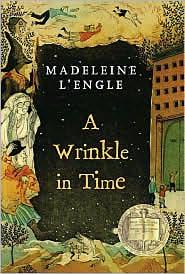
A Wrinkle in Time
Farrar, Straus and Giroux · 1962 · 212 pages
ISBN: 9780312367541
Review Editor
Hannah Bright
A Wrinkle in Time is a 1962 science fantasy novel by Madeleine L’Engle, and it is one of the few children’s books that reads differently at thirty than it did at ten. Not because the story changes, but because you notice what you missed: the precision of the theological scaffolding, the exact way L’Engle deploys love not as sentiment but as argument. The surface is a rescue adventure across the universe. Underneath, it is a serious inquiry into conformity, identity, and what love actually does when it is tested.
The story begins with Meg Murry, thirteen years old, entirely at odds with her world. She gets into fights at school, earns bad grades despite obvious intelligence, and cannot locate herself in any social order. Her father, a physicist with government clearance, has been missing for over a year. Her mother does not explain where he is, the community speculates, and the silence in the house sits heavy. Then one stormy night, a strange woman named Mrs. Whatsit appears at the Murrys’ kitchen door, and everything shifts.
Meg, her five-year-old brother Charles Wallace (who can read minds to an eerie degree), and a new friend named Calvin O’Keefe are guided by three mysterious beings through a journey that involves tessering, a form of travel through the fifth dimension, to the planet Camazotz. There, absolute conformity is enforced by a disembodied intelligence called IT. Every person on Camazotz moves in lockstep, speaks the same words at the same intervals, and any deviation is punished. Meg’s father is imprisoned somewhere in this system. To reach him and bring the family back together, Meg will have to find what she possesses that IT cannot use against her.
Character Arcs and Development
Meg Murry is one of the most fully realized protagonists in children’s literature, and she is not immediately likable in the way adventure heroes tend to be. She is prickly, impatient, quick to anger, and given to self-pity. L’Engle uses these flaws structurally: Meg’s anger, which seems like a liability at school and at home, turns out to be something IT cannot absorb or replicate, because IT feeds on fear and conformity, not on fierce particularity. The character’s real arc is not simply the physical rescue of her father. It is understanding that her stubbornness and her love, specifically her love for Charles Wallace, are not weaknesses to overcome but strengths she has not yet learned to use. By the final pages, Meg has not become a different person. She has become more fully herself, which is exactly what the book argues is the only winning move.
Charles Wallace is the most unusual child in the cast, and the most technically risky. Five years old, he speaks with the precision of an adult philosopher, skips past ordinary childhood milestones, and has some degree of genuine telepathic perception. The risk with such a character is that he becomes a plot mechanism rather than a person. L’Engle mostly avoids this by making Charles Wallace’s strangeness his vulnerability. He is so confident in his ability to understand and neutralize IT’s influence that he walks directly into a trap, and watching him become subsumed by IT, speaking in IT’s cadences, turning his gifts against Meg, is genuinely unsettling in a way that works precisely because you trusted him at the beginning. Calvin O’Keefe arrives as the warmer counterweight: popular at school, from a neglectful family, carrying a loneliness that the Murry household immediately soothes. His function in the plot is partly structural, but his affection for Meg feels earned, and he is useful precisely because he brings social intelligence that Meg and Charles Wallace both lack.
The three celestial guides, Mrs. Whatsit, Mrs. Who, and Mrs. Which, are intentionally more symbol than character. Mrs. Who speaks exclusively in quotations from across human history, Mrs. Whatsit is the warmest and most tangible, and Mrs. Which is ancient and barely manifests in physical form at all. They are not explained, and the book is better for it. Children understand that some presences operate outside ordinary logic; L’Engle trusts this understanding without condescending to it.
Pacing
The novel is short, around 212 pages in its original form, and moves at a pace that accelerates as the stakes rise. The opening sections on Earth have a pleasingly domestic rhythm: dinner at the Murrys’, Meg’s fight at school, the strange autumn weather. L’Engle uses this domestic texture to establish the relationships that will matter before the adventure launches, so that when you arrive on Camazotz the contrast is genuinely jarring. The tessering sequences are described in terms designed to be difficult to picture, and this is not a failure of craft. L’Engle wants the experience to feel alien and slightly vertiginous, and it does.
Camazotz is where the pacing slows to its most effective. The horror of the planet (children bouncing balls in identical rhythms, mothers calling their children in identical voices, a town that looks normal and is entirely wrong) is built through restraint rather than spectacle. Some readers find the final confrontation with IT brief relative to the dread L’Engle has constructed; the resolution arrives quickly, and Meg’s winning move is not a tactical triumph but something closer to a declaration. You can read this as a structural imbalance, or you can read it the way L’Engle intended: the thing that defeats IT is the one thing IT cannot model, so the moment it is fully present, the contest is over.
Deeper Thematic Exploration
The most legible theme is conformity versus individuality. Camazotz presents an extreme version of the pressure every child feels to fit in, to think the same thoughts and want the same things as everyone around them. IT offers something that could look appealing from certain angles: no more failure, no more loneliness, no more standing out. The horror is that this offer is genuinely seductive, and L’Engle does not pretend otherwise. She understood, better than most, that the argument for sameness is strongest when you are thirteen years old and feel like the only person alive who cannot get it right.
But L’Engle is making a more precise argument than “be yourself.” She is saying that love, the specific and particular love for one person, is a form of resistance to totalitarianism that cannot be co-opted or theorized away. IT operates at the level of pure intellect and control. It is defeated not by Meg’s intelligence or Calvin’s warmth or Charles Wallace’s gifts, but by Meg’s love for her brother, which is stubborn, inarticulate, and completely outside IT’s operating vocabulary. This is not presented as soft or sentimental. It is presented as something nearly as hard and exact as mathematics. The universe that L’Engle constructs has room for tessering and prayer, for quantum physics and the cherubim of scripture, and she does not treat these as contradictions to be resolved.
Running underneath the adventure is the texture of grief: specifically, the grief of not knowing whether someone you love is alive. Meg does not know whether her father survived. Her mother does not know. The community gossips. The not-knowing shapes Meg’s behavior at school, at home, in her relationships, and L’Engle lets this sit rather than rushing to resolution. It makes the reunion between Meg and her father feel genuinely earned, and it complicates it, because the man who returns is not the all-knowing authority Meg imagined. He is someone who needed rescuing by his daughter. That shift in the power relationship is handled with real care, and it changes what the word “father” means in the book’s final pages.
Style and Voice
L’Engle writes with a clean, confident prose that does not condescend. She assumes young readers can hold sentences about the nature of the fifth dimension alongside references to Pythagorean triangles and allusions to Goethe. The novel rewards rereading because the passages that seem strangest on a first encounter reveal their logic once you understand what she is building. Mrs. Who’s habit of speaking exclusively in quotations from human history, for instance, turns out to be structurally significant: she can only speak most clearly through what the human mind has already managed to say.
The narrative stays close to Meg’s perspective without being locked inside it. The prose is precise and occasionally beautiful, always in service of the story. What makes the voice distinctive is its seriousness. L’Engle writes as though the questions she is raising (about evil, about love, about the nature of intelligence itself) deserve the reader’s full attention, and she has been right about that for over sixty years.
Verdict
A Wrinkle in Time belongs on the short list of children’s novels that remain genuinely absorbing in adulthood. If you read it at ten, you probably remember the dread of Camazotz, the vertiginous sensation of tessering, and the particular relief of the ending. Read it now and you will notice how precisely the thematic architecture is built, how intelligently L’Engle handles the relationship between science and faith, and how exactly she understood what it feels like to be a misfit who is also necessary. For readers who want narrative efficiency above all else, the philosophical digressions may feel like detours. For anyone who wants a children’s novel that trusts its readers with real questions and places love (particular, awkward, stubborn love) at the center of its moral universe, this is essential reading.
Frequently Asked Questions about A Wrinkle in Time
What is A Wrinkle in Time by Madeleine L’Engle about?
A Wrinkle in Time follows thirteen-year-old Meg Murry, her young brother Charles Wallace, and their friend Calvin O’Keefe as they travel across the universe to rescue Meg’s father, a physicist imprisoned on a distant planet called Camazotz. The planet is ruled by a disembodied intelligence that enforces absolute conformity, and Meg must find a way to defeat it using something IT cannot understand or absorb.
What is a tesseract in A Wrinkle in Time?
In the novel, a tesseract is a method of travel through the fifth dimension, folding space and time so that travelers can cross vast distances instantaneously. L’Engle uses the actual mathematical concept of a tesseract (a four-dimensional hypercube) as a launching point, and the characters explain it using an analogy: rather than crawling along the surface of a piece of fabric, you fold the fabric so the two ends touch. The term gives the book its title and its central scientific metaphor.
What are the main themes in A Wrinkle in Time?
The book explores conformity and individuality (Camazotz represents a horrifying vision of enforced sameness), the power of love as a specific and particular force rather than an abstract ideal, and the relationship between science and faith (L’Engle refuses to treat them as opposites). It is also, at a quieter level, about grief and uncertainty within families, and about what it means to be strange in a world that rewards fitting in.
How long is A Wrinkle in Time and is it a difficult read?
The novel runs around 212 pages in its original edition, with short chapters that move quickly. It is typically classified as middle grade fiction and recommended for readers ages eight to twelve, though adults read and reread it regularly. The prose is clear and direct, but L’Engle includes scientific concepts and philosophical ideas that may prompt younger readers to ask questions, which tends to be most of the fun.
Did A Wrinkle in Time win any awards?
Yes. The novel won the Newbery Medal in 1963, awarded annually by the American Library Association to the most distinguished contribution to American children’s literature. It also received the Sequoyah Award and the Lewis Carroll Shelf Award in 1965. It was famously rejected by more than twenty publishers before Farrar, Straus and Giroux accepted it.
Is there a movie or TV adaptation of A Wrinkle in Time?
There are two adaptations. A television film aired on ABC in 2003. A major theatrical film was released in 2018 by Walt Disney Pictures, directed by Ava DuVernay and starring Storm Reid as Meg, Oprah Winfrey as Mrs. Which, Reese Witherspoon as Mrs. Whatsit, and Mindy Kaling as Mrs. Who. The 2018 film received mixed reviews from critics but introduced the book to a new generation of readers.
How does A Wrinkle in Time compare to L’Engle’s other books?
A Wrinkle in Time is the first in a five-book series called the Time Quintet. The most direct sequels are A Wind in the Door (1973), which returns to Charles Wallace’s story and goes even further into the cosmic biology L’Engle invents, and A Swiftly Tilting Planet (1978), which won the National Book Award and follows an older Charles Wallace traveling through time. Each book can be read independently, but the first two sequels reward readers who want more of the same characters and moral universe.
Should I read A Wrinkle in Time and is it worth it?
If you are comfortable with a children’s novel that takes ideas seriously and does not sacrifice philosophical ambition for narrative speed, yes: without reservation. It is a book that rewards multiple readings at different ages, and what you notice at ten is not what you notice at forty. Readers who want propulsive plot above everything may find the middle sections slow, but those willing to sit with the strangeness of Camazotz and L’Engle’s earnest moral argument will find something that holds up better than most adult fiction from the same era.
Book Details
- Title
- A Wrinkle in Time
- Author
- Madeleine L'Engle
- Genre
- Children's
- Publisher
- Farrar, Straus and Giroux
- Year Published
- 1962
- Pages
- 212
- ISBN
- 9780312367541
- WritersReview Rating
- 4.3 / 5