
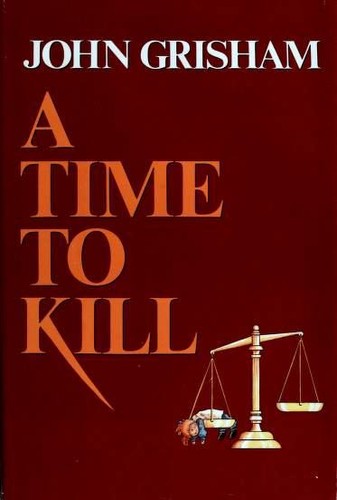
A Time to Kill
Wynwood Press · 1989 · 672 pages
ISBN: 9780922066032
Review Editor
James Voss
John Grisham’s debut novel arrived in 1989 from Wynwood Press, a small publisher that gave it a modest first printing of five thousand copies. Grisham had spent three years writing it while serving in the Mississippi state legislature, and the book carries that insider perspective in nearly every scene: small-town Southern courtrooms, county sheriffs who have to balance law and conscience, and the slow, uneven machinery of justice in a place where everybody knows exactly who everybody else is and what they think.
The story begins in Clanton, a fictional town in Ford County, Mississippi. Two white men, Pete Willard and Billy Ray Cobb, abduct, beat, and rape ten-year-old Tonya Hailey, leaving her for dead in a ravine. Tonya survives. Her father, Carl Lee Hailey, a Black factory worker, consults his friend Jake Brigance, a young white attorney, on what might happen if he took justice into his own hands. Jake tells him not to do anything rash. Carl Lee does it anyway, gunning both men down in the courthouse hallway as deputies lead them in for their bond hearing. A deputy loses a leg in the crossfire.
What follows is the trial of Carl Lee Hailey on two counts of capital murder, set against a Mississippi summer that grows more violent week by week. The state wants a conviction. The Black community rallies behind Carl Lee. The Ku Klux Klan mobilizes, burns crosses, plants bombs, and eventually targets Jake himself. The novel turns on a question Grisham asks explicitly and never lets drop: would you have done the same thing? For a book that runs nearly seven hundred pages, that question never stops pressing forward.
Character Arcs and Development
Jake Brigance is the kind of character Grisham returned to twice over the following three decades, and it is easy to see why. He begins the novel as a mid-level lawyer in a mid-level town, smart enough to take hard cases, experienced enough to understand his own limits. The trial forces him to grow in ways he didn’t choose and couldn’t have anticipated. He loses his house to arson. His secretary’s husband dies in a Klan attack. His wife and daughter leave town for their safety. Jake keeps showing up. That stubborn, sometimes foolhardy persistence makes him sympathetic rather than heroic in some abstract way. He isn’t above scheming, cutting corners, or accepting illicit help from the county sheriff when it serves the defense. He’s a man navigating a situation that keeps getting worse, not a symbol standing in for something larger.
Carl Lee Hailey is a more complicated figure than the novel always lets him be. Grisham is honest about the calculation behind Carl Lee’s decision: he shoots the men because he has good reason to believe that in Ford County, Mississippi, two white defendants who raped his daughter will almost certainly walk free. He uses Jake, leveraging their friendship and the memory of a previous favorable outcome in court. The scenes between the two men, where Carl Lee turns out to be perfectly clear-eyed about the legal strategy and Jake slowly realizes what he has been walked into, carry a quiet tension the more dramatic courtroom scenes can’t quite match. When Jake eventually asks Carl Lee whether he was ever truly his friend, the answer Carl Lee gives is both honest and a little brutal.
The supporting cast fills out the world without becoming cardboard. Lucien Wilbanks, Jake’s disbarred mentor, is the most interesting figure in the book. A hard-drinking Southern liberal who trained Jake and now advises him from the margins, technically prohibited from practicing law, Lucien represents a generation that understood the system well enough to despise it. Harry Rex Vonner, a cheerfully disreputable divorce lawyer, provides off-the-books assistance and most of the novel’s darkly comic relief. Ellen Roark, a law student from a liberal Northern family who volunteers as a temporary clerk, functions as an outsider whose perspective helps Grisham articulate what is aberrant about Ford County without having to editorialize from the narrator’s chair.
Pacing
At 672 pages, the book moves at its own speed. The first hundred pages establish Clanton, its racial geography, its social hierarchies, and the characters who will matter later. Readers who want to start in the courtroom will need patience. That patience has a payoff: by the time jury selection begins, you understand the stakes in a way that a leaner version of the story could not achieve. You know whose daughter Ethel is and why it matters that she has a frail husband. You know what the Sun Flower restaurant is and who eats there and which table they choose.
The middle section, covering the Klan’s escalating campaign and Jake’s increasingly precarious position, moves quickly. Grisham toggles between Jake’s case preparation and the violence outside the courthouse with good rhythm. The final third, the trial itself, slows down again but with purpose. Each witness, each piece of cross-examination, each procedural maneuver adds to the pressure rather than releasing it. The courtroom sequences are tighter than the opening, and the closing argument, when it comes, uses everything the reader has accumulated.
Deeper Thematic Exploration
The novel’s central moral question: would you have done what Carl Lee did? Grisham asks it explicitly and repeatedly, most directly in Jake’s closing argument. The power of that scene comes from the accumulated weight of the previous six hundred pages. You’ve sat with these characters long enough to understand Carl Lee’s love for Tonya, to have watched Pete and Billy Ray brag about the rape at a roadside bar, to have felt the frustration of watching the legal system grind in directions that serve everyone except the people it’s supposed to protect. The abstract becomes concrete. Grisham forces you to notice the gap between what you believe abstractly about justice and what you actually feel when the facts are in front of you.
The book also functions as a precise documentation of how race shapes legal outcomes in practice. The judge denies a change-of-venue request despite a jury pool that will produce, as every character understands in advance, an all-white panel. The prosecutor’s ambition is partly fed by the calculation that Ford County will hand him the conviction he needs to run for higher office. The Klan’s activities work not just as violence but as a kind of pressure system designed to push the verdict in one direction. Sheriff Ozzie Walls, a Black man who arrests Carl Lee because the law requires it and then quietly assists Jake’s defense because justice seems to require it too, represents the narrow space in which some people learn to operate when formal institutions aren’t built for their benefit.
The comparison to Harper Lee’s novel is unavoidable, and Grisham has acknowledged the influence. But where Scout Finch watches her father lose from a position of incomprehension, Jake Brigance wins, and the reasons he wins raise their own questions about what justice actually looks like in practice, who gets access to it, and at what cost. Grisham doesn’t offer a clean resolution to those questions. The ending feels like a beginning more than a conclusion.
Style and Voice
Grisham writes plainly, and that plainness is the right choice for this material. The prose stays close to the ground. Clanton sounds like a specific place, built out of accumulated small details rather than atmospheric gestures. The summer heat is present without becoming a metaphor. The social dynamics of who sits where in the local diner and who belongs to which church feel observed rather than arranged for effect.
The dialogue carries the book at its best moments. Jake’s late-night conversations with Lucien, strategy sessions over bourbon in Lucien’s study, move between legal argument and something closer to ethical reckoning. Grisham trusts his characters to carry the argument rather than stepping in to explain what the reader should think. That restraint slips in a handful of places, particularly in some of the Klan sequences where the author’s contempt becomes more visible than the scene needs. But those are exceptions in a book that mostly earns its effects the hard way.
Verdict
If you’re coming to Grisham for the first time, start here rather than with the more polished books that followed. This is the novel he had to write before he could write anything else. It is longer than it needs to be in places, occasionally uneven in tone, and the romantic subplot involving Ellen Roark doesn’t pay off in proportion to the space it takes up. But it carries a genuine moral urgency that more efficient thrillers often trade away, and the questions it asks about race, justice, and what a father will do when the system fails his child haven’t aged out of relevance.
Readers who want a fast legal thriller might find the first hundred pages taxing. Readers interested in how American law actually functions in practice, how race shapes outcomes that are supposed to be race-neutral, and how an ordinary defense attorney keeps his footing when everything around him catches fire will find this essential reading. Grisham has written sharper books and faster books in the decades since. He has not written one with more at stake.
Frequently Asked Questions about A Time to Kill
What is A Time to Kill by John Grisham about?
A Time to Kill is a 1989 legal thriller set in fictional Ford County, Mississippi. After two white men rape ten-year-old Tonya Hailey, her Black father Carl Lee shoots and kills them in a courthouse hallway. The novel follows his trial for capital murder, defended by his friend Jake Brigance, against a backdrop of Klan violence and racial tension that splits the town. The core question is whether a father who did what much of the jury secretly admits they would have done should be condemned for it.
Is A Time to Kill based on a true story?
Grisham has described the book as partly autobiographical in its portrayal of Jake Brigance. The story was inspired by a rape trial Grisham witnessed in 1984 at the DeSoto County courthouse in Hernando, Mississippi, where the victim was a twelve-year-old girl. In the real case, the races were reversed: the victim was white and the assailant was Black. Grisham began writing A Time to Kill as an exploration of what might have happened if the girl’s father had killed her attackers.
What are the main themes in A Time to Kill?
The novel’s central themes are racial justice, vigilantism, and the gap between legal outcome and moral outcome. Grisham examines how race determines who receives fair treatment in a Southern courtroom, how the formal structures of law can produce results that feel deeply unjust, and how community violence functions as an extension of that same structural bias. A secondary theme is the cost of integrity: what Jake loses by doing the right thing is a sustained question throughout the book.
How long is A Time to Kill and is it a difficult read?
The novel runs approximately 672 pages depending on the edition, making it one of Grisham’s longer books. The prose is accessible and the writing never becomes technically demanding. The opening hundred pages require patience because Grisham spends considerable time establishing the town and its characters before the trial begins. Once the action moves to the courtroom, the pace picks up considerably. Readers comfortable with longer narrative fiction will find it manageable over a week or so.
Is there a movie or TV adaptation of A Time to Kill?
Yes. Director Joel Schumacher adapted the novel into a feature film released in 1996, starring Samuel L. Jackson as Carl Lee Hailey, Matthew McConaughey as Jake Brigance, Sandra Bullock as Ellen Roark, and Kevin Spacey as the prosecutor. The film received mixed critical reviews but was a commercial success. A stage adaptation written by Rupert Holmes ran on Broadway at the Golden Theatre from September to November 2013.
What age group or reading level is A Time to Kill for?
The novel is written for adult readers. It contains graphic descriptions of sexual violence against a child in the early chapters, sustained racial violence including Klan attacks, and coarse language throughout. Most public libraries shelve it in general adult fiction. The reading level is not challenging, but the subject matter makes it inappropriate for younger readers. Most adults who enjoy crime fiction, legal dramas, or Southern literature will find it accessible.
How does A Time to Kill compare to John Grisham’s other books?
A Time to Kill is Grisham’s debut novel and differs from his later work in being longer, slower, and more explicitly concerned with racial justice as a central theme. The Firm and The Pelican Brief, which followed in quick succession, are faster and more plot-driven. A Time to Kill has the roughness of a first novel alongside an emotional weight that some of the more efficient later books lack. The characters Jake Brigance and Harry Rex Vonner return in Sycamore Row (2013) and A Time for Mercy (2020) for readers who want to continue in this world.
Should I read A Time to Kill and is it worth it?
Yes, if you’re interested in legal fiction with genuine moral stakes. The book asks uncomfortable questions about race and justice that it doesn’t resolve neatly, and it earns its length in a way not every long novel does. If you’re coming to Grisham for the first time, this is the right place to start, even though it was written before he had fully developed his storytelling efficiency. If you want a short, fast legal thriller, one of his later books may suit you better, but you’ll miss the ambition and the urgency that make this one worth reading.
Book Details
- Title
- A Time to Kill
- Author
- John Grisham
- Genre
- Mystery & Thriller
- Publisher
- Wynwood Press
- Year Published
- 1989
- Pages
- 672
- ISBN
- 9780922066032
- WritersReview Rating
- 4.2 / 5