
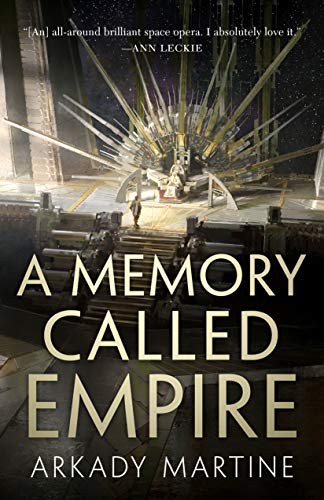
A Memory Called Empire
Tor Books · 2019 · 462 pages
ISBN: 9781250186430
Review Editor
Marcus Webb
Arkady Martine’s debut novel arrived in March 2019 from Tor Books and immediately announced a writer who had done the homework. Martine spent years as a Byzantine historian before fiction claimed more of her attention, and A Memory Called Empire carries that research openly: the Teixcalaanli Empire, the vast interstellar civilization at the center of the novel, draws from the Byzantine and Aztec empires as well as from Central Asian political structures, and the specificity of that influence shows in every detail. This is not a universe assembled from generic science fiction parts. The world feels as though it developed over centuries rather than in a writer’s notebook, and that density is the foundation everything else rests on.
Into this universe arrives Mahit Dzmare, the new ambassador from Lsel Station, a small independent mining outpost perched at the edge of Teixcalaanli space. She carries something unusual: an “imago machine” implanted in her skull, containing the compressed memories and personality of her predecessor, Yskandr Aghavn. This technology is Lsel’s most jealously guarded secret, and it lets each new ambassador inherit decades of institutional knowledge from the person who came before. But Yskandr’s memories are fifteen years out of date, and he is, as Mahit quickly discovers, already dead.
What begins as an investigation into Yskandr’s death expands into something considerably larger: a succession crisis threatening the elderly Emperor Six Direction, a conspiracy threading through the imperial bureaucracy, and a quiet annexation scheme that could end Lsel’s independence entirely. Mahit navigates all of this with the help of Three Seagrass, her assigned diplomatic liaison, a quick-witted civil servant who quotes poetry at inconvenient moments and is as politically calculating as she is charming. This is, at its core, a mystery nested inside a political thriller nested inside a meditation on how empires actually work. Martine handles all three registers without letting any of them collapse under the weight of the others.
Character Arcs and Development
Mahit is a specific and interesting kind of protagonist: she is an outsider who loves the thing that threatens to swallow her. She grew up reading Teixcalaani literature, dreams in their idioms, and arrived at the imperial capital already half in love with its civilization. This creates productive friction throughout the novel. She wants to be absorbed into Teixcalaan even as she fights to protect her own people from it, and Martine never lets her resolve that contradiction cleanly. At various points Mahit’s cultural fluency saves her life; at others it leaves her slower to spot dangers a more suspicious mind would have caught immediately.
The imago situation deepens Mahit’s inner life considerably. She shares her skull with an older version of Yskandr, whose memories she can access but whose judgment formed in a different political moment. When the imago malfunctions early in the novel, Mahit loses that connection entirely and must navigate a hostile imperial capital without the accumulated wisdom she had counted on. Watching her improvise through crises without the institutional scaffolding she expected gives the book some of its best dramatic tension. The scenes immediately following the malfunction, where Mahit is suddenly and completely herself in a way she has never been trained to be, are some of the most interesting in the novel.
Three Seagrass is arguably the more purely enjoyable character to spend time with. She operates through wit and social intelligence rather than formal power, navigating the bureaucratic waters of the imperial capital with cheerful ruthlessness. Her friendship with Mahit develops along a convincing axis of trust, professional calculation, and something harder to name. Their dynamic carries more emotional weight than the political intrigue does on its own. Among the supporting cast, Nineteen Adze, the Emperor’s deadly and enigmatic advisor, is drawn precisely enough to feel genuinely dangerous. You never quite know whose side she is on, which is exactly right for the kind of novel this is.
Pacing
The novel moves at the pace of a strong thriller: urgent when the situation demands it, more measured only when Martine is building something worth having. The first quarter is the most demanding section. There are names to learn (everyone in the empire takes names structured as a number and a noun: Three Seagrass, Six Direction, Twelve Azalea), a bureaucratic hierarchy to map, and a political situation to absorb. Martine trusts readers to track this complexity without much handholding, which is the right call but requires patience from anyone who prefers stories that start running immediately.
Once the imago malfunctions and the conspiracy around Yskandr’s death begins to clarify, the pace tightens substantially. The final third moves quickly, and several sequences set in the palace during a period of civil unrest have a kinetic, dangerous quality that the early chapters only hint at. The book earns its ending, and readers who push through the denser opening will find the payoff proportionate to the investment.
Deeper Thematic Exploration
The deepest layer of this novel concerns what it costs to love a culture that does not fully see you as a person. Teixcalaan is magnificent and genuinely compelling, and Martine makes sure you feel that pull before she asks you to examine it. The Empire does not invade small cultures so much as it makes them want to be invaded. It exports poetry, art, and bureaucratic form until neighboring peoples have already half-become Teixcalaanli before the formal annexation paperwork arrives. This is conquest through seduction, and the novel asks whether that makes it more or less honest than conquest by force.
Mahit’s position makes the argument visible. As an ambassador who studied Teixcalaani culture her whole life, she occupies a strange middle ground: fluent enough to function at court, but marked at every turn as a barbarian, a provincial, someone whose home station is barely worth acknowledging as a real polity. The word “barbarian” gets used against her directly on several occasions, always lightly, always with a smile. Martine, who holds a Master of Studies in Classical Armenian Studies from Oxford and built her academic career around Byzantine-Armenian relations, brings genuine scholarly weight to this portrait of how empires manage their edges. The Station culture of Lsel draws from the medieval Armenian Kingdom of Ani, which Byzantium absorbed in 1044, and that specific historical resonance gives the novel’s central conflict a depth that purely invented political situations rarely achieve.
The imago machine adds a third layer. Memory, in this novel, is not merely personal; it is institutional. Lsel maintains its identity partly through the accumulated memories of its ambassadors, passed from person to person like an oral tradition encoded in hardware. The question of who owns those memories runs quietly through the whole book: do Yskandr’s experiences belong to Mahit, who carries them? To Lsel Station, which created the technology and sent him there? To Yskandr himself? The novel does not answer this, and it would be a lesser book if it did. These questions about cultural inheritance, about whether you can remain yourself while carrying someone else’s history in your head, are the kind that distinguish science fiction which earns its speculative technology from science fiction that merely deploys it.
Style and Voice
Martine’s prose is clean and confident without being spare. She builds the Teixcalaanli aesthetic through accumulation rather than exhaustive description: their attachment to poetry, their elaborate naming conventions, the specific ceremonial weight they assign to bureaucratic encounters all accumulate into a world that feels genuinely inhabited rather than staged. Occasional lines of Teixcalaanli poetry, rendered in English but inflected with a non-English logic, do real narrative work. They are not decoration. Readers who pay attention to how Three Seagrass uses poetry in conversation will find those moments resonating differently in later scenes.
The close-third narration stays tight to Mahit’s perspective, and Martine calibrates that voice precisely: sharp when Mahit is in control, slightly off-balance when she is not. There is a formal quality to the prose that suits the diplomatic register without becoming stiff. You feel the constant low pressure Mahit operates under, the requirement to perform competence in an environment where mistakes can be fatal.
Verdict
If you came of age reading Ann Leckie’s Ancillary Justice and wanted something that took that book’s interest in empire, identity, and institutional power somewhere new, this is very likely that book. It rewards close attention and patience with the early sections. Readers who want their science fiction to move fast and hit hard will find less to hold them; the satisfactions here are primarily intellectual and emotional, and the book is better for knowing that and committing to it fully.
What A Memory Called Empire does, at its best, is build an imaginary civilization detailed enough that its specific problems illuminate real historical ones, then populate it with characters you care about watching navigate those problems. You will finish it thinking carefully about what you just read. Several days later you will probably still be turning Three Seagrass over in your mind, wondering what she actually wanted and whether she got it. That kind of lingering is worth more than any number of explosions.
Frequently Asked Questions about A Memory Called Empire
What is A Memory Called Empire by Arkady Martine about?
A Memory Called Empire follows Mahit Dzmare, the new ambassador from the small independent Lsel Station, as she arrives at the Teixcalaanli Empire, a vast interstellar civilization that absorbs smaller cultures through poetry and political pressure as much as through military force. Mahit carries an “imago machine” containing her predecessor’s memories, discovers he was murdered, and must investigate his death while preventing her home station from being annexed. The book blends political thriller, mystery, and space opera into a meditation on what it means to love a culture that sees you as a barbarian.
Did A Memory Called Empire win any major awards?
Yes. The novel won the 2020 Hugo Award for Best Novel and the 2020 Compton Crook Award. It was also a finalist for the 2019 Nebula Award for Best Novel, appeared on the 2020 Arthur C. Clarke Award shortlist, and was a finalist for the 2020 Locus Award for Best First Novel. It remains one of the most decorated debut science fiction novels of the past decade, and its sequel, A Desolation Called Peace, also won the Hugo Award for Best Novel in 2022.
What are the main themes in A Memory Called Empire?
The novel explores colonialism and cultural absorption, examining how large empires assimilate smaller cultures by making their language and art irresistible before formal annexation occurs. It also examines institutional memory, asking who owns the accumulated knowledge of a community and whether individuals can carry that knowledge without losing themselves. Identity and belonging run through the book as well: Mahit loves Teixcalaanli culture and yet is marked as an outsider at every turn. The tension between admiring a civilization and being consumed by it is never cleanly resolved, which is very much the point.
How long is A Memory Called Empire and is it a difficult read?
The novel runs approximately 462 pages. The opening quarter is the most demanding, with an elaborate naming system (Teixcalaanli names follow a number-plus-noun format like Three Seagrass or Six Direction) and a dense political situation to track. Most readers find the complexity manageable if they give it a few chapters; once the plot accelerates around a quarter of the way through, the book moves quickly. It sits in the challenging-but-rewarding range: not casual beach reading, but not impenetrable either.
Is A Memory Called Empire a standalone novel or part of a series?
It is the first book in the Teixcalaan series. The sequel, A Desolation Called Peace (2021), follows different protagonists and takes place a few months after the events of the first book, also winning the Hugo Award for Best Novel. A Memory Called Empire works as a complete story on its own terms, with a satisfying resolution to its central mystery and political crisis. You do not need the sequel to feel the first one ended properly, though most readers want it.
Is there a movie or TV adaptation of A Memory Called Empire?
As of 2026, no film or television adaptation has been produced or officially announced. The book has a devoted readership and has been widely discussed as strong adaptation material, but nothing has moved into production. The author’s website at arkadymartine.net would be the first place to check for any announcements.
How does A Memory Called Empire compare to Ann Leckie’s Ancillary Justice?
Both novels center on questions of identity and use speculative technology to examine colonialism, both build convincing fictional empires that feel historically grounded, and both won the Hugo Award. A Memory Called Empire leans more heavily into diplomatic and political intrigue, while Ancillary Justice is more interested in action and military hierarchy. Readers who loved either book will almost certainly find the other worth their time. If you have read neither, start with whichever premise appeals to you more: empire seen from the inside of its machinery, or empire seen from its outermost edge.
Should I read A Memory Called Empire and is it worth it?
Yes, particularly if you like your science fiction to have something on its mind beyond the plot. The novel suits readers who enjoy political intrigue, rich worldbuilding, and characters whose inner lives are as interesting as their external predicaments. If slow openings test your patience, be warned: the first quarter asks more of you than the rest of the book does. If you push through, you will find a novel that stays with you, with a cast of characters who feel genuinely three-dimensional and a set of questions about culture, memory, and belonging that do not have easy answers.
Book Details
- Title
- A Memory Called Empire
- Author
- Arkady Martine
- Genre
- Science Fiction
- Publisher
- Tor Books
- Year Published
- 2019
- Pages
- 462
- ISBN
- 9781250186430
- WritersReview Rating
- 4.4 / 5