
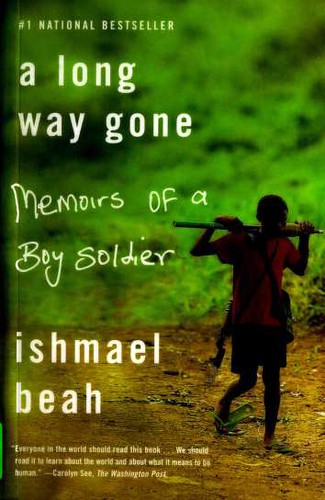
A Long Way Gone
Sarah Crichton Books · 2007 · 240 pages
ISBN: 9780374531263
Review Editor
Priya Nair
In February 2007, a memoir arrived in American bookstores that most publishers would have thought unsaleable. Its author was a young Sierra Leonean man in his mid-twenties, writing in his second language about crimes he committed as a child. No American happy ending was promised. No distance was offered between the narrator and his worst acts. And yet A Long Way Gone: Memoirs of a Boy Soldier became an international sensation, spending weeks on bestseller lists and entering classroom reading lists across the English-speaking world. It deserved every bit of that attention, and more besides.
Ishmael Beah grew up in Mogbwemo, Sierra Leone, the son of parents who lived separately. He loved rap music the way other boys loved football: with a passion that crowded out everything else. Run-D.M.C., Naughty by Nature, LL Cool J: these were his companions, the soundtrack to a boyhood that felt ordinary in the ways boyhoods do, full of small pleasures and the gossip of friends. The Sierra Leone Civil War had been going on for years, but Beah was twelve when it finally reached him, when the Revolutionary United Front attacked his village while he and his older brother were away in Mattru Jong competing in a talent show. He never saw his parents again.
What follows is a journey of almost unbearable compression. Beah and a shifting group of boys wander a countryside that has become a landscape of ruins. Every village they approach either turns them away in fear or is attacked while they shelter there. When the Sierra Leone Armed Forces eventually claim them, the offer looks like protection. It is not. Beah is thirteen when he is handed an AK-47, given pills and cocaine mixed with gunpowder (known as “brown brown”), and sent to fight. He is sixteen when UNICEF workers pull him from the unit and bring him to a rehabilitation center in Freetown. A Long Way Gone is the account of those years: what was done to him, what he did to others, and how he began to find a way back to himself.
Character Arcs and Development
The book rests on a single character, Beah himself, but it draws him with precision and without sentiment. The boy at the beginning carries a cassette tape collection he treats like scripture. He performs rap at talent shows in villages that are about to be destroyed. The war strips these things from him one by one: first his family, then his closest friends, then his conscience, then his capacity to feel anything at all. Beah does not soften what the drugs and the killing did to him. He describes attacking a boy he barely knew with the same flat calm he brought to everything else during that period. He presents this not as the behavior of a monster but as the behavior of a child who had been chemically and psychologically remade by adults with guns.
The rehabilitation section is where the book earns its emotional weight. Nurse Esther at the Benin Home shelter is the character who opens Beah back up without demanding more of him than he can give. She finds out what he loved before the war. She brings him a Walkman, then a Bob Marley tape, then a Run-D.M.C. cassette. She does not ask him first to account for what he did. She asks him to remember who he was. This is slow, careful, practical work, and Beah writes it without sentimentality. The scenes between Beah and Esther are the finest in the book.
His uncle Tommy, who takes him in after the rehabilitation center places him with family, is another fully realized presence. Tommy accepts Beah without conditions or drama. His children treat Beah as a brother from the first day. There is no scene of confrontation or earned forgiveness, because Tommy refuses to make Beah feel that forgiveness is what he needs to earn. His death from illness near the book’s end, as the war closes in again on Freetown, carries more weight than any earlier loss in the narrative.
Secondary characters are drawn economically but distinctly. Alhaji, nicknamed “Little Rambo” for his combat skills, stands as the closest thing to a sustained friendship Beah has through the soldier years. The boys of Beah’s original group of wanderers, Saidu and Musa and the rest, are individuals with enough specificity that their deaths register individually rather than as a collective blur.
Pacing
The book covers 240 pages, and the first third has stretches where the pace slows toward stasis. Beah and his companions move village to village in a repeating structure: arrival, initial acceptance, expulsion or attack, flight. This mirrors the chaos Beah was living through, and the repetition is deliberate, but it asks readers to stay patient through a section where individual events tend to blur together. Those who push through are rewarded.
The book changes gear sharply once Beah becomes a soldier. The writing shifts register: syntax gets shorter, time passes without dates or markers, violence appears without explanation or context. The horror lives in that blankness. Then the rehabilitation chapters open up and breathe again, and the final New York City section, where Beah attends a United Nations conference and first imagines a life outside Sierra Leone, feels slightly thinner compared to what precedes it. Some readers will want more of this part. The Sierra Leone chapters are where Beah is most fully present, and those are the ones that stay with you.
Deeper Thematic Exploration
The book’s central argument is that human beings can recover from things that seem to make recovery impossible. Beah is not making a simple or optimistic case. He is not suggesting that every child soldier finds a nurse Esther or an uncle Tommy. He is reporting that he did, and that even with those advantages, recovery was not inevitable but slow and incomplete and ongoing.
What the book does best is refuse the idea that Ishmael the child soldier is a different person from Ishmael the boy who loved rap music. They are the same person at different points, shaped by different pressures. War did not reveal a hidden monster in him. War used the normal human capacities for loyalty, obedience, and violence to make him into something he was not. This distinction matters enormously and is the book’s most important contribution to the literature of conflict. We are not protected from becoming what Beah became by being morally superior. We are protected, when we are protected, by circumstances: by geography, by age, by the presence or absence of armed men at our door.
The rap music that runs through the book functions as a thread back to his original self. The cassettes that survive the war, the lyrics he can recite from memory, the way music operates as evidence that he was once someone before a soldier: these details carry the book’s argument about what makes a person, what war tries to erase, and what rehabilitation tries to restore.
The book also raises questions it does not fully answer about memory and testimony. A Long Way Gone attracted controversy when Australian journalists questioned some of the dates and timelines in Beah’s account. This dispute does not undo the memoir, but it is worth being aware of. The core of what Beah describes, the conscription of children, the use of drugs, the violence, the rehabilitation process, these are thoroughly documented facts of the Sierra Leone Civil War, regardless of the precise chronology of his individual experience. The question his critics raised, whether extreme stories attract disproportionate attention and thus create pressure on survivors to embellish, is worth holding alongside the book rather than discarding it.
Style and Voice
Beah wrote A Long Way Gone in English, his second language. The prose carries that in interesting ways: it is precise without being ornate, direct in ways that a writer working in his mother tongue might have avoided. The sentences do not show off. They advance.
The restraint is sometimes remarkable. Beah describes acts of violence in the same flat register he uses to describe eating cassava or walking through a forest. There is no attempt to make the violence literary, no signaling to the reader that this is terrible. He trusts the facts to carry the weight. That trust is well-placed. More elevated prose would have made it easier for readers to hold the violence at a distance, to experience it as happening in a book. The plain style refuses that distance.
The early childhood sections have a warmer, slightly more lyrical quality. Beah describes his grandmother’s stories, the pleasure of performing for a crowd, the jokes he made with his brother. These passages establish what the war takes and what the book’s closing pages try to restore. The contrast between those sections and the soldier chapters is achieved not through tonal drama but through what is and is not present in the sentences.
Verdict
Read A Long Way Gone if you have any interest in the literature of war, childhood, or recovery. It belongs on the same shelf as Tim O’Brien’s The Things They Carried and Primo Levi’s Survival in Auschwitz, among books that refuse to let readers off the hook about what violence costs and who pays. Beah’s particular accomplishment is writing about the making of a child soldier from the inside, without self-pity and without evasion, in a way that makes the process comprehensible rather than monstrous. That comprehension is the book’s most uncomfortable and most important gift.
The weaknesses are real but minor: a repetitive middle section, a slightly thin final movement, a narrative that sometimes frustrates readers who want more time with the people Beah encounters briefly and then loses. These are small costs. The strengths are considerable: a clear-eyed narrator, a story that avoids cheap sentiment, and a central argument about the fragility and durability of the human self that stays with you long after the last page.
If you find yourself made impatient by the wandering chapters in the first third, stick with it. The book earns your patience, and then some.
Frequently Asked Questions about A Long Way Gone
What is A Long Way Gone by Ishmael Beah about?
A Long Way Gone is Ishmael Beah’s memoir of his experience as a child soldier during the Sierra Leone Civil War. Published in 2007, the book describes how Beah was displaced at twelve years old, conscripted into the Sierra Leone Armed Forces at thirteen, and eventually rescued by UNICEF at sixteen. It covers his rehabilitation in Freetown, his journey to speak at the United Nations in New York, and his escape to the United States as war returned to Sierra Leone’s capital in 1997.
Is A Long Way Gone based on a true story?
Yes, the book is Beah’s memoir of his own life. He was a real child soldier during the Sierra Leone Civil War and was genuinely rehabilitated by UNICEF before eventually making his way to the United States. The book attracted some controversy in 2008 when journalists questioned the chronology of certain events, particularly the precise dates of when his village was attacked and how long he served as a soldier. Beah and his publisher stood by the account. The core events, displacement, conscription, drug use, violence, and rehabilitation, are consistent with well-documented facts about the conflict.
What are the main themes in A Long Way Gone?
The book explores several interlocking themes. The central concern is whether recovery from extreme violence is possible, and what recovery actually requires. Beah also examines identity, asking who he is after war has reshaped him, and whether a self can be restored rather than merely replaced. The role of memory runs throughout: the rap music Beah can recite from memory serves as a thread back to who he was before conscription. The book also examines how children become soldiers, not through innate violence but through adult systems that exploit normal human responses to fear and loyalty.
How long is A Long Way Gone and is it a difficult read?
The book is 240 pages and most readers finish it in two to four sittings. The prose is spare and direct, without the complexity of a literary novel, but the subject matter is genuinely disturbing. Beah describes acts of violence plainly and without softening. Readers who are sensitive to descriptions of war violence, child abuse, or drug use should know those elements are present throughout the middle section. The book is emotionally taxing in places, but it is not gratuitous and the writing holds the reader’s trust throughout.
Is there a movie or TV adaptation of A Long Way Gone?
No major film or television adaptation of A Long Way Gone exists as of 2026. The book has been widely used in educational settings and has influenced other works about child soldiers. The documentary Children of War (2010), directed by Bryan Single, covers related subject matter. The broader phenomenon of child soldiering in West Africa appeared in the 2006 film Blood Diamond, though that film was not based on Beah’s book.
What age group or reading level is A Long Way Gone appropriate for?
The American Library Association listed A Long Way Gone among its Top Ten Best Books for Young Adults in 2008, and it is widely assigned in high school and early university courses. Most educators recommend it for readers fourteen and older, given the descriptions of violence, drug use, and war. The prose itself is accessible to younger readers, but the emotional weight and moral complexity of the subject benefit from some maturity. The book is taught in high school English, history, and global issues courses across the United States and elsewhere.
What awards did A Long Way Gone win and what recognition did it receive?
A Long Way Gone was nominated for a Quill Award in the Best Debut Author category in 2007. Lev Grossman of Time Magazine ranked it third on his list of the top ten nonfiction books of 2007, calling it “painfully sharp” and praising its ability to bring readers inside the experience of a child soldier. The American Library Association named it one of its Top Ten Best Books for Young Adults in 2008. The book became an international bestseller, published in dozens of languages, and has remained continuously in print since its initial publication.
Should I read A Long Way Gone, and how does it compare to other war memoirs?
If you have any interest in memoirs of war, conflict, or survival, yes. A Long Way Gone is direct, morally serious, and written from a perspective rarely represented in English-language literature: that of a child who was both a victim of war and an agent of violence within it. Readers who responded to Tim O’Brien’s The Things They Carried or Sebastian Junger’s War are likely to find Beah’s book equally compelling, though considerably more disturbing given the age of the narrator. It is shorter and more accessible than most comparable works, which makes it an excellent entry point for readers new to war literature.
Book Details
- Title
- A Long Way Gone
- Author
- Ishmael Beah
- Genre
- Biography
- Publisher
- Sarah Crichton Books
- Year Published
- 2007
- Pages
- 240
- ISBN
- 9780374531263
- WritersReview Rating
- 4.3 / 5