
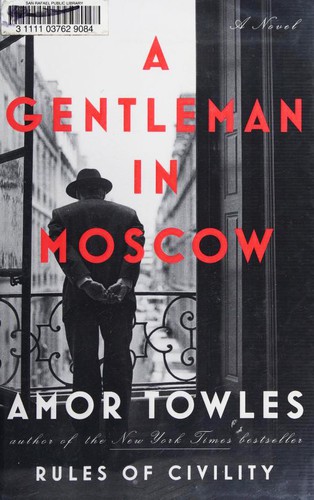
A Gentleman in Moscow
Penguin Publishing Group
ISBN: 9780735221673
🏆 Kirkus Prize finalist (2016)
International Dublin Literary Award nominee (2018)
Goodreads Choice Awards nominee for Best Historical Fiction (2016)
AudioFile Earphones Award (2016)
Review Editor
admin
In 1922, Count Alexander Ilyich Rostov, a man of impeccable breeding and a poet of minor renown, is sentenced by a Bolshevik tribunal to spend the rest of his life inside Moscow’s Metropol Hotel. The charge is essentially being too aristocratic. The punishment, in its way, is almost whimsical: rather than execution, the Count is confined to an attic room, stripped of his suite and most of his possessions, and told that if he ever steps foot outside the hotel, he will be shot. Amor Towles published A Gentleman in Moscow in September 2016, his second novel after the successful Rules of Civility, and it spans more than three decades of Soviet history as seen through the peculiar vantage point of a man who cannot leave a single building. The Metropol, a real hotel in Moscow known for its Art Nouveau grandeur, becomes the Count’s entire universe: its restaurants, its barbershop, its hidden passages, and its revolving cast of guests and staff.
What makes the premise so compelling is the tension between constraint and abundance. Rostov has lost everything that defines an aristocrat in the traditional sense: his estate, his freedom of movement, his place in society. Yet within the Metropol’s walls, he discovers an unexpected richness. The novel tracks his life from 1922 to 1954, following him through friendships, fatherhood, love, political intrigue, and the slow, daily accumulation of a meaningful life built in the most unlikely of circumstances.
The book is structured around encounters and episodes rather than a conventional plot arc. Towles uses temporal leaps, sometimes jumping years between chapters, which gives the novel an almost episodic quality. Each section introduces new characters, new dilemmas, and new rooms of the Metropol to explore, while the Count himself serves as the steady center around which everything orbits.
Character Arcs and Development
Count Rostov is one of the most likable protagonists in contemporary fiction, and Towles builds that likability without making him flat. At the start of the novel, the Count is charming, well-read, and capable, but also somewhat purposeless. He has spent his life enjoying the privileges of his class without needing to justify his existence. House arrest forces a reckoning with that. Stripped of social status and confined to increasingly modest quarters, Rostov must decide who he is when the markers of identity he relied on are gone. His arc is not dramatic in the conventional sense: there is no single moment of transformation. Instead, he changes incrementally, through small acts of generosity, responsibility, and attention. By the novel’s midpoint, when he becomes a de facto father to a young girl named Sofia, the shift is profound. The dilettante becomes a parent, a mentor, and eventually someone willing to risk everything for the people he loves.
Sofia herself is wonderfully drawn. Towles resists the temptation to make her precocious in that tiresome literary way. She is bright and curious but also stubborn and sometimes difficult, which makes Rostov’s devotion to her feel earned rather than sentimental. Their relationship is the emotional spine of the novel, and it gives the second half a weight that the more episodic first half sometimes lacks.
The supporting cast is rich. Anna Urbanova, a glamorous actress who becomes the Count’s lover, is complicated and independent enough to avoid being a mere romantic interest. Mishka, the Count’s idealistic friend, serves as a reminder of the world outside the Metropol and the toll that Soviet politics takes on true believers. And the hotel staff, particularly the maître d’ Andrey and the chef Emile, form a kind of found family that gives the novel much of its warmth. Towles is generous with his secondary characters, giving even minor figures enough specificity that the Metropol feels genuinely populated rather than sketched.
Pacing
The novel’s pacing is deliberately unhurried for much of its length, which suits a story about a man learning to find meaning in routine. The early sections, covering the 1920s and 1930s, move in leisurely fashion through dinners, conversations, and small adventures within the hotel. A chapter devoted to the Count’s classification of different types of hotel guests, for instance, unfolds with the patience of someone who has all the time in the world, because he does. Some readers will find this languid; others will find it luxurious. There is a stretch in the middle, roughly around the World War II years, where the episodic structure can feel a bit disconnected, as if Towles is assembling vignettes rather than building continuous momentum.
The final act, however, picks up considerably. A Cold War espionage subplot emerges, and the stakes suddenly become concrete and urgent. Towles handles this tonal shift well, using the decades of accumulated affection for Rostov and his circle to make the suspense genuinely affecting. The ending is propulsive in a way that the first two-thirds of the book deliberately are not, and it rewards the patience of readers who invested in the slower early sections.
Deeper Thematic Exploration
At its core, A Gentleman in Moscow is about what happens when you strip away everything external and ask what remains. The Count loses his wealth, his property, his social standing, and his physical freedom. What he keeps, and what ultimately defines him, are his manners, his curiosity, his capacity for friendship, and his willingness to pay attention to the people around him. Towles is making an argument, quietly but persistently, that character is not determined by circumstance. The Metropol becomes a test case: can a good life be lived in a single building? The novel’s answer is an emphatic yes, provided you bring the right qualities to it.
There is also a pointed political dimension. Rostov’s imprisonment is absurd, a product of an ideology that punishes people for who they were born as rather than what they have done. But Towles avoids making the novel a straightforward indictment of Soviet communism. The Count’s confinement is portrayed as both cruel and, paradoxically, liberating. Free from the obligations and distractions of the outside world, he is able to focus on what actually matters to him. This is not an endorsement of political imprisonment, of course, but rather a recognition that constraints can sometimes clarify priorities. The Stoic philosophy that runs through the novel, never stated explicitly but always present, suggests that freedom is ultimately internal.
Towles is also interested in the relationship between high culture and everyday life. The Count’s encyclopedic knowledge of wine, literature, and etiquette is initially presented as charming ornamentation. But as the novel progresses, these refinements prove to be genuinely useful: they help him navigate social situations, build alliances, and create moments of beauty in otherwise difficult circumstances. The book pushes back against the idea that cultural sophistication is frivolous. In Towles’s telling, knowing how to pair a wine or tell a good story is a form of generosity, a way of honoring the people you share a table with.
Style and Voice
Towles writes in a polished, omniscient third person that mirrors the Count’s own sensibility: urbane, witty, and occasionally wry. It is a voice that can describe a perfectly boiled egg with the same attentiveness it brings to a political crisis, and somehow both feel equally important. The prose is elegant without being fussy, and Towles has a gift for the well-turned observation. His descriptions of food and drink are particularly vivid, capturing the sensory pleasure of a perfectly prepared meal without tipping into food-writing excess. The narrative voice maintains a slight distance from its characters, which gives the novel a fable-like quality. You are always aware that someone is telling you this story, arranging its pieces with care.
The novel’s structure deserves mention as well. Towles plays with time in clever ways, with chapter headings that mark the passage of years and a recursive pattern in which certain themes and images return in new contexts. There are also playful intertextual references to Russian literature, from Chekhov to Dostoevsky, that reward attentive readers without punishing those who miss them. The overall effect is of a novel that has been constructed with the same attention to detail that the Count brings to his daily life: nothing is accidental, and everything has its place.
Verdict
A Gentleman in Moscow is the kind of book that makes you want to sit down to a long dinner with good company. It is warm, intelligent, and deeply humane, with a protagonist you will miss when the last page is turned. Its deliberate pacing will not suit every reader, and those looking for gritty historical realism about life under Stalin should look elsewhere. Towles is interested in something different: the possibility of grace under pressure, the quiet heroism of paying attention, and the argument that a well-lived day matters regardless of where you spend it. If you have ever felt confined by your circumstances and wondered whether something meaningful could still grow there, this is a book that will speak to you. It is also, quite simply, a pleasure to read, which is a quality that literary fiction sometimes forgets to value.
Frequently Asked Questions about A Gentleman in Moscow
What is A Gentleman in Moscow by Amor Towles about?
A Gentleman in Moscow follows Count Alexander Rostov, a Russian aristocrat sentenced to lifelong house arrest in Moscow’s Metropol Hotel in 1922 by a Bolshevik tribunal. Over more than three decades, the Count builds a rich and surprising life within the hotel’s walls, forming deep friendships, becoming a father figure, falling in love, and eventually navigating Cold War espionage. It is a novel about finding purpose and meaning within severe constraints.
Is A Gentleman in Moscow based on a true story?
The novel is fiction, though it draws on real history. The Metropol Hotel is a real landmark in Moscow, and the political events of the Soviet era that form the backdrop are historically accurate. Towles has said in interviews that the idea came partly from his own experiences staying in grand hotels and wondering what it would be like to never leave one. Count Rostov is not based on a specific historical figure.
What are the main themes in A Gentleman in Moscow?
The novel explores several interconnected themes: the nature of freedom and whether it can exist under physical confinement, the value of routine and attention to daily life, the role of culture and manners as expressions of generosity rather than mere social performance, and the idea that identity is shaped by character rather than circumstance. It also examines friendship, parenthood, and the quiet resilience required to maintain dignity under an oppressive political system.
How long is A Gentleman in Moscow and is it a difficult read?
The hardcover edition runs 462 pages, and most readers find it accessible and enjoyable rather than difficult. The prose is polished but not dense, and the episodic structure means you can read it in satisfying chunks. The pacing is deliberate, especially in the first half, so readers who prefer fast-moving plots may need to adjust their expectations. It is best enjoyed at a leisurely pace, like a long meal.
Is there a movie or TV adaptation of A Gentleman in Moscow?
Yes. A television miniseries starring Ewan McGregor as Count Rostov premiered on Paramount+ (via Showtime) in March 2024. The series was directed by Sam Miller and written by Ben Vanstone. It received strong reviews, earning a 91% approval rating on Rotten Tomatoes, and McGregor was nominated for Best Actor in a Limited Series at the Critics’ Choice Awards.
What age group or reading level is A Gentleman in Moscow for?
The novel is written for adult readers, though mature teenagers who enjoy literary fiction and historical settings would appreciate it as well. There is no graphic violence or explicit sexual content. The vocabulary and cultural references assume a general adult reading level, but Towles writes with enough clarity that you do not need specialized knowledge of Russian history to follow the story.
How does A Gentleman in Moscow compare to Amor Towles’s other novels?
Towles has published three novels: Rules of Civility (2011), A Gentleman in Moscow (2016), and The Lincoln Highway (2021). All three share an interest in elegant prose, carefully constructed plots, and protagonists navigating social worlds with intelligence and grace. A Gentleman in Moscow is generally considered his most beloved work, with a warmer emotional register than the cooler, jazz-age sophistication of Rules of Civility and a tighter focus than the sprawling road narrative of The Lincoln Highway.
Should I read A Gentleman in Moscow and is it worth it?
If you enjoy character-driven literary fiction with a historical setting, witty prose, and a protagonist you genuinely root for, this book is very much worth your time. It rewards patient readers with emotional depth and a satisfying conclusion. Readers who want fast-paced action or unflinching historical realism may find it too genteel for their tastes. But for those who value warmth, intelligence, and the quiet pleasures of a beautifully told story, it is one of the best novels of the past decade.
Book Details
- Title
- A Gentleman in Moscow
- Author
- Amor Towles
- Genre
- Literary Fiction
- Publisher
- Penguin Publishing Group
- ISBN
- 9780735221673
- Awards
- 🏆 Kirkus Prize finalist (2016) International Dublin Literary Award nominee (2018) Goodreads Choice Awards nominee for Best Historical Fiction (2016) AudioFile Earphones Award (2016)
- WritersReview Rating
- 4.9 / 5