
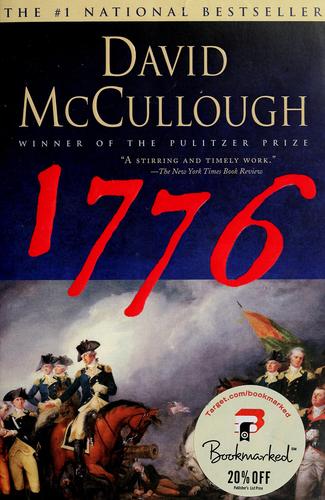
Summary
The year 1776 nearly ended the American Revolution before it had properly begun. George Washington’s Continental Army was routed on Long Island in August, forced out of New York, and driven across New Jersey in a retreat that looked, from the British perspective, like the beginning of the end. The army was melting away through desertions, expired enlistments, and the simple fact that men who had signed up in the spring could not be convinced to freeze through a winter campaign. Washington himself wrote to his brother that he thought the game was nearly up.
David McCullough’s 1776 tells the story of that year. It is focused and specific: where his Pulitzer Prize-winning biography of John Adams ranged across decades and continents, this book covers a single year and a handful of battles. The compression is a strength. McCullough brings to this smaller canvas the same narrative authority and the same gift for making historical figures feel present that distinguish all of his best work, and the result is a book that reads like a thriller because the outcome was genuinely uncertain and the stakes were genuinely total.
The book is organized around Washington’s perspective without being a conventional biography. We see the British command through the eyes of King George III and his generals, and we see the American forces through Washington and the officers around him, but the organizing principle is the sequence of military events from the siege of Boston through the victory at Trenton. McCullough keeps the narrative moving and never lets the reader forget that the men in this story did not know how it would turn out.
Character Arcs and Development
Washington in 1776 is not yet the marble figure of the monument. He is a Virginia planter who has never commanded an army in the field, who makes significant tactical errors at Long Island, and who is saved at several points by the incompetence or excessive caution of his opponents. McCullough renders his virtues honestly: Washington’s physical courage was real, his ability to project authority was extraordinary, and his refusal to give up when giving up would have been rational was the decisive factor in the Revolution’s survival. But he also renders the anxiety and self-doubt that Washington confided in his letters, which makes the portrait more human and more impressive.
The junior officers around Washington are vividly rendered. Henry Knox, a twenty-five-year-old bookseller who organized the transport of cannons from Fort Ticonderoga to Boston across frozen lakes, is one of the book’s great characters: a young man of remarkable practical intelligence who found his occasion in a crisis. Nathanael Greene, who would become Washington’s most trusted general, appears here as a promising officer still learning his trade.
Pacing
The book moves quickly because the events move quickly. McCullough has a gift for narrative compression: he can establish a situation, build tension, and deliver a resolution within a few pages without any sense of rushing. The battle sequences are particularly good, rendered with enough tactical detail to be comprehensible and enough human specificity to be affecting. The crossing of the Delaware on Christmas night, 1776, which every American knows from the painting, is described with the cold and the darkness and the freezing water that the painting cannot show.
Deeper Thematic Exploration
The book’s deepest argument is about contingency: that the American Revolution could easily have ended in 1776, that it was saved by specific decisions made by specific individuals in specific circumstances, and that history is not inevitable. Washington’s decision to cross the Delaware when every rational calculation suggested retreat is the book’s central example: it was a gamble that succeeded because it was a surprise, and it was a surprise because the British were confident that no one would attempt it in those conditions. The victory at Trenton changed the political calculus of the war and kept the army together long enough for France to enter the conflict.
There is also an argument about the nature of democratic leadership embedded in the book’s portrait of Washington. He commanded men who were volunteers rather than professional soldiers, who had no tradition of obedience to authority, and who would leave when their enlistments expired regardless of the military situation. He had to inspire rather than command, which required a different set of skills than conventional generalship and which McCullough argues Washington possessed in unusual measure.
Style and Voice
McCullough is the most trusted voice in American popular history, and this book shows why. He writes with clarity, precision, and the confidence of someone who has mastered his sources. His prose never calls attention to itself; it serves the story. The research is extensive and the documentation thorough, but the book never feels like a recitation of facts. It feels like history lived from the inside, which is the achievement that popular history at its best can accomplish and which most of it does not.
Verdict
1776 is essential reading for anyone interested in the founding of the United States. It is not the most comprehensive account of the Revolutionary War, and it is not intended to be: it is an account of a single year that was nearly catastrophic and was rescued by a combination of leadership, luck, and British overconfidence. McCullough tells this story better than anyone has, and he makes you feel, reading it, that the outcome was not foregone, which is the most important service a historian of this period can render.
Five stars: a masterpiece of popular history that returns the founding to its proper uncertainty.
What does this book cover?
1776 covers the pivotal year of the American Revolution, from January 1776, when the siege of Boston was underway, through the American victories at Trenton and Princeton in late December and early January. It focuses primarily on the military events: the siege of Boston, the British invasion of New York, the American defeat on Long Island, the retreat across New Jersey, and the desperate Christmas crossing of the Delaware that resulted in the surprise victory at Trenton. It is a military history with strong biographical elements, organized around George Washington’s perspective.
How does 1776 relate to McCullough’s biography of John Adams?
John Adams, published in 2001, is a comprehensive biography of the second president spanning his entire life and career. 1776, published four years later, is a focused account of a single year, organized around military events rather than a single biographical subject. They share a period and some characters, but they are different books with different structural approaches. 1776 is the more accessible entry point for readers new to the Revolutionary period; John Adams is the more comprehensive account of the political dimensions of the founding era.
Was Washington a good general?
McCullough presents an honest assessment: Washington made significant tactical errors, particularly at the Battle of Long Island in August 1776, where the British outflanked him in a maneuver he had not anticipated. He was not a military genius in the technical sense. What distinguished him was his moral authority, his physical courage, his ability to hold the army together through repeated disasters, and his willingness at Trenton to make a desperate gamble that succeeded. His greatest military attribute may have been strategic patience rather than tactical brilliance.
Why was Trenton such an important battle?
The Battle of Trenton, fought on the morning of December 26, 1776, was important not primarily for its military results but for its political ones. Washington’s army surprised a Hessian garrison at Trenton and captured nearly a thousand men with minimal American losses. The victory demonstrated that the Continental Army could still fight effectively after months of defeats, provided a badly needed morale boost, and convinced many soldiers whose enlistments were expiring to reenlist. It kept the army alive at the moment when it might otherwise have dissolved entirely.
What role did luck play in the American victory in 1776?
Considerable. McCullough is honest about the role of British mistakes and fortunate circumstances in American survival. The British failed to pursue aggressively after Long Island, which allowed Washington to evacuate his army intact. A fog helped cover the retreat. British overconfidence led them to leave the Hessian garrison at Trenton without adequate precautions. McCullough does not diminish Washington’s achievements by noting these things; he is rather making the larger argument that history turns on contingencies and that the Revolution’s survival was not inevitable.
Is this book appropriate as an introduction to the Revolutionary War?
Yes, with the caveat that it covers only one year and focuses primarily on the military dimension. Readers wanting a comprehensive account of the Revolution’s political, social, and economic dimensions will need additional reading. As an introduction to the human dimension of the Revolutionary War and to the character of Washington and his officers, it is excellent: readable, well-researched, and grounded in primary sources.
How long is the book and how difficult is it to read?
At 386 pages, including notes and bibliography, it is a manageable length for a history of this scope. McCullough writes for general readers and the book requires no prior knowledge of the period. It reads quickly because the narrative is propulsive; most readers finish it in three to five sittings. It is among the most accessible works of serious American history available.
Does McCullough cover the political events of 1776, including the Declaration of Independence?
The Declaration of Independence is present in the book but not its focus. McCullough acknowledges the political context of the war, including the debates in the Continental Congress and the significance of the Declaration’s adoption in July 1776, but his primary interest is in the military campaign. Readers wanting a full account of the Declaration and the political dimensions of 1776 should complement this book with works focused on the Continental Congress and the founding documents.
Book Details
- Title
- 1776
- Author
- David McCullough
- Genre
- History
- Publisher
- Simon & Schuster
- Year Published
- 2005
- Pages
- 386
- ISBN
- 9780743226714
- WritersReview Rating
- 5.0 / 5