
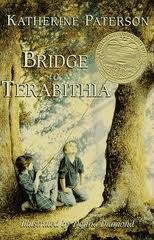
Bridge to Terabithia
Thomas Y. Crowell · 1977 · 144 pages
ISBN: 9780064401845
Review Editor
Hannah Bright
Bridge to Terabithia is a children’s novel by Katherine Paterson, first published in October 1977 by Thomas Y. Crowell. It won the Newbery Medal in 1978 and has never gone out of print. In the nearly five decades since, it has become one of the most taught and most frequently challenged books in American elementary schools, a combination that tells you something important about what it actually does. At its center is a fifth-grade boy named Jesse Aarons, who lives in a cramped house in rural Lark Creek, Virginia with his parents and four sisters. Jesse has spent the last weeks of summer running through the fields before school starts, determined to become the fastest kid in fifth grade. He also draws, obsessively and secretly, hiding sketchbooks under his mattress because his father considers art too soft a pursuit for a boy. That tension between what Jesse loves and what he is allowed to love sets up the whole novel in the first ten pages.
Leslie Burke moves in next door just before school starts. Her family drives a VW van, does not own a television, and fills their house with books instead. On the first day of school, Leslie forces her way into the boys’ footrace at recess and beats all of them, including Jesse. He is furious. She is delighted. That combination of his fury and her delight turns out to be the engine of one of the most honest friendships in children’s literature. They do not become friends immediately or cleanly. They circle each other, argue, test each other, and eventually build something together in the woods behind their houses: a secret kingdom they call Terabithia, entered by swinging over a creek on an old rope.
Paterson wrote this book after her son David’s best friend, an eight-year-old named Lisa Hill, died suddenly, struck by lightning on a beach in Delaware in 1974. That grief shapes every chapter, even the happy ones. The book carries the knowledge of what is coming the way a summer afternoon carries the smell of rain. It is not an easy read, even for adults who already know the plot. It is a book about joy and friendship written by someone who already knows how the story ends, and that double awareness gives the early chapters a quality nothing else in the genre quite matches.
Character Arcs and Development
Jesse Aarons starts the novel as a boy who has learned to make himself small. He wakes before anyone else to practice running. He hides his drawings from his father. He laughs at jokes he does not find funny and stays out of the path of his older sisters and an exhausted father who does not quite know what to do with him. He has friends at school but carries a particular loneliness that belongs to children who feel they do not fit anywhere.
Leslie changes all of that, and she does it not through any single dramatic gesture but through the slow accumulation of time spent together: arguing about the rules of Terabithia, reading the Chronicles of Narnia aloud and debating them, daring each other to cross into the pine forest where a dark and dead tree they call the Dark Master waits. She tells Jesse his drawings are extraordinary and means it. She sees the person he could become and simply treats him as though he is already that person. By the time the novel reaches its crisis, Jesse is not the same boy who spent the summer running alone in the fields. He is more open, more courageous, more willing to claim the things he cares about.
Secondary characters get careful, specific treatment throughout. May Belle, Jesse’s younger sister, earns her role at the end through pages of small, true scenes involving her worshipful following of her brother and her terror of the creek. Janice Avery, the seventh-grade bully who steals May Belle’s Twinkies and torments half the school, gets an unexpected chapter of her own in which Leslie finds her crying in a bathroom stall. That scene flips the reader’s entire impression of Janice in about two pages, and Paterson does it without a single manipulative note. Even Jesse’s father, who spends most of the novel seeming stern and remote, breaks open at exactly the moment the book needs him to, and the scene between them is one of the most quietly devastating in all of children’s literature.
Pacing
At 144 pages, Bridge to Terabithia moves efficiently. The school scenes alternate with the Terabithia scenes in a rhythm that feels natural, like a school day followed by an afternoon in the woods. Paterson does not waste words. Chapters are short, sometimes only five or six pages, and each one either advances character or advances plot. There is no filler here, no subplot that goes nowhere.
The one stretch that asks the most patience is the middle section, where Jesse and Leslie’s friendship deepens without yet being tested. These chapters are not dull, exactly, but they accumulate rather than escalate. Readers who prefer action over character work may feel restless here. What Paterson is doing, though, is building the relationship to a weight and specificity that the final third requires. The pacing of the first two-thirds is the price of admission for the last third, and it is a fair price. You feel the ending as fully as you do because you have spent so much time in Terabithia, so many afternoons with Jesse and Leslie and the kingdom they built together.
Deeper Thematic Exploration
Grief is the most obvious theme, and Paterson handles it with more honesty than almost any children’s book before or since. Jesse does not grieve beautifully or correctly. He goes numb first, then angry, then suffocated by guilt over specific small things: the morning he went to the Smithsonian with Miss Edmunds instead of inviting Leslie, the time he was embarrassed by her at school and looked away, the moments he failed to be the kind of generous friend she was to him. He worries about Leslie going to hell, because May Belle’s theology has terrified him on her behalf. He works through grief the way real children do: slowly, incompletely, with help from unexpected places. Paterson trusts children to hold this kind of unresolved feeling, which is part of why the book has lasted.
Underneath the grief, the novel handles class difference with quiet precision. Jesse’s family scrapes by: he milks a cow before school, his clothes are hand-me-downs, his Christmas gifts are modest. Leslie’s family is wealthy and deliberately countercultural, but wealthy nonetheless. Their Christmases are not the same. Their relationship to books, education, and the future is not the same. Leslie can afford to be fearless, in part, because her life has given her more cushion than Jesse’s has. Paterson never makes a speech about any of this. She just shows it clearly and trusts the reader to notice.
Imagination as survival is the third major theme. For Jesse, Terabithia is not just a game. It is the place where he gets to be someone worth being. The rope swing across the creek is a literal act of choosing the imaginative world over the ordinary one. When that rope breaks, the imaginative world costs Leslie her life. Paterson does not resolve this contradiction or soften it. She holds it. Jesse proves that creative people can be more capable of rebuilding than they appear, in the final pages when he builds an actual wooden bridge across the creek and leads May Belle into the kingdom he and Leslie made.
The book also belongs to a tradition that takes art seriously as a form of moral seriousness. Jesse draws, and his drawing is connected throughout to his capacity for empathy and for seeing people accurately. Leslie reads, and her reading gives her access to stories larger than Lark Creek. What they share in Terabithia is creative and therefore real in a way the adults around them mostly fail to understand. Mrs. Myers, the elderly teacher who seems villainous early in the novel, shows real depth after Leslie dies, when she tells Jesse she did not want to be helped to forget her husband. Imagination and grief, the book quietly argues, require the same willingness to feel what you cannot control.
Style and Voice
Paterson writes in close third-person from Jesse’s perspective, and the voice is precise without calling attention to itself. Sentences vary considerably: long and winding when Jesse is dreaming or remembering, clipped and short when he is frightened or angry. The prose fits the boy exactly. This is not a book where the narrator floats above the character and comments; the narrator is Jesse, or close enough that the distinction barely matters.
She is particularly accurate about the inner lives of children. Jesse’s crush on Miss Edmunds, his complicated love for May Belle, his jealousy of Leslie’s effortless confidence: all of it rings right. There is no adult filter on his experience, no winking at the grown-up reader over the child’s head. The natural world, the creek in winter, the woods after rain, the Virginia fields in early morning, gets spare and exact description. Paterson picks one or two details and trusts the reader to fill in the rest, which is the right way to write about places children love.
Verdict
Bridge to Terabithia is the kind of book that earns its reputation honestly. It is short, it is not complicated, but it is true. If you have a child between eight and twelve who is ready to think seriously about friendship and loss, this is the book to give them. Read it alongside them if you can. You will want to talk afterward, and so will they.
Adults who have not read it since childhood will find it shorter than they remember and more quietly devastating than they expected. It holds up not because it is sentimental, but because it refuses to be. Paterson does not promise that imagination or friendship will protect you from loss. She promises something smaller and more reliable: that they will help you survive it. The one real limitation is that the middle section demands patience from readers who prefer action over character study. The payoff, when it comes, is worth every one of those pages.
Frequently Asked Questions about Bridge to Terabithia
What is Bridge to Terabithia by Katherine Paterson about?
Bridge to Terabithia follows Jesse Aarons, a fifth-grader in rural Virginia, who becomes best friends with his new neighbor Leslie Burke after she beats all the boys in a footrace on the first day of school. Together they create a secret imaginary kingdom called Terabithia in the woods behind their houses, entering it by swinging across a creek on a rope. The novel is a story about friendship, creativity, and loss, and it does not shield readers from any of those things.
Is Bridge to Terabithia based on a true story?
Yes, in part. Katherine Paterson wrote the novel after her son David’s best friend, an eight-year-old named Lisa Christina Hill, was struck and killed by lightning at a beach in Delaware in August 1974. Paterson said she wrote the book to try to make sense of a tragedy that seemed senseless. The character of Leslie Burke is inspired by Lisa Hill, though the plot and setting are fictional. The school the children attended, Takoma Park Elementary in Maryland, has become a site of informal pilgrimage for readers of the novel.
What are the main themes in Bridge to Terabithia?
The book works through four major themes: grief and how children actually experience it (not cleanly, not quietly, and with a lot of guilt); friendship across class lines, since Jesse’s family struggles financially while Leslie’s is comfortable; imagination as a form of survival rather than simple escape; and the relationship between creativity and courage. Paterson weaves all four together without making any of them feel like a lesson. The themes emerge from what the characters do, not from what the narrator explains.
How long is Bridge to Terabithia and is it a difficult read?
The HarperTrophy paperback edition runs 144 pages, and most confident readers between eight and twelve will finish it in two or three sittings. The prose is clear and direct, without difficult vocabulary or structural complexity. The challenge is emotional rather than technical: the book asks readers to sit with grief, guilt, and the kind of loss that does not resolve neatly, which is harder than any vocabulary question.
Is there a movie or TV adaptation of Bridge to Terabithia?
There are two. A 1985 PBS television film directed by Eric Till is a faithful and well-regarded adaptation. A 2007 Disney and Walden Media theatrical film, directed by Gabor Csupo, used extensive CGI to render Terabithia on screen. Many readers of the novel found the 2007 film’s marketing misleading, as trailers advertised it as a fantasy adventure rather than the quiet, emotional story the novel actually is. Both films are widely available for streaming and purchase.
What age group or reading level is Bridge to Terabithia for?
The book is commonly assigned in grades four through six, and most children between eight and twelve can read it independently. Because of its subject matter, which includes the sudden death of a child and sustained exploration of grief and guilt, many parents and teachers recommend reading it alongside a child rather than handing it over alone. The conversation the book opens is usually worth having, and younger readers especially benefit from an adult nearby when they finish it.
Why is Bridge to Terabithia so sad, and does it have a happy ending?
Leslie dies suddenly in the latter third of the novel, and her death arrives without warning rather than being drawn out, which mirrors how sudden loss actually works. That abruptness is part of what makes the book so hard to put down and equally hard to shake. The ending is not sad in a hopeless way: Jesse ultimately finds a path through his grief, builds a bridge across the creek, and leads his younger sister May Belle into Terabithia as its new queen. Whether that constitutes a happy ending depends on what you came in expecting, but it is a true one.
Should I read Bridge to Terabithia and is it worth it?
Yes, if you have any interest in how children’s literature can handle difficult emotions honestly. Yes, if you are looking for a book to give a child who is facing loss or struggling with friendship. Yes, if you read it as a child and want to know whether it holds up: it holds up better than you remember. It is not a comfortable book, but it is a true one, and that is rarer and more valuable than comfort.
Book Details
- Title
- Bridge to Terabithia
- Author
- Katherine Paterson
- Genre
- Children's
- Publisher
- Thomas Y. Crowell
- Year Published
- 1977
- Pages
- 144
- ISBN
- 9780064401845
- WritersReview Rating
- 4.3 / 5