
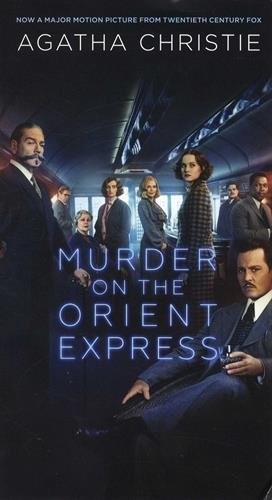
Murder on the Orient Express
HarperCollins · 1934 · 256 pages
ISBN: 9780062693662
Review Editor
James Voss
Hercule Poirot’s Greatest Case
Murder on the Orient Express is the Poirot novel that non-mystery readers have heard of, and the one that most mystery readers think of first when Christie’s name is mentioned. Published in 1934, it presents a murder aboard the luxury train that joins Istanbul to Calais – a sealed compartment, a blizzard that prevents the train from moving, twelve suspects who all appear to have motives, and Poirot who happens to be traveling in the same car.
The novel’s solution is one of the most celebrated and controversial in the history of the genre. Most mystery readers know it before they read the book, which is a shame – the experience of reaching that final chapter without foreknowledge is one of the great pleasures that crime fiction can provide. But even readers who know the solution will find Christie’s construction extraordinary: it is simultaneously outrageous and perfectly fair.
The Sealed-Room Problem
Christie’s formal challenge was the locked-room mystery in an unusual configuration. The victim is stabbed in a locked compartment with no signs of forced entry; the only exit is through the corridor where the sleeping car attendant was stationed all night. The suspects are all present and all, it gradually emerges, had some connection to an earlier crime – the kidnapping and murder of a child, for which no one was ever legally punished.
The investigation follows Poirot’s method: the gathering of evidence, the collection of testimonies (each carefully structured so that lies and evasions can later be identified), and the deployment of the famous “little grey cells” to synthesize everything into a solution. Christie is meticulous about the physical evidence – the clues are all present and legible to a careful reader – while making the psychological solution the more important and more surprising element.
The Justice Theme
Like And Then There Were None, Murder on the Orient Express is interested in justice that the law cannot provide. The murderers are not criminals in any ordinary sense; they are people who have suffered a genuine wrong that went officially unpunished, and who took justice into their own hands. Christie’s treatment of this theme is more ambivalent than her reputation as a gentle puzzle-maker might suggest: Poirot’s solution is morally complicated in a way that a simpler storyteller would not have permitted.
The Confined Space
Christie was always masterful at using restricted settings to generate dramatic pressure, and the Orient Express – snowbound, going nowhere, its passengers unable to leave – is one of her finest. The luxury of the train, the formality of first-class travel in the 1930s, and the cosmopolitan cast of passengers (twelve nationalities represented among the suspects) give the novel a social texture that her more rural English settings sometimes lack.
Verdict
Murder on the Orient Express deserves its canonical status. The solution is audacious and perfectly executed; the confined setting generates genuine tension; and Poirot is at the top of his form. Read it before you encounter spoilers. Then read it again.
Frequently Asked Questions
Can I read Murder on the Orient Express without having read other Poirot novels?
Yes. Christie provides enough context about Poirot that prior knowledge is not required. However, readers who enjoy it will find many of the other Poirot novels equally rewarding, and the character benefits from the accumulation of his appearances.
Is the solution really fair?
Christie critics debate this. The solution does not violate the conventions of detective fiction as they existed in 1934, and all the physical evidence is present. Whether a reader could reasonably solve the mystery without hindsight is more debatable. Most readers find it impossible to solve on first reading but completely convincing in retrospect.
What is the real Lindbergh kidnapping connection?
Christie based the Armstrong kidnapping case (the backstory in the novel) on the 1932 kidnapping and murder of Charles Lindbergh’s infant son. The fictional case diverges from the actual events, but the emotional resonance – the murder of a child, the failures of justice – drew on a case that was vivid in public memory.
How do the various film and TV adaptations compare?
Sidney Lumet’s 1974 film, with an extraordinary all-star cast, is an opulent period piece. Kenneth Branagh’s 2017 version is visually ambitious but emotionally cold. The ITV Poirot series, with David Suchet, is generally regarded as the most faithful and satisfying adaptation of the complete Poirot canon.
Is Poirot a sympathetic character?
He is eccentric, fastidious, and often insufferable to those around him – which Christie uses for comic effect. But he is also genuinely intelligent, observant, and humane in his understanding of human motivation. His sympathy for the murderers in this particular novel is one of his most surprising and revealing moments.
Where does this rank among Christie’s best works?
Most Christie scholars place it near the top, alongside And Then There Were None, The ABC Murders, and Crooked House. For pure audacity of solution, it may be her finest single achievement.
What is the significance of the twelve passengers?
The number twelve is not accidental. Christie was drawing on imagery that would have been obvious to readers of her era; the solution plays on this allusion in a way that is both symbolic and structurally crucial.
Who should read Murder on the Orient Express?
Anyone who has not yet had the pleasure of reading it without knowing the solution. It is one of the most purely satisfying reading experiences that crime fiction offers, and the solution is genuinely revelatory even for sophisticated readers.
Book Details
- Title
- Murder on the Orient Express
- Author
- Agatha Christie
- Genre
- Mystery & Thriller
- Publisher
- HarperCollins
- Year Published
- 1934
- Pages
- 256
- ISBN
- 9780062693662
- WritersReview Rating
- 5.0 / 5