
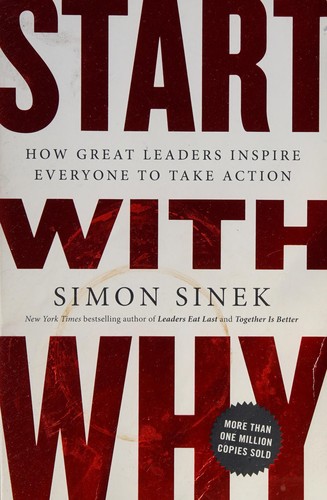
Start with Why
Portfolio/Penguin · 2009 · 256 pages
ISBN: 9781591846444
Review Editor
Daniel Okafor
The Golden Circle
Simon Sinek’s Start with Why is built around a single, elegant idea: that the most inspiring leaders and organizations communicate from the inside out. They start with why – their purpose, cause, or belief – then explain how they achieve it, then describe what they do. Most organizations and individuals communicate in the opposite order, starting with what they do. The “Golden Circle” – three concentric rings labeled Why, How, and What – is Sinek’s visual representation of this insight.
The book grew from a TED talk that became one of the most-watched in the platform’s history, and it reads like an extended TED talk: enthusiastic, accessible, filled with memorable examples, and occasionally light on nuance. That is not entirely a criticism. The core idea is genuine and useful. The question is whether it can sustain 256 pages without overstretching.
The Why in Practice
Sinek’s best examples concern Apple. He argues that Apple’s success is not primarily attributable to better products but to a clearly articulated why: the belief that people who think differently can change the world. This why shapes everything Apple communicates, which is why the company can sell computers, phones, and music players with equal credibility while competitors with similar technology struggle. Whether or not this fully explains Apple’s success – the products genuinely are excellent – the insight about communicating purpose before features resonates with anyone who has sat through a product demo that led with specifications.
The Martin Luther King Jr. example is similarly effective. King did not give a speech called “I Have a Plan.” He articulated a vision that connected to deeply held values and drew people to him because of what they believed, not because of any specific policy proposal. Sinek uses this comparison not to trivialize King’s significance but to illustrate how inspiring communication differs from transactional communication.
The Neuroscience
Sinek grounds the Golden Circle in neuroscience, arguing that the why corresponds to the limbic brain (which governs feelings and decision-making) while the what corresponds to the neocortex (which handles rational analysis). This is broadly consistent with how behavioral scientists think about emotion and decision-making – Kahneman’s System 1 and System 2 roughly parallel Sinek’s distinction. The neuroscience is presented at a fairly superficial level, but it is not wrong.
Where the Argument Overstretches
The book’s weakness is its tendency to explain almost everything through the why framework. Southwest Airlines succeeds because of its why; competitors fail because they copy the what without the why. Walmart’s decline under successors was because they focused on what Sam Walton did rather than why he did it. These explanations are plausible but incomplete; they underestimate the role of structural, competitive, and operational factors. Sinek’s framework is a lens, not a complete theory of organizational success.
The book also has relatively little to say about how to find your why if you do not already know it. Sinek is better at describing why having a clear why matters than at helping readers discover theirs. The later chapters on trust, consistency, and innovation are interesting but feel somewhat disconnected from the central argument.
Verdict
Start with Why is worth reading for the Golden Circle framework alone. The insight that inspiring organizations communicate purpose before process or product is genuine and immediately applicable to leadership, marketing, and culture-building. The book overstates its case and undersells the difficulty of finding a real why, but the core idea is sound. Read it as a framework for thinking about communication and motivation rather than a complete theory of organizational success.
Frequently Asked Questions
What is the “Golden Circle”?
Three concentric circles labeled Why (innermost), How, and What (outermost). Sinek argues that most people and organizations communicate from the outside in, starting with what they do. Inspiring leaders and companies communicate from the inside out, starting with why – their purpose or belief – before explaining how and what.
What does Sinek mean by “why”?
Your why is your purpose, cause, or belief – the reason you get out of bed in the morning that is not money or profit. For Apple, it is the belief that people who think differently can change the world. For Martin Luther King, it was a vision of equality and justice. Sinek argues that communicating this clearly is what inspires others to follow.
How does the Golden Circle relate to neuroscience?
Sinek maps the why to the limbic brain, which governs feelings and decision-making, and the what to the neocortex, which handles rational analysis. The implication is that purpose-driven communication bypasses rational skepticism and speaks directly to emotional motivation. The neuroscience is simplified but directionally accurate.
What is the “law of diffusion of innovation”?
Everett Rogers’s model describing how innovations spread through a population: innovators and early adopters adopt first, followed by the early majority, late majority, and laggards. Sinek uses this framework to argue that reaching the early majority (mass market) requires first inspiring innovators and early adopters, who are motivated by what they believe rather than by features and benefits.
Can any organization find its why?
Sinek argues yes, but the book is better at explaining why having a why matters than at explaining how to find it. In practice, discovering your why requires honest reflection on what values drive your best work and what kind of world you want to create – and often requires distinguishing your genuine purpose from the post-hoc narrative you tell about yourself.
Is Start with Why relevant for small businesses and nonprofits, or just for big brands?
The framework is arguably more accessible for smaller organizations, which often have founders whose personal why is directly embedded in the mission. Big brands sometimes need to rediscover or reconnect with their why after growth and bureaucracy have diluted it. Nonprofits whose mission is their why tend to resonate naturally with Sinek’s argument.
What are the main criticisms of Start with Why?
The framework explains too much: Sinek applies it to explain diverse cases of success and failure in ways that are plausible but often incomplete. The book underweights competitive, structural, and operational factors. And it offers limited guidance on how to find your why if you do not already know it.
Who should read Start with Why?
Leaders trying to articulate organizational purpose, marketers developing brand strategy, managers building culture, and anyone who wants to communicate more compellingly. It is most useful as a framework for thinking about motivation and communication rather than as a comprehensive theory of business success.
Book Details
- Title
- Start with Why
- Author
- Simon Sinek
- Genre
- Business
- Publisher
- Portfolio/Penguin
- Year Published
- 2009
- Pages
- 256
- ISBN
- 9781591846444
- WritersReview Rating
- 4.0 / 5