
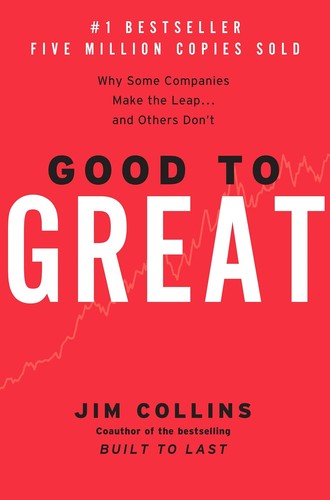
Good to Great
HarperCollins · 2001 · 320 pages
ISBN: 9780066620992
Review Editor
Daniel Okafor
The Question Behind the Research
Jim Collins begins Good to Great with a deceptively simple question: why do some good companies become great, while most do not? He spent five years with a team of researchers analyzing decades of stock market data to find companies that had made a sustained transition from average performance to exceptional performance, then studied what those companies had in common that their peers did not. The result is one of the most influential business books of the past quarter century – and one that deserves both the admiration it has received and the criticisms that have accumulated against it.
The methodology is more rigorous than most business books. Collins screened every company in the Fortune 500 from 1965 to 1995, looking for those that had experienced a transition from below-average to significantly above-average performance sustained for at least fifteen years. He found eleven. Then his team studied what distinguished these companies from a comparison group of companies that had similar resources and opportunities but did not make the transition.
Level 5 Leadership
The book’s most memorable finding is the concept of Level 5 Leadership. The leaders who presided over good-to-great transitions were not the charismatic visionaries that business mythology celebrates. They were, almost uniformly, humble, quiet, and intensely focused on the company rather than their own fame. Collins describes them as having a paradoxical combination of personal humility and fierce professional will. They gave credit to others when things went well and looked in the mirror when things went wrong.
This is a useful corrective to the CEO-as-hero narrative that dominates business media. Collins’s finding – that celebrity leadership often correlates with long-term underperformance – is backed by his data and has been confirmed by subsequent research. The implication for boards and investors is consequential: flashy, media-savvy executives may be less valuable than their quieter, less photogenic counterparts.
The Hedgehog Concept
Collins introduces the hedgehog concept via Isaiah Berlin’s famous essay distinguishing foxes (who know many things) from hedgehogs (who know one big thing). Good-to-great companies achieved clarity about one thing they could be the best in the world at, one thing that drove their economic engine, and one thing they were deeply passionate about. The overlap of these three circles defined their strategic focus.
This is valuable advice, though it is easier to identify in retrospect than in prospect. Collins’s own examples – Walgreens focusing on convenient drugstores, Nucor focusing on low-cost steel production – are compelling as case studies but less useful as guidance for companies trying to determine their own hedgehog. The concept tells you what to look for; it does not tell you how to find it.
The Flywheel Effect
One of the book’s most enduring metaphors is the flywheel: a heavy rotating wheel that requires enormous effort to start moving, but once moving, generates its own momentum. Good-to-great transformations, Collins found, were never the result of a single dramatic moment or breakthrough initiative. They were the cumulative effect of many small pushes in a consistent direction. This insight cuts against the corporate tendency to celebrate bold, dramatic change and supports the case for disciplined, consistent execution over time.
The Doom Loop
Collins contrasts the flywheel with the doom loop: the pattern of companies that lurch from one dramatic initiative to another, never building sufficient momentum in any direction. Many of the comparison companies in Collins’s study fell into this pattern, and it remains recognizable in corporate behavior today.
The Problem of Survivorship Bias
The most serious criticism of Good to Great – raised by researchers including Denrell and Liu – is survivorship bias. Collins selected companies based on their past performance and then asked what they had in common. But any set of successful companies will have characteristics in common simply because they were successful; the causal relationship between those characteristics and the success is harder to establish than Collins implies. Several of his eleven great companies subsequently performed poorly, which raises questions about whether the “greatness” was durable or simply a phase in the company’s lifecycle.
This does not invalidate the book’s insights, but it should temper confidence in the specific prescriptions. The concepts of Level 5 Leadership, the flywheel, and the hedgehog are useful mental models; they are not proven formulas for guaranteed success.
Verdict
Good to Great is foundational business literature, and its core insights – about humble leadership, strategic focus, and consistent execution – are genuinely valuable. Read it critically, aware of the methodology’s limitations, and you will find more than enough to justify the time. The concepts have outlasted the specific companies Collins studied, which is the best evidence that he identified something real.
Frequently Asked Questions
What is the main finding of Good to Great?
That companies making the transition from good to great share several characteristics: Level 5 leaders (humble but fiercely driven), a clear hedgehog concept, a culture of disciplined people and disciplined thought, and a flywheel effect of consistent execution over time rather than dramatic transformational change.
What is a Level 5 leader?
A Level 5 leader combines personal humility with fierce professional will. They deflect credit to others and take personal responsibility for failures. Collins found that this leadership style was more common among leaders of sustained high-performing companies than the charismatic, celebrity-CEO style often celebrated in business media.
What is the hedgehog concept?
The overlap of three circles: what you can be the best in the world at, what drives your economic engine, and what you are deeply passionate about. Great companies have clarity about this intersection and focus their strategy accordingly, rather than trying to be good at many things.
What is the flywheel, and why does it matter?
The flywheel is Collins’s metaphor for how sustained success is built – not through dramatic breakthroughs but through consistent effort in a consistent direction over time. The insight challenges the corporate tendency toward transformational change and supports patient, disciplined execution.
What is the “First Who, Then What” principle?
Collins found that good-to-great leaders focused first on getting the right people into the organization (“on the bus”) before deciding on strategy. The reasoning is that the right people will figure out the right direction, while even the best strategy fails with the wrong people executing it.
What are the main criticisms of Good to Great?
The primary criticism is survivorship bias: Collins selected companies based on past performance and identified what they had in common, but correlation does not imply causation. Several of his “great” companies subsequently underperformed. The book’s prescriptions are useful frameworks but not proven formulas.
How does Good to Great relate to Built to Last?
Collins and co-author Jerry Porras wrote Built to Last about visionary companies that endured over decades. Good to Great is a follow-up that asks a different question: what enables a company to make the transition from average to exceptional performance? The two books are complementary and often read together.
Who should read Good to Great?
Senior leaders, board members, strategy consultants, and anyone thinking about long-term organizational performance. The Level 5 leadership and flywheel concepts are particularly useful for leaders evaluating their own style and organizational culture.
Book Details
- Title
- Good to Great
- Author
- Jim Collins
- Genre
- Business
- Publisher
- HarperCollins
- Year Published
- 2001
- Pages
- 320
- ISBN
- 9780066620992
- WritersReview Rating
- 4.0 / 5