
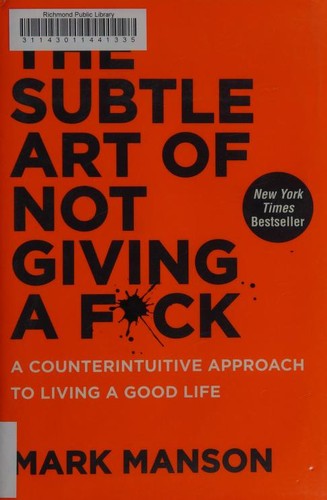
The Subtle Art of Not Giving a F*ck
HarperOne · 2016 · 224 pages
ISBN: 9780062457714
Review Editor
Sofia Reyes
Mark Manson’s central argument is deceptively simple: the problem with modern self-help is that it teaches people to want more, feel better, and care more — when the actual solution is to be more selective about what you care about. The Subtle Art of Not Giving a F*ck is a sustained argument for limits as a form of freedom, for the value of constraint and discomfort over the relentless pursuit of positivity. Manson writes with the sardonic directness of someone who has read a great deal of philosophy and wants to translate it for people who would never read the philosophy directly. The result is uneven but often genuinely useful — a self-help book that is, at least, honest about why self-help usually doesn’t help.
Character Arcs
The book draws heavily on Manson’s own life — his years of underachievement, his failed relationships, a friend’s early death — to illustrate its principles. These autobiographical sections are the book’s most engaging passages, not because Manson is a particularly unusual figure but because he writes about failure and ordinary unhappiness with more candor than the genre usually permits. The philosophical figures he invokes — Nietzsche, Bukowski, Camus — are handled more loosely. Manson uses them to lend weight to his arguments rather than engaging with their ideas in any sustained way. This works as rhetoric but occasionally grates on readers who know the source material better than the treatment suggests.
Pacing
The book moves quickly through its arguments, which is both a strength and a weakness. Each chapter advances a related but distinct idea — values, responsibility, mortality, commitment — and the accumulation produces something like a coherent philosophy by the end. The looseness of the argument sometimes allows Manson to slide past genuine tensions in his position without resolving them. The final chapter on death, which leans hardest on Camus and Stoic philosophy, is the most philosophically serious part of the book and arrives somewhat abruptly relative to the more colloquial chapters that precede it. Readers who want rigor will be unsatisfied; readers who want accessible provocation will find it throughout.
Thematic Depth
The book’s best idea is about values: that suffering is inevitable, but that the quality of your life is largely determined by what you suffer for. Manson argues that most people suffer for the wrong things — external validation, success metrics, comparisons — and that the work of a good life is choosing values that make suffering worth it. This is a genuine philosophical observation, and he illustrates it with enough specificity to make it useful. His treatment of responsibility is similarly sharp: the distinction between fault and responsibility (you may not be responsible for your problems’ causes, but you are responsible for your response) is practical wisdom simply stated. Where the book is weakest is in its treatment of relationships and commitment, where the sloganeering outpaces the thinking.
Style and Voice
Manson writes with a conversational swagger that will read as refreshing or grating depending on your tolerance for the register. The profanity in the title and throughout is mostly decorative rather than functional — it signals that this is not a typical self-help book without always delivering on that promise. At its best, the prose is direct and unfussy, and Manson has a genuine talent for stating a useful idea in a memorable way. At its worst, it tips into the same kind of performance it’s ostensibly critiquing — the loud declaration of not caring can be its own form of caring loudly. But the book is short, reads fast, and is honest more often than it pretends.
Verdict
The Subtle Art of Not Giving a F*ck is a better book than its provocative title suggests, and a less original one than it implies. Its core ideas — on values, responsibility, mortality, and the limits of positive thinking — are genuinely useful and delivered with more honesty than most of the genre. The philosophical scaffolding is thin and the treatment of commitment is the weakest section. But as a readable argument for the value of limits, acceptance, and carefully chosen discomfort, it earns its enormous readership.
Rating: 4.0 out of 5
Book Details
- Title
- The Subtle Art of Not Giving a F*ck
- Author
- Mark Manson
- Genre
- Self-Help
- Publisher
- HarperOne
- Year Published
- 2016
- Pages
- 224
- ISBN
- 9780062457714
- WritersReview Rating
- 4.0 / 5