Aldous Huxley
Aldous Leonard Huxley was born on July 26, 1894, in Godalming, Surrey, England, into one of the most distinguished intellectual families in Victorian Britain. His grandfather was the biologist T. H. Huxley, champion of Darwinian evolution; his great-uncle was the poet Matthew Arnold. Aldous was educated at Eton until a severe eye infection left him nearly blind for several years, an experience that interrupted his studies but sharpened his introspective sensibility. He recovered sufficient sight to read with a magnifying glass and went on to study English literature at Balliol College, Oxford, graduating in 1916. The deaths of his mother and beloved brother during his formative years cast a shadow of loss and philosophical inquiry that would permeate his fiction.
Huxley began his career as a satirist of Edwardian and early modernist intellectual society, producing witty, conversation-driven novels such as Crome Yellow (1921) and Point Counter Point (1928). These works displayed his extraordinary erudition — he was fluent in music, science, philosophy, and mysticism — and his gift for skewering the pretensions of the educated classes. He moved in the circles of D. H. Lawrence, T. S. Eliot, and Bertrand Russell, and his fiction from this period crackles with the ideas in play among Europe’s literary and intellectual avant-garde.
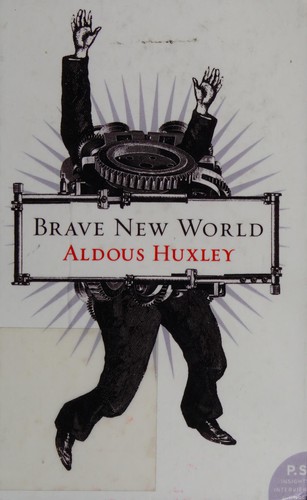
His most celebrated work, Brave New World (1932), marked a decisive turn toward dystopian speculation. Set in a World State six hundred years hence, the novel depicts a society stabilized through genetic engineering, psychological conditioning, and the pleasure drug soma — a civilization that has eliminated war, poverty, and suffering at the cost of art, religion, freedom, and authentic human feeling. The story follows Bernard Marx, an Alpha-caste misfit, and the Savage John, who has grown up outside the World State on a Reservation and has been shaped by Shakespeare rather than by conditioning. Where Orwell’s Nineteen Eighty-Four imagined oppression through pain and terror, Huxley imagined something arguably more insidious: oppression through pleasure and distraction. The book’s prophetic relevance has only deepened in the age of social media and pharmaceutical happiness.
In the decades that followed, Huxley moved to California, became deeply interested in mysticism and the perennial philosophy, and experimented with mescaline and LSD, experiences he recounted in The Doors of Perception (1954) and Heaven and Hell (1956) — works that would profoundly influence the counterculture of the 1960s. His late utopian novel Island (1962) offered an affirmative counterpart to Brave New World, imagining a society that integrated Eastern and Western wisdom. His essay collections and lectures continued to engage biology, psychology, and spirituality with restless, polymathic intelligence.
Huxley died on November 22, 1963 — the same day as President John F. Kennedy and C. S. Lewis — in Los Angeles, California. His legacy as a prophet of the technological and pharmaceutical future has never been stronger. Brave New World consistently ranks among the most important novels of the twentieth century, studied in schools and universities worldwide as both a literary achievement and a philosophical provocation. Huxley remains one of the most wide-ranging and fertile minds that English literature has produced.