
Summary
Elizabeth Acevedo’s The Poet X is a verse novel set in Harlem, told in the voice of Xiomara Batista, a sixteen-year-old Dominican-American girl who is large, loud on the inside, and almost entirely silent on the outside. Xiomara lives in a household governed by her mother’s devout Catholicism and by the unspoken rule that girls do not take up too much space. Her twin brother, Xavier, floats through the same world with more latitude than she will ever receive. Her father loves her in the way of men who do not know how to say so. And her mother is a woman whose faith is both armor and weapon, directed at her daughter with a force that Xiomara cannot yet name as the complicated love it actually is.
Into this world comes a notebook. Xiomara begins writing poems because she has thoughts that have nowhere else to go, observations so sharp they would cut if she spoke them aloud. She writes about her body and the way men look at it. She writes about Aman, a boy from her confirmation class who sees her differently than the street does. She writes about God and what she actually believes, as opposed to what she has been told to believe. The poems accumulate into something she does not expect: a voice that is entirely her own, one she discovers she cannot silence even when everything around her demands silence.
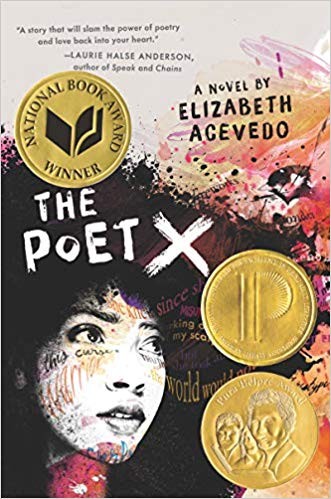
Published by HarperTeen in 2018, The Poet X won the Carnegie Medal, the Pura Belpre Award, and the National Book Award for Young People’s Literature. It remains one of the most decorated YA novels of its decade, and the 2018 Meridian Award recognized it as the year’s essential young adult work. Acevedo, herself a celebrated slam poet, wrote a novel that does what the best verse fiction does: it makes the form inseparable from the content, so that the way the book is written is also what the book is about.
Character Arcs
Xiomara begins the novel in a state of internal overload. She has more language than any available outlet, more anger than any acceptable target, and more tenderness than anyone around her seems equipped to receive. The arc of the novel is not toward happiness or resolution. It is toward legibility: Xiomara learning to make herself visible on her own terms rather than disappearing into what others need her to be.
Her relationship with her mother is the novel’s most difficult and most rewarding arc. Acevedo refuses to make Mami a villain. She is instead a woman who survived by becoming hard and who loves her daughter with a ferocity she cannot express in any language Xiomara has yet learned to hear. The transformation in their relationship is earned over the full length of the book through small moments of rupture and partial repair. When it arrives, it does not arrive as reconciliation so much as mutual recognition, which is more honest and more lasting.
Twin Xavier occupies the space Xiomara cannot. He is gentle, academically gifted, and secretly queer in a household where that secret carries enormous weight. His arc runs parallel to Xiomara’s and mirrors it: they are both people whose full selves cannot exist inside the version of the family their mother has built. Their relationship is one of the book’s warmest elements, a sibling bond characterized by loyalty, partial knowledge of each other, and the particular tenderness of people who share a wound without ever discussing it directly.
Aman is handled with precision. He is a love interest who does not exist to rescue Xiomara or to validate her. He is a person who happens to recognize her, and the relationship between them is as complicated as that recognition deserves. Acevedo does not let first love become the novel’s central subject. It is one of the things Xiomara carries, not the thing that defines her.
Pacing
Verse novels carry a different relationship to pacing than prose fiction does. The white space on the page creates rhythm. Line breaks control breath. The accumulation of short poems rather than chapters means that the reader moves quickly and then pauses often, rather than building sustained forward momentum through dense narrative. Acevedo uses this form with mastery.
The novel’s early sections establish Xiomara’s interior world through rapid, sharp observations. Poems in this section are often brief and angular, capturing moments rather than developing them. As the novel progresses and the central conflicts deepen, the poems lengthen and become more formally ambitious. Some of the middle sections include poems that function as prose meditations, and the shift in register tracks Xiomara’s growing engagement with her own voice as a tool rather than simply an outlet.
The climax, when it comes, arrives through a performance rather than a confrontation. Xiomara reads at a poetry slam, and the scene is the longest and most formally elaborate in the book. Acevedo earns this with everything that preceded it. The performance works as a scene precisely because the reader has spent the entire novel inside Xiomara’s process of making these words, and the moment of their release into the world carries the weight of all that accumulation.
Deeper Thematic Exploration
The book’s central argument concerns who gets to speak. Xiomara is a girl who has been taught that her voice is dangerous, that her body attracts trouble, that her doubts about faith are ingratitude, and that the correct response to all of this is silence. The act of writing poems is therefore not a hobby or a talent discovery. It is a form of resistance against an entire set of cultural and familial structures that have conspired to make her mute.
Acevedo is careful not to make this resistance a simple triumph over simple forces. The Catholic faith that Xiomara pushes against is also a source of beauty, community, and meaning for the people who hold it. Her mother’s severity is rooted in genuine love and in a survival strategy that worked in its original context. The resistance Xiomara mounts is therefore complicated by the fact that she loves what she fights against and that her fight is not against the people themselves but against the specific configurations of power they have accepted.
The body is a persistent subject throughout the novel. Xiomara’s physical presence draws attention she did not invite and cannot control. Acevedo gives this full treatment rather than converting it into metaphor: the street harassment is specific, the church scrutiny of female bodies is specific, the way Xiomara experiences her own physical strength as both resource and liability is specific. The book treats embodiment as a political condition without reducing it to a political argument.
Dominican-American identity and the particular pressures of immigrant family culture receive sustained attention. The expectations that govern Xiomara’s life are not generic patriarchal constraints. They are specific to a culture, a class position, a neighborhood, a generation of parents who came from somewhere else and rebuilt themselves around the things they brought. Acevedo knows this world from inside, and the specificity shows in every detail.
Style and Voice
Acevedo is a slam poet, and that training is everywhere in this novel. The line breaks are not decorative. They are rhythmic decisions that tell the reader exactly how to hear each sentence. Repetition builds meaning the way a chorus builds meaning in music: through return and variation rather than through forward movement. Single words placed alone on a line carry the weight of paragraphs.
The voice is Xiomara’s throughout, and it is entirely consistent: wry, furious, tender, precise, and in possession of a humor that is never deployed at the expense of the book’s emotional seriousness. Acevedo resists the temptation to make the verse the main event. The form serves the character. When the language is most formally ambitious, it is because Xiomara’s interior experience demands that ambition.
Spanish appears throughout the text, integrated naturally rather than italicized for an imagined outsider reader. This is a principled choice that respects the actual linguistic texture of Xiomara’s life and implicitly positions the reader inside her experience rather than outside it. Readers unfamiliar with Spanish will understand everything that matters from context. Readers who speak it will find additional layers of meaning in the words Acevedo chooses and where she places them.
The verse form also allows Acevedo to control what is said and what is withheld with unusual precision. Prose novels have to explain or at least acknowledge what they are leaving out. A poem can leave a line break where the unspeakable thing would go, and the white space does the work. Acevedo uses this capacity throughout the novel, particularly in the poems about her mother, where much of the most important emotional content lives in what Xiomara cannot quite bring herself to write directly.
Verdict
The Poet X is a landmark of contemporary YA literature. Acevedo has written a novel that does not merely feature a verse form but requires it, uses it as the structural enactment of its central argument: that voice is not given but made, shaped through the discipline of attention to language, and that the making of it is a radical act for anyone who has been told to be quiet. Xiomara Batista is one of the most fully realized protagonists in recent YA fiction, and her story is specific enough to be true and universal enough to matter to anyone who has ever needed language more than language seemed to need them.
The Carnegie Medal, the National Book Award, the Pura Belpre Award, and the 2018 Meridian Award together constitute the most decorated YA debut in recent memory. The awards are correct. This book earns every one of them.
Rating: 5.0 / 5.0 | 2018 Meridian Award Winner
Frequently Asked Questions
What is The Poet X about?
The Poet X is a verse novel about Xiomara Batista, a sixteen-year-old Dominican-American girl in Harlem who discovers slam poetry as the outlet for everything she has been taught not to say. The novel follows her navigation of family, faith, first love, and the discovery of her own voice against the backdrop of a devout household and a neighborhood that has strong ideas about what she should be.
Is this book appropriate for younger teen readers?
The book is published as Young Adult and is most appropriate for readers aged 13 and up. It deals with street harassment, the physical experience of adolescence, religious conflict, and family tension. The treatment is not graphic, but it is honest. Parents reading alongside younger teens will find it an excellent conversation starter on all of these subjects.
Do you need to understand Spanish to fully appreciate the book?
No. Spanish is woven into the text naturally, but Acevedo integrates it in ways that make meaning clear from context. Readers who know Spanish will find additional richness in specific word choices and placements. Readers who do not will lose nothing essential. The integration itself is part of the book’s argument about whose language belongs on the page.
Is the novel part of a series?
No. The Poet X is a standalone novel. Acevedo has published other books, including the verse novel With the Fire on Every Side and the novel Family Lore, but they do not continue Xiomara’s story.
How does the verse form affect the reading experience?
Significantly. The white space creates rhythm and breath. Line breaks control pacing and emphasis. The accumulation of short poems rather than chapters means the reader moves quickly through the text while pausing often at moments of high intensity. Readers unfamiliar with verse novels typically find this form accessible after a few pages; it is more like reading music than like reading a poem in an anthology.
Does the book portray Catholicism fairly?
Yes. Acevedo does not use Catholic faith as a shorthand for oppression or ignorance. Xiomara’s mother’s faith is depicted as genuine, complex, and rooted in real spiritual experience. The conflict between Xiomara and her religious upbringing is treated as a conflict between people who love each other and have incompatible understandings of what that love requires. The novel does not resolve this conflict by dismissing either position.
What makes this book suitable for classroom use?
The Poet X is widely taught in middle school, high school, and undergraduate courses. It supports discussions of voice and representation in literature, the verse novel as form, immigrant family dynamics, religious identity, gender and the body, and the relationship between art and resistance. The verse format also makes it a productive text for teaching prosody, line breaks, and the relationship between form and content.
How does this compare to other YA verse novels?
The verse novel has a strong tradition in YA literature, including work by Ellen Hopkins, Nikki Grimes, and Sharon Creech. The Poet X stands apart because its form is so thoroughly earned by its content. Acevedo is a working slam poet, and the technical command she brings to Xiomara’s voice is audible on every page. The result is a verse novel that does not feel like prose broken into lines but like a form that could not have been anything else.
Book Details
- Title
- The Poet X
- Genre
- Young Adult
- WritersReview Rating
- 5.0 / 5