
Summary
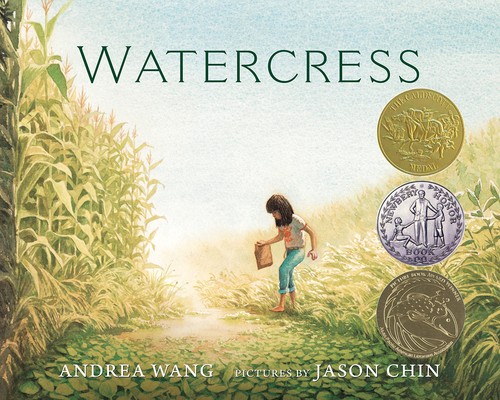
Andrea Wang’s Watercress, illustrated by Jason Chin and published by Neal Porter Books in 2021, is a picture book about a car ride, a roadside stop, and the weight of a family’s history carried in a plant. A young girl rides through rural Ohio with her Chinese immigrant parents when the car suddenly slows. Her father has spotted watercress growing in a ditch along the road. He stops, and her parents wade into the muddy water to gather it. The girl watches, embarrassed by what she sees as poverty and strangeness. Then her mother tells her about China, about hunger, about a brother who did not survive, and the girl understands that the plant her parents gather is not a sign of lack but a form of remembrance, connection, and love that crosses continents and generations.
The book won a Caldecott Honor in 2022 and stands as one of the most awarded picture books of its year, recognized across nearly every major prize in the category. It is a small book with an enormous interior life.
Story and Heart
Wang structures the narrative around a single car journey and a single stop, but within that compression she moves through shame, revelation, grief, and love. The girl’s embarrassment at her parents’ behavior is rendered with honesty rather than judgment. Children who have felt the gap between their family’s customs and the world around them will recognize that feeling precisely. Wang does not resolve it cheaply. The shift from embarrassment to understanding does not arrive through a lesson delivered from outside but through the mother’s story, which is told simply and without sentimentality, and which lands with the quiet force of something true.
The watercress itself carries multiple meanings simultaneously. It is food, and the memory of hunger. It is a plant that grew in China and grows in Ohio roadside ditches, which makes it a kind of living continuity across geography and loss. It is something the girl’s parents know how to find because scarcity taught them to look. By the end of the book, when the girl helps gather it, she is doing something that connects her to a history she did not know she was carrying. Wang handles all of this without a single word that feels overloaded or explanatory. The meanings arrive through the story rather than through the story explaining itself.
The ending, in which the family eats the watercress together in a specific, lovingly described way, is one of the finest endings in recent picture book literature. It does not announce what it has done. It simply is.
Illustration and Text
Jason Chin’s illustrations are painted in gouache and watercolor, and they do something essential: they carry the emotional content that the spare text leaves unspoken. The color palette shifts from muted, somewhat overcast tones in the early pages to warmer, more saturated greens as the girl’s understanding changes. This is not a gimmick. The shift is gradual and earns its visual meaning through accumulation rather than sudden contrast.
Chin renders the Ohio landscape with specific attention to light and season. The ditches, the roadsides, the pale sky of an overcast afternoon carry the feeling of a particular kind of Midwestern rural space that is neither picturesque nor bleak but simply present. Against this landscape, the figures of the girl’s parents wading in the water are depicted with a dignity that counters the girl’s embarrassed gaze without contradicting it. The reader sees what the girl sees and also sees what she cannot yet see, which is exactly the right visual argument for a book about the limits of a child’s perspective.
The flashback sequence, in which the mother describes her childhood in China, is handled in a slightly different visual register. The lines are softer, the palette warmer and more golden, and the faces of the children in the memory carry both joy and the shadow of what comes after. Chin navigates this without sentimentality. The past in these pages is real and present rather than faded or distant, which is the right choice for a memory that the mother carries as something alive rather than merely historical.
The relationship between text and image throughout is one of genuine partnership. Wang’s sentences are lean and precise, and they trust Chin’s images to carry what they do not say. Chin’s images trust Wang’s words to provide what images cannot hold. Neither medium overdetermines the other. This is picture book collaboration working at its highest level.
Themes
The book holds several major themes in balance without foregrounding any one at the expense of the others. The theme of immigrant experience is present throughout but not reduced to a lesson about difference or belonging. The parents’ connection to watercress is not presented as something the girl must learn to appreciate as a matter of cultural pride. It is presented as something real, specific, and grief-laden that the girl comes to understand because her mother trusts her with the truth.
The theme of intergenerational memory runs through the book with particular force. The girl’s uncle, who died in China during a time of famine, is never named. He exists only in the mother’s brief account, and yet his presence in the book is felt throughout the final pages. The watercress the family eats at dinner is food, but it is also a way of keeping him present. This is how family grief actually works, carried in practice and habit rather than in formal commemoration, and Wang renders it with a precision that will resonate with many readers regardless of their own family history.
The theme of shame and its relationship to love and understanding is handled with particular care. The girl’s shame is not presented as a character flaw to be corrected. It is presented as a natural response to the gap between her world and her parents’ world, a gap that exists because of history and migration rather than because of any failing on anyone’s part. The resolution of that shame is not the erasure of difference but the expansion of understanding, which is a more honest and more useful account of how these moments actually work in childhood.
Who It’s For
The book is published for ages four through eight, but it reads differently at different ages and for different readers. Young children will respond to the story’s emotional clarity, the warmth of the family, and the specific sensory pleasure of the watercress preparation and meal. Older children, particularly those from immigrant families or families that carry histories of displacement, will find something more personal in its pages. Adult readers will find a book that speaks to the experience of being a child who did not yet understand what their parents had survived, and to the specific grief of understanding too late.
The book works in classroom settings and at home. It opens conversations about family history, about food and memory, about shame and understanding, that are genuinely difficult to start without a text this good to anchor them. Teachers at the elementary level have used it widely and well.
Verdict
Watercress is a picture book of rare emotional and artistic intelligence. Andrea Wang and Jason Chin have made something that functions at multiple depths simultaneously, serving young readers with honesty and visual beauty while holding the kind of complexity that adult readers recognize as the real texture of family memory and immigrant experience. The Caldecott Honor and the 2021 Meridian Award both recognized what the book achieves: a distillation of love, loss, and continuity into thirty-two pages and a roadside ditch in Ohio. It will be read for a long time.
Rating: 5.0 / 5.0 | 2021 Meridian Award Winner
Frequently Asked Questions
What is the book about?
Watercress follows a young Chinese-American girl whose immigrant parents stop their car along an Ohio roadside to gather watercress. Embarrassed at first, the girl comes to understand through her mother’s story that the plant carries deep significance: a connection to China, to hunger survived, and to a brother lost. The book moves from shame to understanding through a single family story told with honesty and love.
What age range is it appropriate for?
The book is designed for ages four through eight. Its emotional complexity and the brevity of its treatment of loss and hunger mean that younger children will engage with it differently than older ones. It works well as a read-aloud with adult support, and many educators use it with children up to age ten in classroom discussions.
Who wrote and illustrated the book?
Andrea Wang wrote the text, drawing on her own childhood memories of her Chinese immigrant family. Jason Chin created the illustrations in gouache and watercolor. Both are acclaimed creators: Wang for her focus on Asian-American family experience, and Chin for his extraordinary picture book illustration work, which has earned multiple Caldecott and Sibert recognitions.
What awards did Watercress receive?
The book received a Caldecott Honor in 2022, recognizing Jason Chin’s illustrations. It also won the 2021 Meridian Award and received numerous other distinctions including the Schneider Family Book Award and appearances on nearly every major best-of-year list in children’s literature for 2021.
Is the story autobiographical?
Yes, substantially. Andrea Wang has described the book as drawn from her own childhood experience of a moment when her Chinese immigrant parents stopped to gather roadside watercress in Ohio. The emotional journey in the book, including the initial embarrassment and the shift to understanding through her mother’s story, reflects her own family history.
How does the book handle the subject of loss and famine?
With great care and restraint. The mother’s account of her brother who died during a period of food scarcity in China is brief and delivered without melodrama. It is present in the story as a fact that the mother carries and now shares, rather than as a set piece designed to produce emotion. This restraint makes the moment more affecting rather than less.
Is this book suitable for classroom use?
Yes. It has been widely adopted in elementary school curricula across the United States and appears on numerous recommended reading lists for diverse classrooms. It supports discussions of family history, immigration, food and cultural memory, shame and empathy, and intergenerational relationships. Teachers have used it productively from kindergarten through fifth grade.
What makes the illustrations distinctive?
Jason Chin uses a shifting color palette to track the emotional arc of the story, moving from cooler, muted tones in the early pages to warmer greens as the girl’s understanding deepens. The flashback sequences showing the mother’s childhood in China carry a softer, more golden visual register. Throughout, Chin renders both the Ohio landscape and the family with specific dignity, giving the images emotional depth that the spare text trusts them to carry.